Europe’s aluminium roadmap: Circularity, resource security, low-carbon imperative
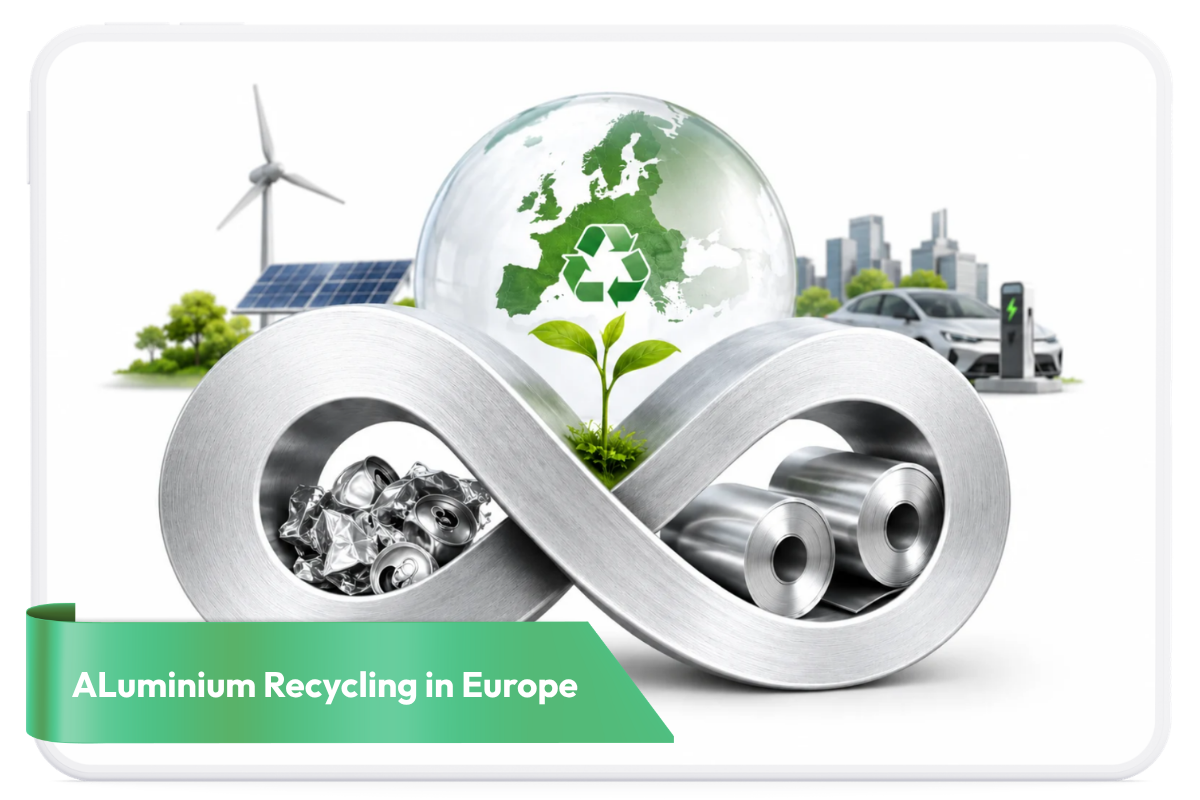
The image used in this article is generated with an AI tool and does not depict any real-time moment
As Europe accelerates its shift towards a low-carbon economy, aluminium is emerging as a cornerstone material across automotive, renewable energy, packaging and industrial applications. The region is simultaneously pursuing greater recycling, strengthening resource security, advancing circular economy models and tightening carbon regulations. Yet, rising scrap exports, evolving trade mechanisms and growing demand for sustainable materials continue to test the resilience of Europe’s aluminium value chain.
CBAM, carbon leakage and Europe’s regulatory tightrope
As the European Union prepares to expand its Carbon Border Adjustment Mechanism (CBAM) to around 180 downstream aluminium-intensive products from 2028, exporters face a major shift from simply supplying metal to proving the carbon footprint embedded across their supply chains. The new regime is expected to increase compliance costs, particularly for carbon-intensive products, while placing greater emphasis on emissions tracking, verified data, and low-carbon production. For aluminium exporters targeting Europe, early investment in traceability, reporting systems and decarbonisation strategies will be critical to maintaining competitiveness in an increasingly carbon-conscious market.
The European aluminium industry has renewed its call for stronger safeguards to protect aluminium scrap and shield Europe from the incomplete CBAM framework. As the European Union finance ministers prepare to finalise their position on revisions to the CBAM, European Aluminium strongly warns that the existing framework still falls short of protecting the sector from carbon leakage.
Delve deeper into the recycled aluminium and secondary aluminium market with our World Recycled ALuminium Market Analysis Industry forecast to 2032
Recycling expansion meets growing scrap security concerns
Europe’s aluminium recycling sector continues to expand despite rising scrap exports, with demand for recycled aluminium expected to approach 8 million tonnes by 2025. Recycling rates remain above 80 per cent across key sectors, supported by advanced sorting technologies, closed-loop systems and growing investments from major producers. However, aluminium scrap exports have surged 66 per cent since 2014, raising concerns over feedstock availability, industrial competitiveness and Europe’s ability to secure enough low-carbon material for its long-term decarbonisation goals.
Europe is intensifying efforts to retain aluminium scrap within the region as part of its broader push toward circularity and low-carbon manufacturing. Recent policy measures are expected to strengthen recycling rates and improve feedstock availability for domestic remelters and downstream producers. However, challenges remain, particularly around scrap exports. Industry stakeholders argue that without addressing outbound flows, Europe would no longer be equipped to provide to sectors like automotive and packaging.
Germany's secondary aluminium sector is emerging as a cornerstone of the country's circular economy. High collection rates for beverage cans and packaging, coupled with extensive remelting and recycling infrastructure, have helped Germany reduce dependence on primary metal while strengthening resource efficiency. The automotive sector remains the largest consumer of secondary aluminium, accounting for nearly half of demand. Despite these strengths, rising scrap shortages and competition for recyclable material are becoming key challenges for maintaining future growth and securing feedstock for domestic recyclers.
The UK aluminium industry is urging policymakers to treat aluminium scrap as a strategic resource rather than waste, arguing that recycled metal is critical for industrial resilience, decarbonisation and supply-chain security. Shifting global trade flows and growing international demand for recycled aluminium are creating supply risks for domestic remelters and manufacturers. As governments increasingly recognise aluminium as a critical material, the debate is moving beyond recycling rates to focus on resource security, circular economy goals and the long-term value of keeping high-quality scrap available for local processing.
Explore the position of aluminium at the intersection of sustainability and strategy in Sustainability & Recycling: Aluminium's Dual Commitment
Low-carbon aluminium shapes geopolitics, mine and mobility
Electricity is becoming the defining factor in where and how aluminium is produced. Hydropower-rich regions such as Canada, Norway and parts of China are gaining a competitive edge, while coal-dependent producers face increasing pressure to decarbonise. However, challenges related to renewable intermittency, grid stability and storage remain significant, making a balanced energy mix crucial for the industry's future. At the same time, recycled aluminium is emerging as a key solution, requiring only a fraction of the energy needed for primary production, thereby helping producers cut both costs and emissions.
Europe’s automotive sector is on track to consume 4.2 million tonnes of aluminium annually by 2030, fuelled by electrification and lightweighting trends. Recycled aluminium is expected to gain momentum thanks to its lower emissions and energy use, while primary aluminium will remain indispensable for quality-sensitive applications. With scrap availability and recycling capacity still posing challenges, the industry’s future is likely to depend on a complementary blend of primary and recycled aluminium.
Rio Tinto is introducing automated drill rigs with data-driven operational systems to improve the operating performance of its existing mining operations with increased levels of operational precision and less manual input. This announcement highlights the industry’s continued push toward automation and smarter mining tech for better efficiency and cost savings. It also has a USD 1.5 billion project to expand a low-carbon aluminium smelter in Quebec, Canada. It aims to meet growing global demand for eco-friendlier materials.
Waaree Renewable Technologies has received a contract to develop a 300 MW solar project, planned to be completed by FY27. The company has received the new order from its wholly owned subsidiary, Sunsational Power Private Limited (SPPL), for the development of the large-scale solar project. Under the agreement, Waaree will handle the construction of a 300 MW/450 MWp ground-mounted solar power project. The contract also includes operation and maintenance services for two years after the project is commissioned.
Toyota Motor Manufacturing UK has advanced its circular economy strategy by establishing a closed-loop aluminium recycling system at its Burnaston facility in Derbyshire, England. It has created what the company describes as a European-first process for recovering aluminium from end-of-life vehicles and reusing it in the production of new hybrid auto components.
German aluminium producer Trimet has planned to invest at its recycling operations, including the construction of a new aluminium recycling facility in Hamm and capacity expansions at existing sites in Gelsenkirchen and Essen. At its recycling plant in Gelsenkirchen, the company has expanded production capacity through the installation of new melting units. The additional equipment is expected to increase recycled aluminium output by up to 80,000 tonnes per year.
Paper-based packaging company Elopak has begun using low-carbon aluminium produced with renewable electricity in carton packaging manufactured at its facilities in the Netherlands, Denmark and Ukraine, to reduce the environmental impact of its products. According to the company, it lowers the carbon footprint of its standard packaging by nearly 8 per cent. Based on cradle-to-gate calculations, the carbon footprint of a standard aseptic Pure-Pak carton has been reduced from 53 grams of CO₂ to 49 grams per carton.
Rising tensions in West Asia are beginning to ripple through the renewable energy sector. Prices of locally produced solar cells have climbed by as much as 35 per cent since the start of the year, driven by higher aluminium, copper and petrochemical costs, alongside supply-chain disruptions. This has lifted overall solar project costs by around 20 per cent, burdening developer margins, financing plans and project economics. Industrialists warn that prolonged inflation could slow renewable energy deployment and complicate efforts to meet clean-energy goals.
Trading aluminium across borders? Find out the exact cost you need to bear for the embedded carbon in the product by using this CBAM calculator.

SuperAlloy sees revenue growth as carmakers increase the use of recycled aluminium
Next articleDestinations for the EU’s aluminium scrap exports in Q1 2026 – India and Thailand top the list despite annual declines
Grow with
AL Circle