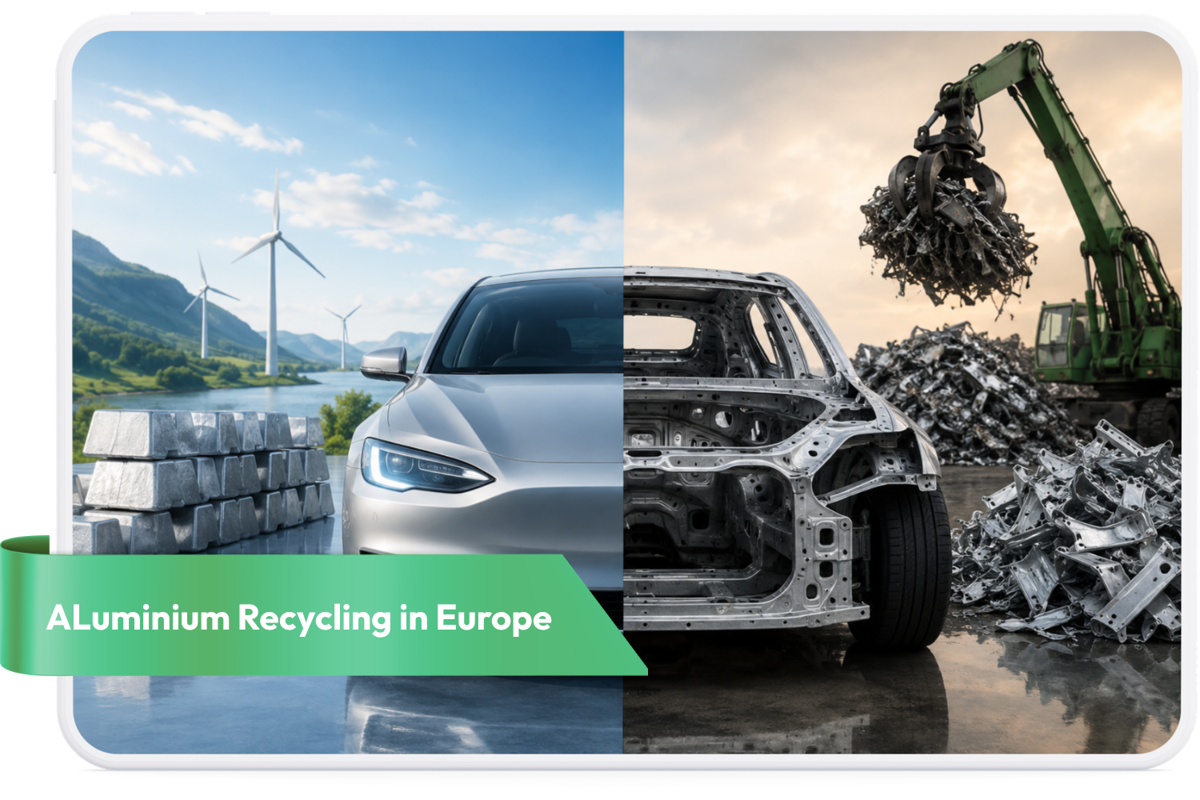
Europe exports roughly 1 million tonnes of aluminium scrap every year, enough material to potentially reduce the region's primary aluminium imports by nearly 24 per cent if retained and recycled domestically. Yet despite recycled aluminium production already catching up with primary output, the automotive industry continues to include a higher percentage of virgin metal.
All at the same time, the region’s automotive industry is entering a period where aluminium procurement strategies are becoming as important as vehicle design itself. Driven by electrification, lightweighting requirements and increasingly stringent sustainability targets, automotive manufacturers are consuming more aluminium than ever before.
The transition is, though, far from straightforward. While recycled aluminium offers significant environmental and energy advantages, primary aluminium continues to account for the majority of automotive-grade aluminium requirements because of quality, alloy composition and supply constraints.
Europe's growing appetite for aluminium
The transport sector is one of the largest consumers of aluminium in Europe, accounting for approximately 42 per cent of total aluminium consumption. Within the transport segment, the automotive industry represents the dominant share of demand.
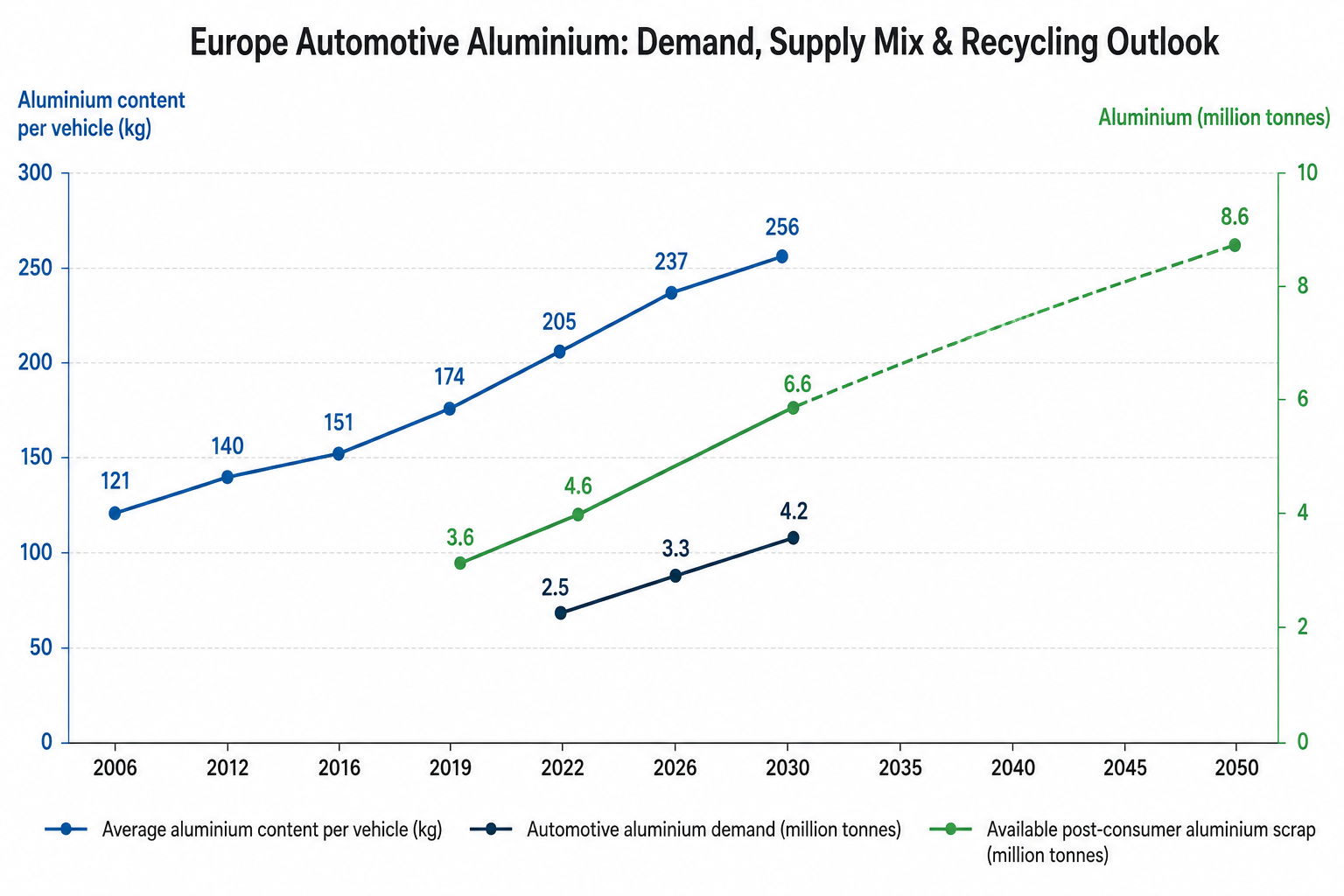
The shift towards electric mobility is accelerating aluminium consumption per vehicle in Europe as discussed in my previous article, where it is clear that Europe's 36% BEV surge meets a 42% aluminium consumption share in Q1'26. In 2006, passenger cars produced in Europe contained an average of 121 kilograms of aluminium. By 2012, the figure had increased to 140 kilograms, rising further to 151 kilograms in 2016 and 174 kilograms in 2019.
The upward trajectory has continued. Average aluminium content reached 205 kilograms per vehicle in 2022 and is projected to rise to 237 kilograms in 2026 before touching approximately 256 kilograms per vehicle by 2030.
Hence, the deduction that aluminium content in European passenger vehicles is expected to more than double between 2006 and 2030 is evident.
Much of the increase is linked directly to electric vehicles. By 2030, EV-specific applications alone are expected to account for nearly 54 kilograms of aluminium per vehicle. Battery housings, thermal management systems and lightweight structural components are becoming major aluminium-intensive applications as automakers seek to offset battery weight and improve vehicle efficiency.
Forecasts indicate Europe could produce around 16.5 million vehicles annually by 2030. Approximately 60 per cent, or 9.9 million units, are expected to be battery electric vehicles. To support this production volume, the automotive industry will require roughly 4.2 million tonnes of aluminium annually, almost double the 2.5 million tonnes consumed in 2022.
As of now, primary aluminium remains the dominant source
Though the ambition is about sustainable metal inclusion and a low carbon footprint, the current scenario shows that primary aluminium continues to form the backbone of automotive aluminium supply.
Produced from bauxite through alumina refining and Hall-Héroult electrolysis, primary aluminium is highly energy-intensive. Around four tonnes of dried bauxite are required to produce two tonnes of alumina, which ultimately yield only one tonne of aluminium metal.
The energy requirement for primary aluminium production is approximately 200 gigajoules per tonne (though the actual figure may vary from plant to plant), making it one of the most energy-intensive industrial materials.
Global primary aluminium production has skyrocketed over the past two decades, rising from approximately 33 million tonnes in 2006 to 71 million tonnes in 2023. China alone accounted for roughly 58 per cent of global primary aluminium production in 2023.
Europe, meanwhile, has experienced a contraction in domestic primary aluminium capacity. The number of active primary aluminium producers in Europe declined from 23 in 2002 to only 10 in 2023.
As production capacity shrank, import dependence increased. In 2023, European demand for primary aluminium reached approximately 7.2 million tonnes, while net imports amounted to 5.8 million tonnes. Norway and Iceland remain among the most important suppliers to the European market.
The automotive industry's growing demand, therefore, continues to rely heavily on imported primary metal.
Trading aluminium across borders? Find out the exact cost you need to bear for the embedded carbon in the product by using this CBAM calculator
The case (pro) of recycled aluminium
Recycled aluminium, also known as secondary aluminium, is produced from pre-consumer and post-consumer scrap. Recycling one tonne of aluminium can save up to 14,000 kilowatt-hours of energy and approximately 7.6 cubic metres of landfill space. In 2025, Europe produced approximately 5.9-6 million tonnes of secondary aluminium.
The carbon reduction potential is equally significant. Forecasts suggest that recycling aluminium instead of producing primary metal can reduce carbon dioxide emissions by as much as 92 per cent.
Globally, aluminium already records one of the highest recycling rates among industrial metals. Approximately 75 per cent of all aluminium ever produced remains in circulation through recycling.
Within Europe, more than 90 per cent of aluminium was recovered from sectors such as transportation and construction in 2018. In 2017 alone, around 4.9 million tonnes of aluminium were recycled across the region.
Current estimates indicate that recycled aluminium production in Europe already exceeds primary aluminium production. European primary aluminium output (including Russia) reached approximately 7.06 million tonnes in 2025.
The European Union's end-of-life aluminium recycling rate stands at approximately 69 per cent, meaning more than half of all end-of-life aluminium generated in the region is collected and returned to production cycles.
Participate in our upcoming e-magazine 'Sustainability & Recycling: Aluminium's Commitment 2026' to showcase your green initiative stance to the world industry leaders and beyond
Automotive recycling volumes continue to rise
The automotive industry is emerging as one of the most important sources of post-consumer aluminium scrap.
Vehicle aluminium components typically remain in service for around 15 years before entering recycling streams. As vehicle aluminium content continues increasing, future scrap availability is expected to expand substantially.
Post-consumer aluminium available for recycling in Europe was estimated at approximately 3.6 million tonnes in 2019. By 2030, the figure is projected to rise to 6.6 million tonnes, representing growth of about 83 per cent.
By 2050, post-consumer aluminium availability could reach 8.6 million tonnes annually.
If collection and recycling systems continue improving, nearly all available post-consumer aluminium could be recovered and reintroduced into production by 2050. Under such a scenario, approximately 50 per cent of Europe's aluminium demand could be met through post-consumer recycling alone.
But significant material leakage remains. Europe exports roughly 1 million tonnes of aluminium scrap annually. According to the study, retaining domestically generated scrap within Europe could potentially reduce primary aluminium imports by approximately 24 per cent.
Join our exlusive webinar 'Hedging for recyclers - Become an expert in 6 hours' to stay ahead in the competitive market
Recycled versus primary aluminium in automotive applications
According to the International Aluminium Institute, approximately 58 per cent of aluminium used by the automotive industry currently comes from primary sources, while recycled aluminium supplies around 42 per cent of demand.
Several factors explain this balance. Automotive applications increasingly require alloy-specific performance, especially for electric vehicle battery enclosures and structural components. These applications demand precise chemical compositions and strict quality standards.
Recycled aluminium frequently contains impurities such as iron, copper, zinc, oxides and organic contaminants. Iron contamination is particularly problematic because it cannot be easily removed once dissolved into molten aluminium and can negatively affect mechanical properties.
As a result, many high-performance automotive applications continue relying on primary aluminium despite the environmental advantages of recycled metal.
Where aluminium is growing inside the vehicle
The changing composition of vehicle aluminium demand further illustrates the challenge.
Between 2019 and 2025, aluminium demand in extruded automotive products is projected to increase by 41 per cent. Rolled products are expected to grow by 27 per cent, while forged products will increase by 5 per cent.
Cast aluminium products, traditionally dominant in internal combustion engine components, are expected to record only a 2 per cent increase over the same period.
The trend reflects the transition away from engine-intensive vehicle architectures towards electric mobility. Battery packs, crash structures, body-in-white components and lightweight chassis systems increasingly rely on extruded and rolled aluminium products.
Consequently, recycling systems must evolve beyond simply recovering aluminium volume and focus on producing high-quality, alloy-specific secondary materials suitable for these growing applications.
Our study on Aluminium Dross Processing: A Global Review adopts a comprehensive and structured approach to assess the key aspects of aluminium dross generation, processing technologies, recovery rates, and emerging sustainability innovations. Click here to get your copy now...
Collection, sorting and recovery challenges
Europe's automotive aluminium recycling chain currently achieves collection rates of around 85 per cent.
Most end-of-life vehicles are still processed through shredding systems that mix cast and wrought aluminium components. While EU regulations require a 95 per cent recovery rate from end-of-life vehicles, including 85 per cent reuse or recycling, mixed processing often leads to contamination and material downgrading.
More than 90 per cent of automotive aluminium is reportedly recycled through modern treatment facilities, yet significant quality losses occur when different alloy families are combined.
The industry is increasingly focusing on component-level sorting before shredding. Separating extruded, rolled, forged and cast products prior to processing could enable more efficient closed-loop recycling and improve the availability of high-quality recycled aluminium for automotive applications.
What to expect from the near future?
The European automotive industry's aluminium requirements are set to rise sharply as electrification accelerates. Average aluminium content per vehicle is expected to increase from 121 kilograms in 2006 to 256 kilograms by 2030, while annual automotive aluminium demand could reach 4.2 million tonnes.
At the same time, recycled aluminium is becoming an increasingly important source of supply. Post-consumer scrap availability is forecast to rise over two times by 2050, creating opportunities to reduce dependence on imported primary aluminium.
Yet the current material balance remains tilted towards primary metal. Approximately 58 per cent of automotive aluminium demand continues to be met by primary aluminium, compared with 42 per cent from recycled sources.
The extent to which this balance shifts in the coming years will depend on collection efficiency, scrap retention, alloy-specific sorting capabilities and the industry's ability to deliver recycled aluminium that meets increasingly demanding automotive specifications.
Information credit: https://doi.org/10.3390/recycling11010019
Note: This is exclusive coverage by AL Circle and may not be reproduced, republished or shared without prior permission.













_md.webp)
_md.webp)







