From Zorba to high-purity aluminium: How advanced sorting is overcoming scrap contamination and alloy mixing
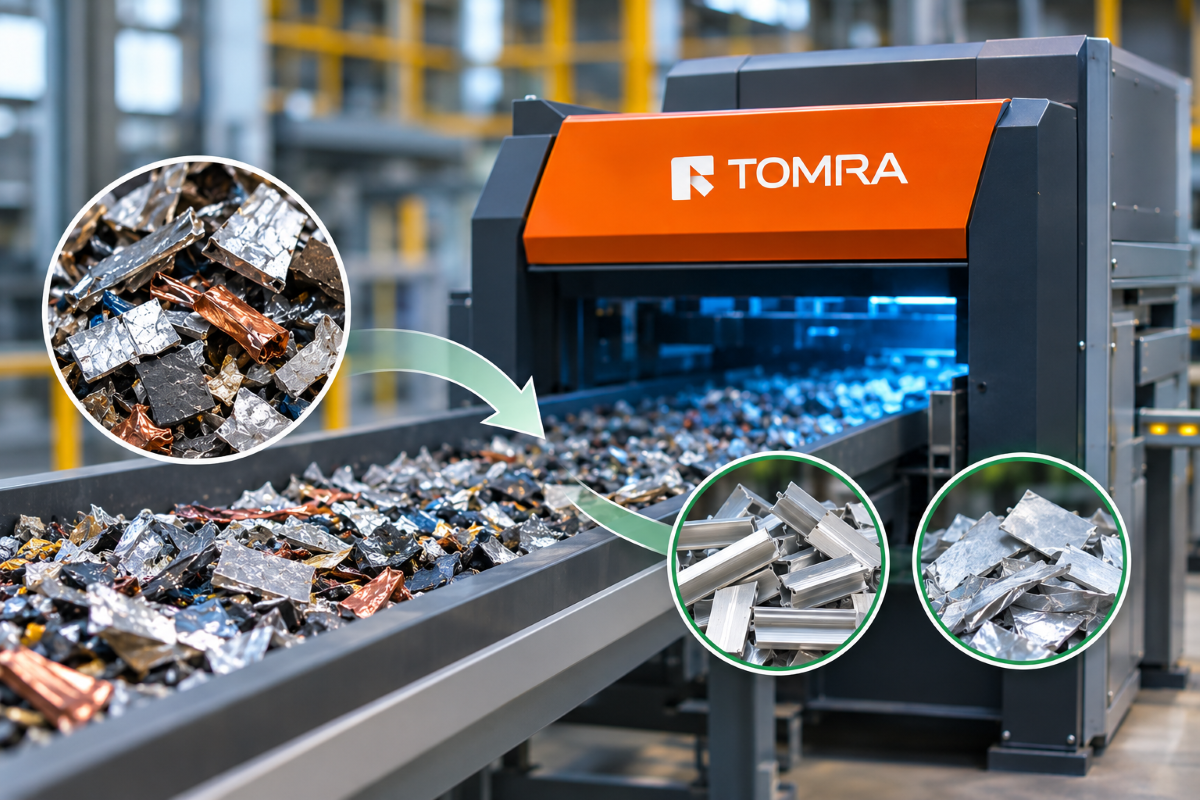
The image used in this article is generated with an AI tool and does not depict any real-time moment
Aluminium recycling is no longer just about recovering metal from end-of-life products. For recyclers and secondary smelters, the bigger challenge is ensuring that recovered material is clean, correctly classified and suitable for reuse in demanding manufacturing applications. A batch of shredded aluminium may contain different alloy grades, heavy metals, plastics, rubber and other unwanted materials. Even after recovery, its mixed composition can make it difficult to return the metal to its original application.
This creates a significant challenge for an industry looking to expand the use of recycled aluminium in automotive, aerospace, construction and other industrial applications. Manufacturers require metal with tightly controlled chemical compositions, while secondary smelters need consistent, furnace-ready feedstock. When different alloy grades are mixed or contaminants remain in the scrap, the resulting metal may not meet these requirements, leaving recyclers with fewer opportunities to supply higher-value markets.
The problem is particularly evident in Zorba, a common post-shredder non-ferrous scrap fraction. According to TOMRA, Zorba typically contains 70–80 per cent aluminium, alongside copper, brass, zinc, magnesium, rubber and foil. Secondary aluminium smelters generally seek magnesium levels below 0.5 per cent by weight, while automotive and aerospace applications impose strict limits on elements such as silicon and iron.
How is TOMRA addressing the aluminium scrap quality challenge?
Turning mixed and contaminated scrap into high-quality aluminium requires more than conventional separation methods. Different alloy grades can have similar appearances and densities, while contaminants such as magnesium, copper and plastics can affect the composition and quality of recovered metal.
TOMRA Sorting GmbH is addressing these challenges through a combination of X-ray transmission (XRT), laser spectroscopy and artificial intelligence (AI)-based sorting technologies. Its solutions focus on three important stages of aluminium scrap processing: removing contaminants, identifying individual alloy grades and improving the recovery of complex or overlapping scrap pieces.
The company's technology portfolio includes X-TRACT for contaminant removal, AUTOSORT PULSE for alloy identification and GAINnext for AI-based object recognition. Together, these systems are designed to help recyclers produce cleaner, more consistent and alloy-specific feedstock for secondary aluminium production.
Why is conventional aluminium scrap sorting facing limitations?
One of the biggest difficulties in aluminium recycling is that different alloy grades can have similar appearances, shapes and densities. The 5xxx and 6xxx series, for example, may look almost identical despite having different chemical compositions. Conventional sorting methods can therefore struggle to distinguish between them.
When these alloys are mixed during recycling, the resulting metal may not satisfy the specifications required for higher-value applications. This can restrict its use in automotive, aerospace, construction, packaging and industrial products, resulting in downcycling and a loss of material value.
Contamination creates another obstacle. Heavy metals such as copper and brass can compromise the quality of recovered aluminium, while magnesium is particularly difficult to separate because its density is relatively close to that of aluminium. Conventional density-based sink-float methods can therefore struggle to distinguish between the two.
Surface conditions add further complexity. Scrap pieces may be painted, coated, oxidised or covered in dust, making it harder for sorting equipment to identify their actual material composition. At the same time, recyclers are dealing with increasingly complex scrap streams from automotive manufacturing, packaging, electronics and post-shredder operations.
The industry therefore needs solutions that can go beyond basic metal recovery and deliver accurate contaminant removal, alloy identification and high-volume processing.
X-TRACT: Removing contaminants before aluminium reaches the furnace
One of the first requirements for producing high-quality recycled aluminium is removing unwanted materials from the scrap stream. TOMRA's X-TRACT technology addresses this through X-ray transmission (XRT), which measures the atomic density of materials to distinguish aluminium from denser substances, including heavy metals.
The system can also separate magnesium from aluminium, alongside aluminium-plastic compounds and lightweight plastics. This is particularly relevant when processing Zorba, where different materials can compromise the quality of the recovered aluminium.
X-TRACT can identify fine particles as small as 5 mm and operate at speeds of up to 3.8 metres per second. The system incorporates TOMRA's DUOLINE sensor and enhanced software to support high-throughput and flexible sorting operations.
In company-reported testing, TOMRA's X-TRACT application achieved purity rates of up to 99 per cent, producing low-magnesium, furnace-ready aluminium from Zorba in the 5–120 mm size range. These results relate to specific testing conditions and are not a guaranteed outcome for every recycling operation.
Removing contaminants, however, is only one part of the process. Recyclers must also ensure that the recovered aluminium is separated according to its alloy composition.
To know the world's future aluminium recycling market and its growing trends, download our report - World Recycled ALuminium Market Analysis Industry Forecast
AUTOSORT PULSE: Identifying alloy grades and preventing downcycling
Separating different aluminium alloy grades remains one of the major technical challenges in scrap recycling. When alloys with different chemical compositions are melted together, the resulting metal may not meet the specifications required for higher-value applications.
TOMRA's AUTOSORT PULSE addresses this challenge through Dynamic Laser-Induced Breakdown Spectroscopy (LIBS), which analyses the elemental composition of individual scrap pieces.
Unlike conventional static LIBS, the technology combines 3D laser measurements with AI to identify the optimal laser-targeting position and repeatedly analyse the same spot on a moving scrap piece. This is particularly useful when processing painted, coated, oxidised or dusty materials, as repeated targeting allows the laser to work through surface layers and analyse the underlying composition.
AUTOSORT PULSE can distinguish between aluminium alloy families, including the 3xxx, 5xxx and 6xxx series, as well as specific grades such as 6063. This allows recyclers to separate mixed alloys into individual streams rather than sending them together for melting.
TOMRA reports purity levels above 97 per cent for certain alloy streams, with recovery rates exceeding 95 per cent and reaching 97–98 per cent for some 4xxx and cast alloy fractions.
Processing capacity is equally important. Conventional alloy-identification technologies, including standard LIBS and X-ray fluorescence (XRF), can face limitations when maintaining accurate separation at industrial-scale volumes. AUTOSORT PULSE combines 3D object scanning, multiple single-point laser measurements and AI-based object identification to balance sorting precision with throughput.
According to TOMRA, the system can process 4–7 tonnes per hour of lighter stamping scrap and more than 10 tonnes per hour of typical used aluminium old sheet or mixed wrought fractions.
GAINnext: Using AI to improve the recovery of overlapping scrap
Even when scrap is correctly identified, the physical arrangement of materials on a conveyor belt can affect sorting performance. Aluminium pieces frequently overlap or sit close together as they move through high-speed sorting systems. If sorting equipment cannot distinguish between individual objects, valuable material may be incorrectly ejected, affecting recovery and output purity.
TOMRA's GAINnext technology uses deep-learning-based object recognition to identify materials according to their shape and position on conveyor belts. It can distinguish overlapping pieces and help the sorting system determine whether it is processing one object or several.
This improves single-object detection, allows higher belt occupancy and supports faster processing. It can also reduce reliance on manual sorting. GAINnext is additionally used to improve the cleaning of used beverage can (UBC) fractions.
The combination of X-TRACT, AUTOSORT PULSE and GAINnext addresses different stages of the sorting process, from removing contaminants and identifying alloy grades to handling complex material arrangements on conveyor belts.
Looking for secondary aluminium? Explore a wide range of aluminium scrap and recycled aluminium products from global suppliers on AL Biz
From automotive stamping scrap to complex post-shredder fractions
The relevance of advanced sorting technologies becomes clearer when applied to real recycling operations, particularly in the automotive and industrial sectors, where maintaining alloy specifications is essential.
At Gerhard Lang Recycling in Germany, TOMRA's AUTOSORT PULSE separates automotive stamping scrap into distinct 5xxx and 6xxx alloy streams. The process enables the production of higher-purity material and supports closed-loop recycling in the automotive sector.
Another example involves Twitch, a challenging scrap fraction because of its complex composition. TOMRA and Novelis explored a multi-stage sorting process combining X-ray transmission, deep learning and Dynamic LIBS. In a company-reported test, the process recovered 40 per cent of the wrought aluminium from a 100 per cent Twitch input as high-quality 5xxx and 6xxx alloy fractions.
These applications demonstrate the importance of moving beyond basic aluminium recovery. The ability to separate individual alloys and remove difficult contaminants can help recyclers produce material that is more suitable for demanding manufacturing applications.
Who are the competitors in advanced aluminium sorting?
The growing importance of scrap quality and alloy separation has created opportunities for several equipment manufacturers operating in the aluminium recycling sector. Among the closest competitors to TOMRA are STEINERT and Redwave, particularly in sensor-based sorting, contaminant removal and aluminium alloy identification.
STEINERT is one of the most direct competitors, offering technologies that cover both contaminant removal and alloy sorting. Its portfolio includes the XSS T EVO 5.0 XRT system, alongside LSS LIBS and PLASMAX LIBS technologies. These systems help separate aluminium from copper, brass, zinc, iron and free magnesium, while enabling the classification of 5xxx, 6xxx and 7xxx alloy series, including specific grades such as 6063.
Redwave is another close competitor, particularly in optical and sensor-based sorting for recycling and packaging applications. Its systems are used to recover aluminium from complex packaging and recycling streams, including aluminium-can recycling applications.
Beyond these direct competitors, several manufacturers supply equipment used in different stages of aluminium recycling and material recovery.
MSS (Magnetic Separation Systems) provides automated optical and sensor-based sorting equipment for material recovery facilities. Its solutions help separate recyclable materials and metals from mixed waste streams, supporting material recovery before or alongside more specialised aluminium upgrading processes.
Eriez offers magnetic separators, eddy-current separators and metal-detection equipment. These technologies help recover ferrous and non-ferrous metals from mixed scrap streams and are commonly used as an upstream separation stage before more advanced alloy-sorting operations.
Similarly, Bunting supplies magnetic separation and eddy-current separation systems designed to remove ferrous metals and recover non-ferrous materials, including aluminium, from mixed waste and scrap streams.
Binder+Co operates in the screening, optical sorting and recycling plant equipment segment. Its technologies help prepare, classify and process material streams for recycling, including applications associated with aluminium recovery.
SGM also supplies magnetic and eddy-current separation technologies for metal recycling. Its equipment is used to recover non-ferrous metals, including aluminium, from shredded scrap and mixed waste streams.
Participate in AL Circle’s upcoming e-Magazine Smart ALuminium: Advancing Industrial Technologies in 2027 to showcase the advancement of technologies in aluminium recycling
Grow with
AL Circle












_md.webp)
_md.webp)
_md.webp)