Trump’s 50% auto tariff puts US-Canada trade, aluminium supply chain at risk
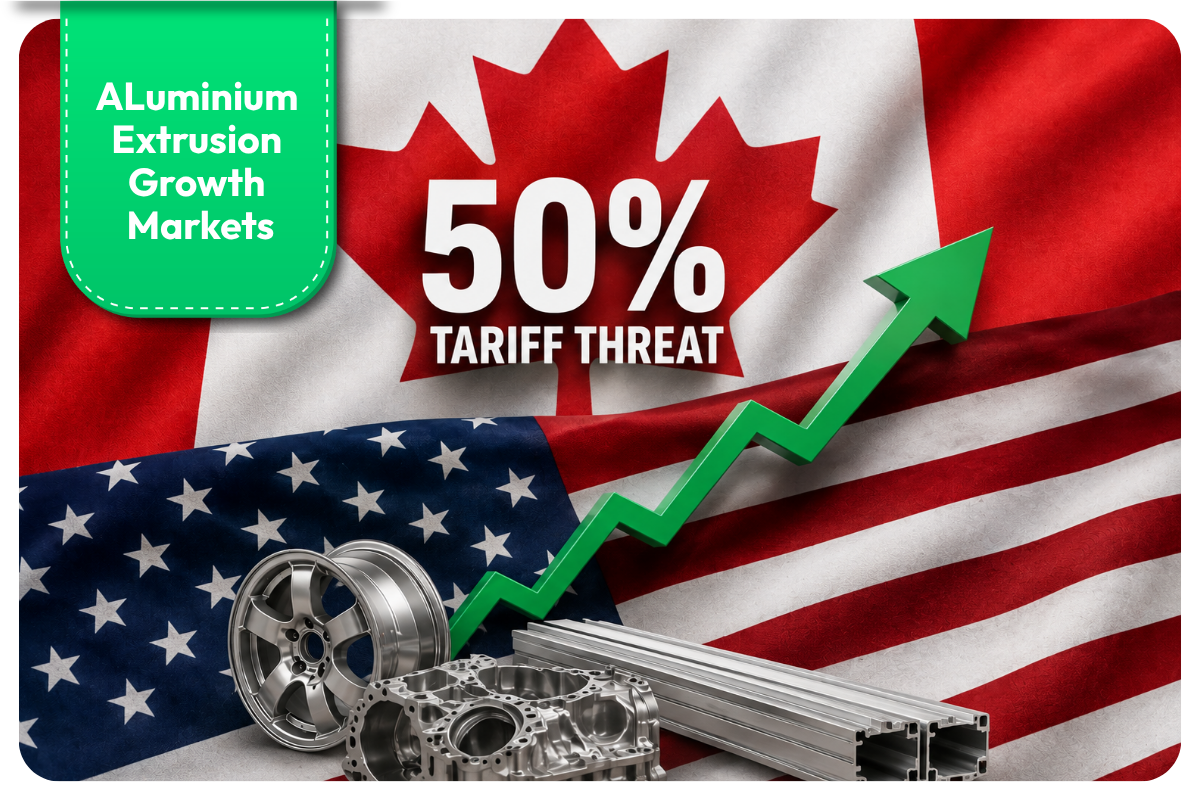
The image used in this article is generated with an AI tool and does not depict any real-time moment
The US-Canada trade debate has taken a sharper turn after President Donald Trump warned of raising tariffs on Canadian cars, trucks and automotive parts to 50 per cent from January 1, 2027. The move could have significant implications for the deeply integrated North American automotive supply chain, where cross-border movement of vehicles, components and aluminium-intensive parts is central to production. With Canada preparing retaliatory measures, automakers and suppliers now face greater uncertainty over costs, sourcing and investment decisions.
President Donald Trump announced the proposed tariff increase after US-Canada trade negotiations broke down. He also called on companies to manufacture in the US, stating, “Build in the US and there are ZERO TARIFFS.”
To know the aluminium casting demand forecast in the transportation sector, explore our report “Global Aluminium Casting Market 2026-2032: Plant Economics, Alloy Segmentation, Pricing Intelligence, Supply Chain Analysis & Strategic Recommendations”
The proposed automotive tariff matters because Canada and the US operate an integrated production system rather than two independent automotive markets. As per Global Affairs Canada, Canada exported approximately CAD 80.3 billion (USD 57.95 billion) of motor vehicles and parts in 2024, with nearly 95 per cent of Canadian motor-vehicle and parts exports destined for the US.
This exposure means that a major tariff could affect not only finished vehicles but also the tier-one and tier-two suppliers that provide components, materials and subassemblies to plants on both sides of the border.
Auto parts at Trump’s tariff risk
The proposed 50 per cent duty would be added to an already complicated tariff environment. Existing US automotive measures do not apply uniformly to every Canadian vehicle or part: treatment depends on factors including USMCA qualification, the share of non-US content and the specific tariff classification. For USMCA-compliant vehicles, the effective duty can depend on the non-US content rather than automatically applying to the full customs value.
Automotive parts may cross the border several times during production, for instance, when a Canadian-made component is shipped to a US assembly plant, incorporated into a vehicle, or returned for further processing. Each customs entry can create additional duty, compliance and logistics exposure. However, the tariff burden does not automatically compound at every crossing because exemptions, origin rules, content calculations and remission mechanisms may apply.
The potential disruption is significant because Canada’s automotive demand and production base are large enough to support a substantial components ecosystem. According to Statistics Canada, Canada recorded 1.87 million new-vehicle registrations in 2025, up 0.7 per cent from 2024, while US light-vehicle sales reached approximately 16.2 million units, up 2.4 per cent year-on-year. The US therefore represents the much larger end market, while Canada remains an important integrated production and supply location.
Explore downstream aluminium suppliers, product listings and trade opportunities on AL Biz
Aluminium at the pressure point
Aluminium is exposed at two levels: first as a traded material and second as an input into vehicles and automotive components. It is widely used in body structures, wheels, battery enclosures, heat exchangers, castings, extrusions, crash-management systems and lightweight structural components.
That exposure is amplified by how structurally dependent the US remains on Canadian metal. Canadian smelters run on hydroelectric power, giving them comparatively low-cost, low-carbon electricity that primary aluminium production needs in enormous volumes, i.e., a cost base no single US project can currently replicate at scale. That metal already moves into the US manufacturing base, making Canada less a substitutable trade partner and more an extension of the domestic supply chain itself.
Any single American project cannot close that gap quickly. Century Aluminum’s Mt Holly expansion in South Carolina added around 10 per cent to total US primary output when it began shipping hot metal in April. The proposed 750,000-tonne Century-EGA smelter in Inola, Oklahoma, still awaits approval and a final investment decision. These fall short of replacing the volume and cost advantage Canadian aluminium provides.
That’s what makes a Section 232 tariff on Canadian aluminium a different kind of risk than a trade measure, being a supply chain the US has not yet built a domestic alternative for.
The Bank of Canada reports that Canadian aluminium currently faces a 50 per cent US tariff, while aluminium derivatives face a 25 per cent tariff. Canadian aluminium exports to the US initially fell to approximately 50 per cent below 2024 levels after tariffs were introduced, before recovering as US inventories tightened; some Canadian producers also redirected shipments to Europe at lower margins.
This creates a potential two-sided cost pressure for automotive suppliers:
- The aluminium input may already be subject to a metal or derivative tariff.
- The finished vehicle component made from that aluminium may face a separate automotive tariff if shipped to the US.
- The actual exposure will depend on the product classification, origin, USMCA qualification, US content and whether the relevant aluminium is primary metal, billet, sheet, extrusion, casting or a finished component.
Consequently, a “double cost squeeze” scenario might surface in case of select aluminium automotive components.
Canada prepares retaliation
Ottawa has responded to the latest escalation by preparing dollar-for-dollar retaliatory tariffs for Trump’s administration from September 8. The Canadian measures include US products such as electronics, steel, and other industrial and consumer products.
Canada also maintains tariff measures related to US steel, aluminium and automotive products. Canada’s Automotive Parts Manufacturers’ Association (APMA) President Flavio Volpe noted, “A threatened US tariff on Canadian auto parts will be paid by [the] US auto assembly. Without those specific parts, auto assembly throughout the US would halt.”
At the same time, the government has provided tariff relief for certain US-origin aluminium inputs used by Canadian manufacturers, processors, agriculture and food-packaging industries.
The conflict could therefore affect Canadian automotive and aluminium exporters, US vehicle industry segments relying on Canadian parts, North American aluminium suppliers, and automotive dealers and consumers through higher vehicle prices.
Unlock key insights from leading companies and experts across the aluminium ecosystem with our e-Magazine - Mine to Market: ALuminium Producers & Manufacturers 2026
Demand and production impact
Canada’s June 2026 transportation-equipment sales, as reported by Statistics Canada, increased 2.8 per cent to CAD 12.4 billion (USD 11.83 billion), while motor-vehicle-parts sales increased 6.2 per cent.
This indicates that the Canadian components sector remained active before the proposed January 2027 tariff. They also provide a useful baseline for measuring any subsequent demand or production slowdown.
For the US, the automotive aftermarket adds another major source of component demand. According to the Auto Care Association and MEMA Aftermarket Suppliers, the US light-vehicle repair and maintenance aftermarket was projected to reach approximately USD 435 billion in 2025, marking a 5.3 per cent growth rate.
This demand is less directly tied to new-vehicle assembly and could remain comparatively resilient even if tariff uncertainty weakens OEM production.

The immediate impact of the proposed tariff could therefore be uneven:
- OEM suppliers may face the greatest pressure because they operate on tightly coordinated cross-border schedules and narrow margins.
- Aftermarket suppliers may be less exposed to vehicle-production disruption but could still face higher costs for imported components and materials.
- Canadian exporters may lose scale efficiencies if US customers shift sourcing.
- US assembly plants may face higher costs or production interruptions if substitute parts are not available quickly.
- Aluminium suppliers may redirect material to Europe, Mexico or other markets, although alternative destinations may not absorb the same volumes or offer equivalent margins.
However, the eventual impact will not necessarily be a simple 50 per cent tariff imposed by President Donald Trump on every Canadian vehicle or component. USMCA qualification, US content, product classification, exemptions and tariff-remission arrangements will determine the effective burden.
Note: This is exclusive coverage by AL Circle and may not be reproduced, republished or shared without prior permission.
Automotive aluminium in spotlight as Wetzel acquires Martinrea Honsel Brasil
Next articleSudarshan Chemical deepens aluminium dyes footprint with $8.7m Swiss plant deal
Grow with
AL Circle