Canada’s aluminium extrusion imports rise 20% over five years, strengthening the case for protection measures
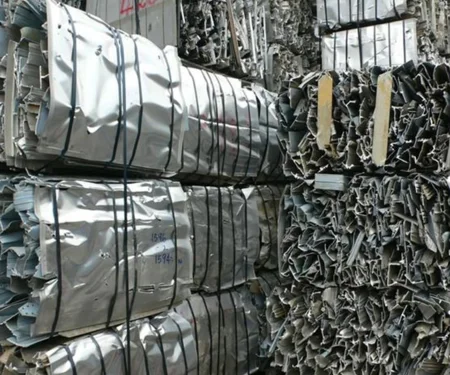
The image used in this article is generated with an AI tool and does not depict any real-time moment
Canada’s aluminium extrusion market is expected to expand significantly over the coming years. The market was valued at USD 2,747.8 million in 2025 and is projected to reach USD 3,745.4 million by 2030, representing a 6.4 per cent CAGR, according to industry data. Recovery in automotive production, infrastructure investment and resilience in aerospace are expected to support this growth.
At the same time, imports remain a significant part of Canada’s aluminium extrusion market. Average annual imports increased from 100,068.18 tonnes in 2016-2020 to 120,266.40 tonnes in 2021-2025, representing a 20.18 per cent increase.
Imports peaked at 135,981 tonnes in 2022, before falling to 116,054.48 tonnes in 2024, down 14.7 per cent, and then to 111,376.35 tonnes in 2025, a further 4.0 per cent decline year on year.
The decline has continued into 2026. Canada imported 55,133.20 tonnes of aluminium extrusions during January-June, compared with 56,732.51 tonnes in the same period of 2025 and 59,487.62 tonnes in January-June 2024. This represents a 2.8 per cent decline from 2025 and a 7.3 per cent decline from 2024.
While imports have declined in recent years, Canada’s average import volume remains significantly higher than during 2016–2020. With the domestic extrusion market also expected to grow, the continued level of imports highlights the importance of protection measures for Canadian aluminium extrusion producers.
The US relationship makes the shift even more important
The answer becomes clearer when the US is brought into the picture.
The US remains Canada's largest supplier of aluminium extrusion products, but its position has been weakening. At the same time, the latest breakdown in Canada-US tariff talks has made the future of that trade relationship even less certain.
On August 21, Canada and the US failed to reach a deal that would have reduced US tariffs on Canadian steel and aluminium from 50 per cent to 25 per cent. Canada would have responded by removing its retaliatory tariffs on US steel, aluminium and autos.
For Canadian extrusion producers, the stakes are particularly high because around 40 per cent of their production is exported to the US.
The deal fell apart after Carney said the US returned with terms he considered “uneconomic and unfair”. US Trade Representative Jamieson Greer, meanwhile, blamed Canada for moving back from earlier commitments and adding new demands.
That leaves Canadian extrusion producers caught between two sides of the same market: imports are becoming more difficult at home, while selling into their biggest export market is also becoming more challenging.
The pressure is already showing up in employment. Mike Flynn, President of Apel Extrusions Ltd., said the industry had lost around 500 jobs since March 2025, equivalent to about 12.5 per cent of its estimated 4,000-person workforce. He warned that another 800 jobs could be lost by the end of the year without policy intervention.
Canada is not simply importing less aluminium extrusion products; it is also changing where those products come from. The US and China, once major sources for the Canadian market, have seen their shipments fall, while countries such as Vietnam and Türkiye have gained ground.
To know the global production, demand and consumption forecasts of aluminium extrusions, explore our report "The World of Aluminium Extrusions to 2035"
From where Canada imports?
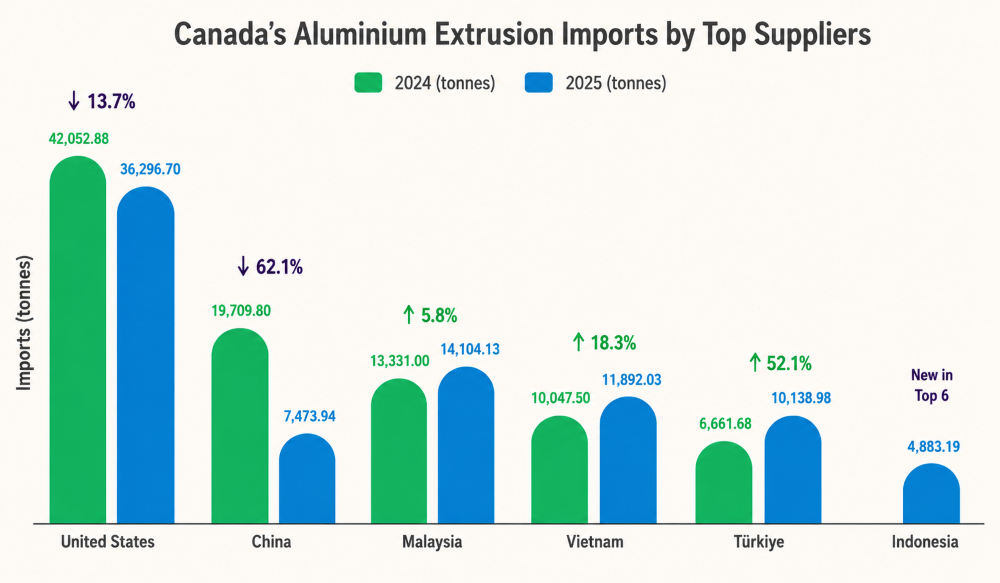
The US remained Canada's largest supplier in 2025, but shipments fell 13.7 per cent to 36,296.70 tonnes, from 42,052.88 tonnes in 2024.
China recorded an even sharper decline. Canadian imports from China plunged 62.1 per cent, from 19,709.80 tonnes in 2024 to 7,473.94 tonnes in 2025.
Meanwhile, other suppliers increased their presence. Malaysia's shipments rose 5.8 per cent to 14,104.13 tonnes, while Vietnam's increased 18.3 per cent to 11,892.03 tonnes. Türkiye recorded the strongest growth among suppliers present in both years, with imports jumping 52.1 per cent to 10,138.98 tonnes.
Qatar, which supplied 4,610.21 tonnes in 2024, was no longer among the top six suppliers in 2025 and was replaced by Indonesia, which supplied 4,883.19 tonnes.
If we year to date numbers, it also shows the same trend
US imports fell 31.4 per cent, from 27,888.27 tonnes in YTD June 2022 to 19,141.57 tonnes in 2025, before falling another 7.9 per cent to 17,625.20 tonnes in 2026. Overall, US shipments were 36.8 per cent below 2022 levels.
China's decline was even larger. Imports dropped 56.6 per cent, from 9,442.79 tonnes in 2022 to 4,097.35 tonnes in 2025, followed by another 18.2 per cent decline to 3,353.47 tonnes in 2026. Chinese shipments were therefore 64.5 per cent below 2022 levels.
Vietnam has followed a different path. Imports fell 23.2 per cent, from 7,637.91 tonnes in 2022 to 5,867.91 tonnes in 2025, but then jumped 48.2 per cent to 8,698.42 tonnes in 2026. Its shipments were consequently 13.9 per cent higher than in 2022.
Malaysia increased 28.2 per cent between 2022 and 2025, from 5,966.23 tonnes to 7,646.74 tonnes, before falling 30.1 per cent to 5,347.18 tonnes in 2026.
Türkiye has recorded the strongest overall growth. Imports rose 60.3 per cent, from 3,108.76 tonnes in 2022 to 4,984.58 tonnes in 2025, followed by another 13.9 per cent increase to 5,677.76 tonnes in 2026. Its YTD 2026 shipments were 82.6 per cent above 2022 levels.
Looking to source or sell aluminium extrusions? Discover relevant business opportunities on our B2B marketplace.
Trade measures reshape Canada’s extrusion supply chain
Canada's year on year falling extrusion imports are closely linked to the changing cost of bringing foreign products into the country. Canada introduced a 25 per cent surtax on specified Chinese-origin aluminium products on October 22, 2024, including HS 7604.10, 7604.21 and 7604.29, covering aluminium bars, rods and profiles. The surcharge is calculated on the customs value and paid by the Canadian importer.
Canada also applied anti-dumping and countervailing duties to foreign profiles under the Special Import Measures Act (SIMA). The Canada Border Services Agency (CBSA) and the Canadian International Trade Tribunal (CITT) maintain these measures, while stricter country-of-origin tracking and mandatory import permits through Global Affairs Canada are intended to prevent practices such as third-country transshipment.
These measures have changed the economics of importing aluminium extrusion products into Canada, particularly for suppliers competing mainly on price. As the cost and complexity of imports increase, Canadian buyers have more reason to consider alternative suppliers or source finished products locally.
There is also a wider North American supply-chain connection behind the shift. Canada exports primary aluminium to the US, where downstream producers have a large extrusion and fabrication base. Canadian aluminium and billet can therefore move south for processing into specialised profiles and components before some finished products return to Canadian customers.
That model becomes more expensive when tariffs and higher regional aluminium premiums push up costs. US extruders face higher raw-material costs, while Canadian buyers face higher prices for finished US extrusion products. This can make domestic production more competitive.
Canada already has a substantial primary aluminium base. The country produced 3.3 million tonnes of aluminium in 2024, with around 3 million tonnes exported, and 90 per cent went to the US, according to the Aluminum Association of Canada. Canadian smelters also benefit from low-carbon hydropower and higher aluminium prices.

But Canadian extrusion producers are not completely protected from trade pressures. Around 40 per cent of their production is exported to the US, leaving them exposed to the same tariff uncertainty affecting cross-border trade.
This continued reliance on imported aluminium extrusion products is why Canadian producers are calling for stronger protection measures. With imports still accounting for a substantial share of supply and the domestic market expected to grow, the industry is seeking measures that can help protect local producers from rising import pressure and give them greater scope to meet future demand.
Unlock key insights from leading companies and experts across the aluminium ecosystem with our e-Magazine - Mine to Market: ALuminium Producers & Manufacturers 2026
VALCO expands beyond primary aluminium with new rolling mill, a step to address Ghana’s import gap
Next articleP.A. Resources Q4 profit jumps 200% to $4.5m on higher extrusion sales
Grow with
AL Circle