
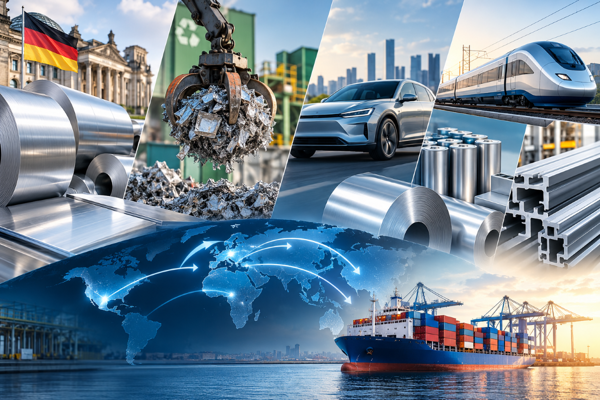
AL Circle analysis: Germany’s aluminium trade surplus, Novelis’ US expansion, Asia’s EV demand & India’s underutilised downstream capacity
Aluminium’s next growth phase is increasingly being shaped by downstream processing, supply-chain resilience and demand from specialised applications. Germany continues to generate a substantial trade surplus in flat-rolled products despite a shrinking primary aluminium base, while North America is investing in recycling and rolling. Across Asia, new manufacturing capabilities and growing demand from electric vehicles, railways and batteries are creating further opportunities. However, declining exports, underutilised capacity and uneven profitability show that investment alone does not guarantee success. For industry leaders, the challenge is to identify where demand is shifting, develop products that meet customer requirements and ensure that new investments translate into sustainable...
AL Circle Analysis: From Guinea to Gulf, how bauxite, tariffs and logistics redraw aluminium map
Aluminium markets in late 2026 are being shaped by more than the headline LME aluminium price. Bauxite security, alumina availability, geopolitical disruptions, tariff negotiations, logistics diversification and regional premiums are increasingly determining where metal moves and what buyers pay. From RUSAL reassessing Caribbean assets and Vedanta securing Odisha bauxite to Brazil extending mine life and EGA rebuilding its Guinea supply chain, producers are strengthening control over critical raw materials. At the same time, the US remains heavily dependent on imported bauxite and alumina, while Europe and Asia are experiencing sharply different premium dynamics. These developments point to a market where physical availability is becoming a regional factor even as aluminium itself remains...
Grow with
AL Circle

As the US and EU ring-fencing aluminium scrap through targeted measures, will Asia withstand the supply pressure?
Aluminium scrap has quietly become one of the most protected raw materials in the world specially in United States and the European Union — not through restrictions, but through deliberate exemptions. Washington has carved scrap out of Section 232 tariffs even as it tightened duties on primary aluminium, lifting the tariff rate to 50 per cent by June 2025. The split treatment is intentional. The US has a domestic primary metal shortage of nearly four million tonnes a year, and secondary smelters can expand only if scrap continues to flow in duty-free. Europe has taken a parallel — but more climate-driven — route. Aluminium scrap is excluded from the EU’s Carbon Border Adjustment Mechanism, which places carbon prices on primary and semi-finished imports but assigns zero emissions to...

Strong metal packaging market in North America and Europe reflects through Ardagh’s Q3 earnings
Ardagh Group, a global supplier of packaging solution, has turned in a solid set of numbers for the third quarter of 2025 ended September 30, riding on resilient demand for packaging across Europe and the Americas. Here metal packaging was star of the show overlooking glass that let Ardagh saw an uptick in Q3 performance. Metal packaging emerged as the star performer in Q3 For the three months ended September 30, the Group’s revenue resulted in USD 2,504 million in three months, up by 4.86 per cent from USD 2,388 million a year ago. While glass packaging in North America slipped 2.4 per cent, metal packaging held its ground with an increase of 8.4 per cent from USD 741 million to USD 803 million. Even in Europe, the revenue from metal packaging saw a staggering rise of 9.3 per cent from...

Global rare earth reserve, production and consumption scenario: A real-time check
In the 19th century, steel became the backbone of global industrial strategy. In the 20th century, it was oil. And, in the 21st century, it is the rare earth elements. 17 metallic elements from the periodic table, chemically similar and physically unremarkable to the eye, have become the scaffolding of electric vehicles, wind turbines, fighter jets, smartphones, navigation systems, medical devices, modern weapons and everything else that powers clean energy, digital connectivity and national defence. They are the ingredients behind the magnets that spin a wind turbine’s rotor, the catalysts that refine fuels, the phosphors that light an aircraft cockpit, and the polishing compounds that perfect wafer-thin lenses. Explore- Most accurate data to drive business decisions with 50+ reports...

India aims for 68% renewable and nuclear power capacity by 2032 - what should aluminium smelters do about energy mix?
India is exactly in the middle of energy transition, with its non-fossil fuel capacity exceeding 50 per cent of the national power mix. By 2032, the aim is to achieve 68 per cent of renewable and nuclear power capacity of the total energy mix. With this, the wake-up call for energy-intensive industries becomes explicit that the adoption of renewable energy is no longer optional. Particularly for the aluminium industry, which is one of the most electricity-hungry industrial sectors, the implications are sharp, but the path is far from straightforward. India’s reliance on coal and why so Not judging, but Indian aluminium industry is still heavily reliant on coal-fired electricity for its operations. Reasons are many, such as the need for round –the-clock power supply. An aluminium smelter...

Asia (Ex-China) and Africa reports 4.84MT aluminium and 10.68MT alumina output amid rising domestic demand
The aluminium sector across Africa and Asia (excluding China) has been gathering strength for three years now, and the momentum has carried cleanly into 2025. Over the first nine months of the year, the two regions produced 4.84 million tonnes of primary aluminium, supported by steady monthly output in the 504–544 thousand-tonne range and daily averages holding between 17.3 and 17.5 thousand tonnes. That consistency pushed cumulative production 1.55 per cent higher than in 2024 and 3.70 per cent above 2023, signalling a supply base that has become both more resilient and more predictable. According to International Aluminium Association, the quarterly numbers show the same quiet climb. The 2025, began with 1.59 million tonnes in Q1, edged up to 1.61 million tonnes in Q2, and reached 1.63...

United States clean energy spending reaches a new high on EV surge, solar boom, and rising aluminium usage
The United States closed the third quarter of 2025 with a record investment of USD 75 billion in renewable energy, suggesting a rapid momentum in the country’s energy transition efforts. Figures compiled by the Clean Investment Monitor (CIM) show a similar trend, with spending on clean energy rising 9 per cent from the previous quarter and 8 per cent compared with Q3 last year. The momentum extends across the year with USD 279 billion invested in clean vehicles (zero emission vehicles), carbon management, building electrification and clean power deployment, contributing to 6 per cent annual increase, reveals CIM. A snapshot of a rapidly expanding market Based on the nationwide records covering 22,000 manufacturing and energy facilities, five million zero-emission vehicle registrations, 28...

GACC: China's Oct aluminium scrap imports up 2 per cent M-o-M, 19 per cent Y-O-Y
Last month, Thailand held its position as the top aluminium scrap supplier to China, with shipments jumping 16.5 per cent on year to 26,708 tonnes, accounting for 16.9 per cent of China's total imports, but the volume slumped by 33.6 per cent from the previous month. It's worth noting that aluminium scrap imported from the UK increased substantially in October, leaping by 29.3 per cent on a month and 45.4 per cent on year to 21,844 tonnes, making it the second-largest supplier of the material to China, GACC data showed. Explore- Most accurate data to drive business decisions with 50+ reports across the value chain The large increase in last month's imports was driven mainly by a steady growth in demand for this scrap material among Chinese secondary aluminium manufacturers, Mysteel Global...

15 countries make it to the headline of Global EV sales 2025 with 90% contribution
World electric vehicle sales in October stood at 1,783,000 units, growing 10.5 per cent year-on-year. The cumulative sales of electric vehicles from January to October 2025 have been calculated to cross 16.5 million with a 23 per cent rise as compared to YTD 2024 (Jan-Oct). In this, China has remained the leading power with 10.3 million sales for the ten months (up 22 per cent), Europe saw 3.4 million sales with a 32 per cent hike, North America sold 1.6 million units, which was 4 per cent higher than the number for the same period last year. The rest of the world registered 1.3 million sales with over 48 per cent boost as compared to YTD 2024, shared RHO motion. Image source: https://www.strategyand.pwc.com/ Explore- Most accurate data to drive business decisions with 50+ reports across...

Beyond the ore: How Rio Tinto is rebuilding lives and reshaping communities across the globe
There is another side to Rio Tinto that exists far from its mine sites — a steady, growing effort to support the people and communities round the globe. This year, during the 16 days of activism against gender-based violence, the company renewed its involvement with organisations that help women, children and 2SLGBTQ+ survivors rebuild their lives. This year marks the sixth consecutive time it has stepped forward to support these groups. The company has put USD 400,000 into supporting 15 organisations across Canada that offer shelter, counselling, education and other essential services. With this latest round, its total contribution since 2020 now reaches USD 2.335 million. One of the long-standing partners, SOS violence conjugale, has used the support to modernise its tools and...

Modern technology’s role in metal packaging quality testing
The evolution of testing technology is presenting manufacturers with opportunities to build resilience, optimise production and protect brand integrity. But what do these technological advances mean in practice, and how can operations adapt intelligently? Here, Stefan Welker, strategic segment manager, rigid packaging at Industrial Physics, shares his insights. As metal packaging manufacturers navigate increasing complexity, from global supply chain disruptions to sustainability targets and skilled labour shortages, quality assurance has taken on renewed strategic importance. While compliance remains a baseline requirement, many in the industry are beginning to see quality testing differently: not as a gatekeeper, but as a gateway. As a result, many are shifting away from traditional...

WEEKLY: China's alumina stocks reach new high, output remains stable
China's alumina inventories mounted further during the November 14-20 week, with stocks as of November 20 refreshing a new all-time record high, as they have for the past four weeks, Mysteel data show. But despite the persistent supply surplus, production of the raw material remained largely stable last week, as most producers had to maintain normal operations to meet term contract obligations and secure opportunities to conclude new contracts. According to Mysteel's survey, total alumina stocks across the ten major Chinese ports, 44 alumina producers, 89 primary aluminium smelters, and rail yards or in transit monitored by Mysteel increased for the 25th consecutive week to 4.88 million tonnes as of November 20, up by a tiny 0.9 per cent from the previous week but still making for the...

Investment viability check: Surinamese bauxite’s rise, fall and the prospect of resurgence
Suriname is one of those countries that quietly sits on the world map, half-hidden under a canopy of forests, rivers and rain-soaked roads that rarely make it to global headlines. Yet at one point in the twentieth century, this small nation punched far above its weight in the aluminium value chain. Ask anyone old enough in Paramaribo and they’ll tell you how bauxite once shaped Suriname’s identity just as much as its rivers and rainforest. The irony is that today, those same forests and the difficulty of reaching its interior have become the very reasons investors hesitate. Image source - Drone Suriname by Max Breinburg Explore- Most accurate data to drive business decisions with 50+ reports across the value chain Even now, when you fly into Suriname, you can almost sense the potential...

Global aluminium extrusion market stabilises in 2025 as China rises, Europe slows, and growth builds across Asia, Americas and MEA
As 2025 draws to a close, the aluminium extrusion industry finds itself steadier than it started, as global usage is expected to settle at 35.25 million tonnes, just above 34.27 million tonnes in 2024, a modest 2.8 per cent increase that reflects stability in a market still navigating post-pandemic aftershocks. The pressures haven’t eased: geopolitical tensions continue to shift unpredictably, construction activity remains slower than before 2020, major economies struggle to regain momentum, and energy costs stay elevated. If 2024 proved anything, it’s that China’s grip on the aluminium extrusion market is as firm as ever. The country accounted for around 65 per cent of global usage that year - an extraordinary share by any measure. Europe follows next, then the Rest of Asia Pacific, and...

1914-2025: More than 100 years of America’s journey from primary smelting to modern circularity – and this is how tariff fits in
The United States shares a deep, long, and almost personal bond with aluminium as the metal has played a pivotal role in shaping up the nation’s manufacturing base while contributing about USD 228.31 billion to the economy. But at the same time, the industry in the US has weather many highs and lows. The country was once responsible for contributing more than 50 per cent to the world's primary aluminium supply and now it accounts for less than 1 per cent. But has this shift hurt the nation's backbone in the aluminium industry, has it carved out new pathways to sustain its legacy in the sector? Here’s a look at the century-long evolution of America’s aluminium landscape and what's reshaping it. The journey of aluminium industry in the United States back to World War I (1914-1918) when...

GACC: China's Jan-Oct bauxite imports jump 30 per cent Y-o-Y
Over the same ten-month period, China's alumina production reached 76.3 million tonnes, representing an 8 per cent on-year increase, data from the National Bureau of Statistics showed. Since the growth in bauxite imports outpaced that of alumina output, the figures signalled an oversupply of bauxite in the domestic sector, market watchers pointed out. In October alone, China imported 13.8 million tonnes of bauxite, a decline of 13.3 per cent from September but still 12.5 per cent higher compared with a year earlier, according to the GACC. Guinea and Australia remained China's two mainstream sources of imported bauxite, accounting for 65.4 per cent and 27.8 per cent of total arrivals last month, respectively. Explore- Most accurate data to drive business decisions with 50+ reports across...

Amcor broadens its horizon with aluminium, along with plastic, in a year of circular consolidation
Amcor’s FY25 sustainability disclosure arrives at a pivotal moment — not only as its first report after absorbing Berry Global, but also as a quiet but significant inflexion point for aluminium’s role within one of the world’s largest packaging companies. Although plastics still dominate Amcor’s 2.9-million-tonne material footprint, the FY25 report reveals a slow but unmistakable recalibration in how the packaging brand sources, certifies and circularises aluminium across its global operations. Image source: https://www.amcor.com/ Explore- Most accurate data to drive business decisions with 50+ reports across the value chain The newly combined entity ended the fiscal year with 15,000 tonnes of post-consumer recycled (PCR) aluminium, representing 8 per cent of all aluminium used, as...

South Korea’s EV sector splits into two realities, but aluminium consumption remains unshaken
South Korea’s electric vehicle sector is this year’s perfect example of one country with two different scenarios. While on one hand, the country is experiencing a strong domestic market for EVs, on the other, it undergoes an adverse impact of the United States 25 per cent tariff on EV imports. Yes, the United States is the largest export market for South Korea’s electric vehicles. In 2024, South Korea exported 2.78 million vehicles, most of the headed to the US, according to the Korea Automobile Manufacturers Association (KAMA). In 2025, the momentum faltered as the steep US duties dragged down export volumes lower. Meanwhile, the country’s EV production stood at 407,009 units, accounting for 11 per cent of total automobile production, with an increased sales figure Y-o-Y. The question...

Government races to save Tomago Aluminium from a 2028 shutdown — will negotiations with Snowy Hydro come to the rescue?
The Albanese government is pushing forward a multi-billion-dollar rescue plan to prevent the Tomago Aluminium smelter in New South Wales’ Hunter Valley from shutting down when its electricity contract expires in 2028. Taxpayer-owned Snowy Hydro is expected to take the lead in securing the long-term power supply that the smelter needs to keep operating. Image for representational purpose Under the proposal, Snowy Hydro would underwrite or directly sign long-term, renewable-heavy power offtake agreements, giving the smelter access to stable, lower-cost and cleaner electricity. The plan follows growing pressure from unions, environment groups and industry bodies urging governments to secure a structural, renewable-based solution for the Hunter Valley’s largest employer and one of Australia’s...

