Flat-rolled aluminium products (FRP), excluding aluminium foil, are no longer just another industrial material — they’ve become part of the machinery that keeps modern life running. They are everywhere: in electric cars, in the hardware behind renewable-energy systems, packaging, etc. As industries chase lighter, recyclable and more energy-efficient solutions, FRP has slipped into a central role almost by default. What’s striking is how quickly demand has climbed. With sustainability rules tightening and manufacturing in emerging economies expanding at full tilt, consumption has been rising at a pace rarely seen in metals. Global FRP demand is on track to jump from 20.33 million tonnes in 2020 to 40.30 million tonnes by 2030, and further rise by 6.82 per cent CAGR through 2032, which means the market will more than double in just 12 years.
Amid this global push, the Americas have taken on an outsized role. North and South America aren’t just adding volume; they’re reshaping the market’s direction, influencing the types of products being demanded and the pace at which new capacity is being built. The rest of the world is paying close attention, because the shifts underway in the Americas are increasingly setting the tone for the wider FRP landscape.
North America’s consumption vs demand
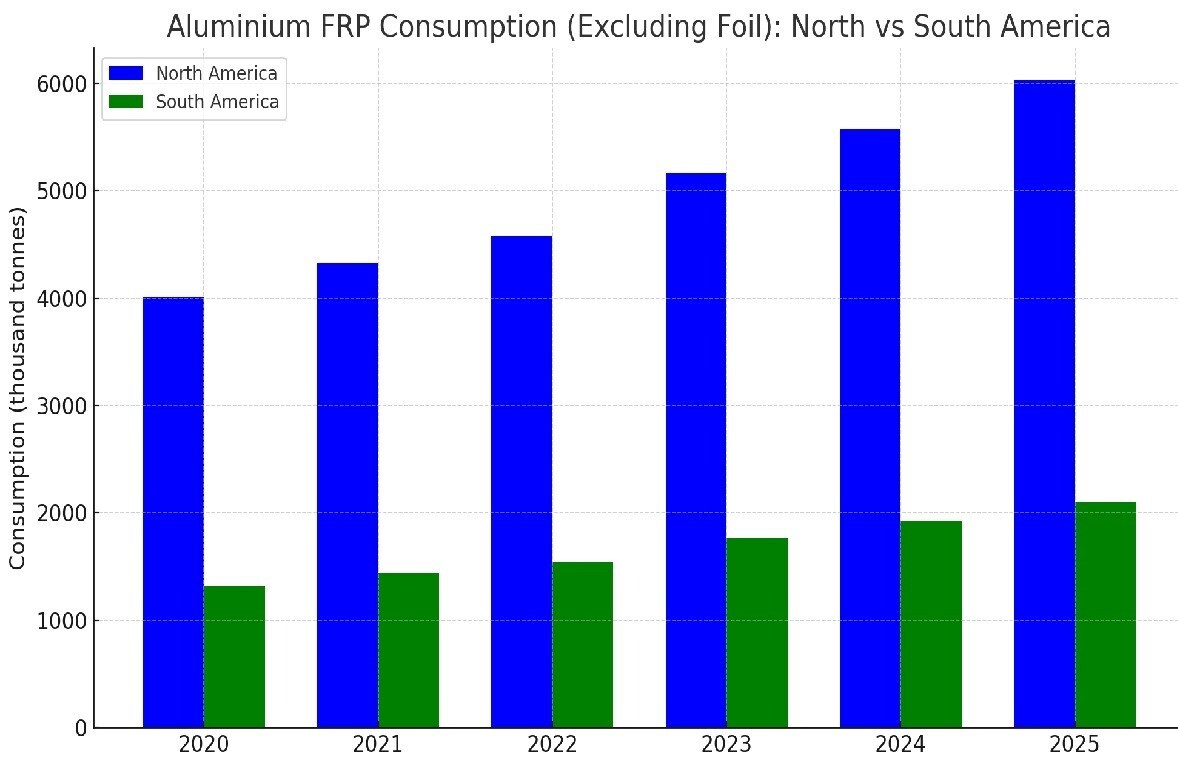
The appetite for flat-rolled aluminium, excluding aluminiumfoil, has been building across North America for a while now, but the last few years have given it a real shove. Back in 2020, the region used 4,011.24 thousand tonnes. A year later that crept up to 4,324.54 thousand tonnes — roughly a 7.81 per cent bump. In 2022, it moved again to 4,579.33 thousand tonnes, another 5.89 per cent rise. The bigger shift came in 2023, when the number suddenly jumped to 5,166.78 thousand tonnes, up 12.83 per cent.
By 2024, consumption had climbed to 5,574.67 thousand tonnes, a further 7.89 per cent increase. And if the forecasts hold, 2025 nudges North America past the 6-million-tonne line, hitting 6,028.96 thousand tonnes — another 8.15 per cent rise. Longer projections keep the region growing at a solid 7.13 per cent CAGR through 2030, slowing slightly to 5.79 per cent from 2030 to 2032. To access the data, download: Aluminium Flat Rolled Products: Insights & Forecast to 2032.
Demand is headed the same way. Total FRP demand moves from 4.01 million tonnes in 2020 to 8 million tonnes in 2030, then up to 8.95 million tonnes in 2032. A lot of this is coming from EV growth, renewable-energy rollout, reshoring of manufacturing, and a very direct push from the Inflation Reduction Act.
South America’s consumption vs demand
South America’s pattern looks calmer, but the trajectory is unmistakably upward. The region consumed 1,318.32 thousand tonnes in 2020. A year later, consumption climbed to 1,441.64 thousand tonnes, a 9.35 per cent rise. In 2022 it increased to 1,540.08 thousand tonnes (up 6.83 per cent), and then came a sharper step: 1,768.80 thousand tonnes in 2023 — a 14.85 per cent surge. By 2024, consumption grew again to 1,928.18 thousand tonnes (up 9.01 per cent), and 2025 is expected to push the figure to 2,098.10 thousand tonnes, an additional 8.81 per cent rise. Longer-term forecasts place the region at an 8.16 per cent CAGR through 2030 and 4.86 per cent from 2030 to 2032, according to AL Circle.
Demand follows almost the same script: 1.6 million tonnes in 2020, then rising toward 3.19 million tonnes in 2030 and 3.48 million tonnes in 2032. Brazil is easily the biggest reason why, with packaging, transport and solar-related demand outpacing the rest of the continent. Chile and Argentina fill in the gaps through construction and appliances.
Where all this FRP actually ends up?
If you map the consumption inside North America, it is surprisingly concentrated. Michigan alone uses anywhere between 500,000 and 700,000 tonnes annually because Ford, GM and Stellantis rely on aluminium sheet for the 14.9 million light vehicles they build every year. Switching to aluminium trims 10–20 per cent off vehicle weight, so the volumes add up fast.
Ohio and Texas each pull in 300,000–500,000 tonnes, thanks to assembly plants and supplier networks tied to Honda, Toyota, Tesla and other automakers. Then there’s California, which quietly absorbs about 200,000 tonnes a year through aerospace, EV-battery work and high-value manufacturing.
Packaging is another huge sink. The US goes through roughly 1 million tonnes of can sheet annually in a USD 28.1 billion beverage-can market growing at 2.88 per cent CAGR to 2030. Even with national recycling stuck at 43 per cent in 2023, cans still average 71 per cent recycled content. Texas leads consumption because of its filling capacity; California and Florida follow. Michigan and Ohio punch above their weight in recycling—Michigan alone recovers 63.6 per cent of its cans.
Novelis’ Bay Minette facility — 600,000 tonnes of new rolling capacity coming online in late 2025 — should ease some of the pressure and trim freight to the West Coast by up to USD 80 per tonne.
In South America, Brazil remains the gravitational centre for consumption, thanks to its huge packaging and transport sectors and rapidly expanding solar market. Chile and Argentina contribute more modest but steady volumes, led by construction and consumer durables.
Plates and Sheets: Two product lines, same upward push
North America’s appetite for aluminium plate has been rising steadily year after year. Consumption grew 7.61 per cent from 719.862 thousand tonnes in 2020 to 774.612 thousand tonnes in 2021, followed by a 5.53 per cent increase in 2022 as volumes reached 817.420 thousand tonnes. The pace accelerated in 2023 with a 12.61 per cent jump to 920.485 thousand tonnes, before climbing another 7.74 per cent in 2024 to 991.717 thousand tonnes. For 2025, plate consumption is projected to touch 1,070.305 thousand tonnes, marking a further 7.92 per cent rise.
South America mirrors this upward trajectory but with sharper swings. Consumption rose 11.12 per cent from 119.349 thousand tonnes in 2020 to 132.624 thousand tonnes in 2021, followed by an 8.01 per cent rise in 2022 as volumes reached 143.262 thousand tonnes. A more pronounced surge came in 2023, when demand jumped 17.77 per cent to 168.718 thousand tonnes. Growth continued into 2024 with a 10.41 per cent increase to 186.286 thousand tonnes, and 2025 is expected to add another 10.09 per cent, taking consumption to 205.080 thousand tonnes.
Longer-term, North America is expected to grow at 5.53 per cent CAGR through 2030 (and 5.54 per cent to 2032), while South America expands at 7.21 per cent to 2030 (and 4.96 per cent through 2032).
A similar pattern shows up in sheet consumption. North America moved from 1,076.31 thousand tonnes in 2020 to 1,745.82 thousand tonnes in 2024 — an 62.17 per cent jump— and should reach 1,928.08 thousand tonnes in 2025 (a 10.43 per cent rise). Growth projections sit at 7 per cent CAGR through 2030 and 4.76 per cent for 2032.
South America’s sheet market is even more dynamic: 541.68 thousand tonnes in 2020, rising to 988.40 thousand tonnes in 2024 — an 82.45 per cent increase. For 2025, consumption is expected at 1,107.54 thousand tonnes, up 12.04 per cent. The region is forecast to grow at 7.66 per cent through 2030 and 4.81 per cent from 2030–2032.
Here’s where the story tightens: The Americas are consuming far more flat-rolled aluminium than they produce. To know about the production gap, read the part 2, coming up next.















_md.webp)








