Part 1 showed how North and South America have become major drivers of global FRP consumption growth. But behind that surge lies a challenge the region can’t ignore — the Americas simply don’t produce enough flat-rolled aluminium to match this accelerating demand.
North America manufactures only around 2.3–2.35 million tonnes a year. Novelis supplies the biggest share — 1.2 million tonnes in 2023, 1.25 million tonnes in 2024 and around 1.3 million tonnes expected in 2025. Alcoa adds 450–500 thousand tonnes from its Tennessee and Iowa mills; Constellium brings about 350 thousand tonnes from Georgia and Kentucky; Norsk Hydro contributes roughly 200 thousand tonnes.
South America adds another 450–500 thousand tonnes, almost entirely from Novelis’ rolling operations in Brazil. The region produced 460 thousand tonnes in 2023, 470 thousand tonnes in 2024 and is expected to hit 480–500 thousand tonnes in 2025, helped by a USD 150 million expansion that bumps Brazil’s rolling capacity above 600,000 tonnes.
Together, both continents face a supply deficit of around 4.76 million tonnes each year — 3.26 million tonnes missing in North America and around 1.5 million tonnes in South America. Imports cover only a small share: Canada sends 65.91 thousand tonnes of flat-rolled material, the UAE sends 2.616 thousand tonnes and Mexico adds 685.192 tonnes.
So the reality is blunt: The United States simply doesn’t produce or import enough flat-rolled aluminium to satisfy its own consumption.
Tariffs reshape trade flows and market behaviour
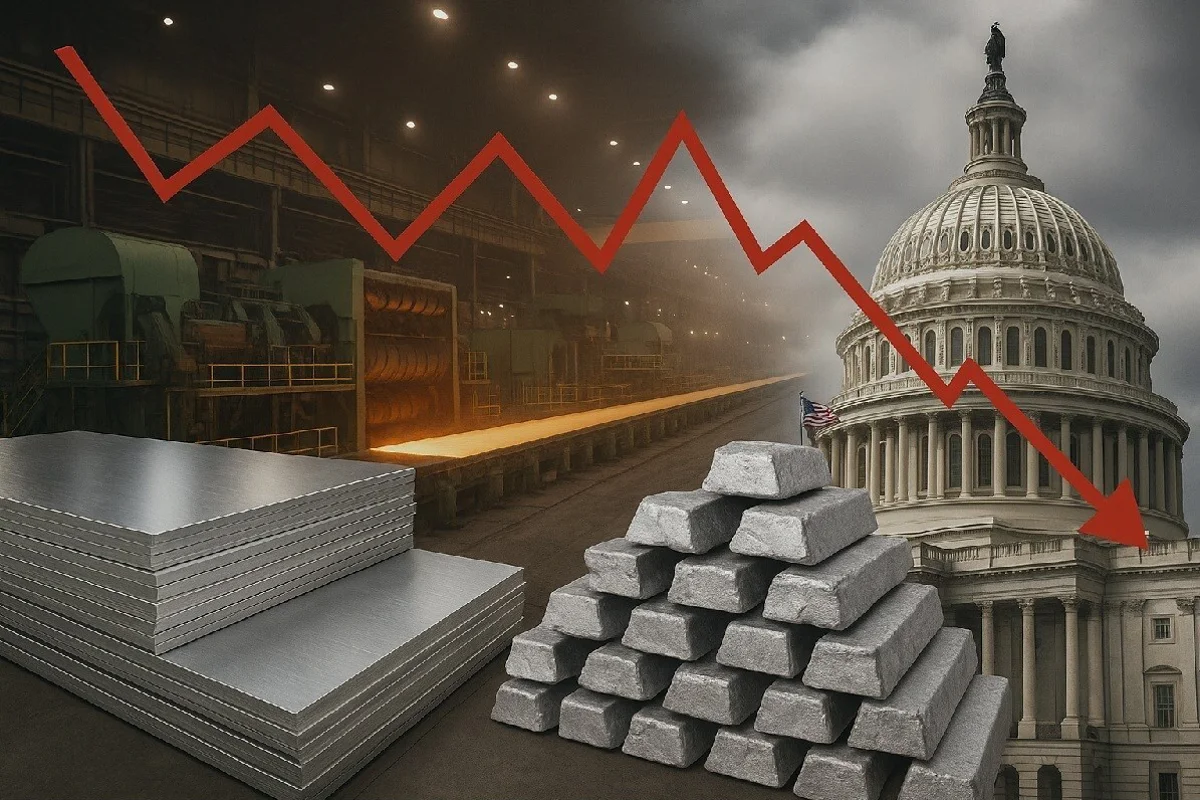
This imbalance has collided head-on with trade policy. In March 2025, the US raised tariffs on imported aluminium flat-rolled products from 10 per cent to 25 per cent, then doubled them again to 50 per cent on June 4 for most countries (with the UK capped at 25 per cent). The higher duties added USD 50 billion in annual costs and pushed US aluminium prices 139 per cent above European levels by May, severely limiting imports from China and Europe.
The tariff shock produced immediate volatility. Consumption dipped 4.4 per cent in early 2025 as costs rose. Importers rushed to stock up before the June tariff hike, after which shipments from non-USMCA countries dropped sharply. Still, total imports rose 15.8 per cent in the first half due to exemptions and rerouting.
Scrap dependence and the push for new capacity
To keep mills running, the US leaned more heavily on scrap. With no tariff burden and requiring just 5 per cent of the energy needed for primary aluminium, scrap now makes up around 70 per cent of mill inputs, and stockpiles rose 14.7 per cent. Canada and Mexico supply 60–70 per cent of remaining imports, with Canada alone sending 1.2 million tonnes of unwrought aluminium in the first half of 2025 for rolling.
New manufacturing capacity is finally rising. Steel Dynamics’ 650,000-tonne rolling mill and Novelis’ 600,000-tonne Bay Minette facility will add more than 1 million tonnes of US rolling capacity in 2025, backed by USD 10 billion in investments.
On the primary metal front, the US is reviving long-stalled ambitions. Century Aluminum is planning the first new smelter in 45 years; EGA is investing USD 4 billion in a 600,000-tonne smelter in Oklahoma; and Alcoa is modernising Massena with stable long-term power pricing. But the challenge remains steep: smelters only remain viable with 20-year electricity contracts below USD 30–40 per MWh—hard to secure as AI data centres push power prices higher.
Washington is now exploring “smart tariffs” to protect domestic value chains while preserving essential Canadian and Mexican supply. By 2030, the US aims for 80 per cent self-sufficiency through new capacity, expanded scrap use and stable USMCA flows.
Ultimately, the challenge for the US is not just to shield its market, but to rebuild enough capacity to keep pace with the demand it helped create.














_md.webp)








