AL Circle Analysis: 243% US scrap rise, 6Mt European recycling & Germany’s power fix drive aluminium trade
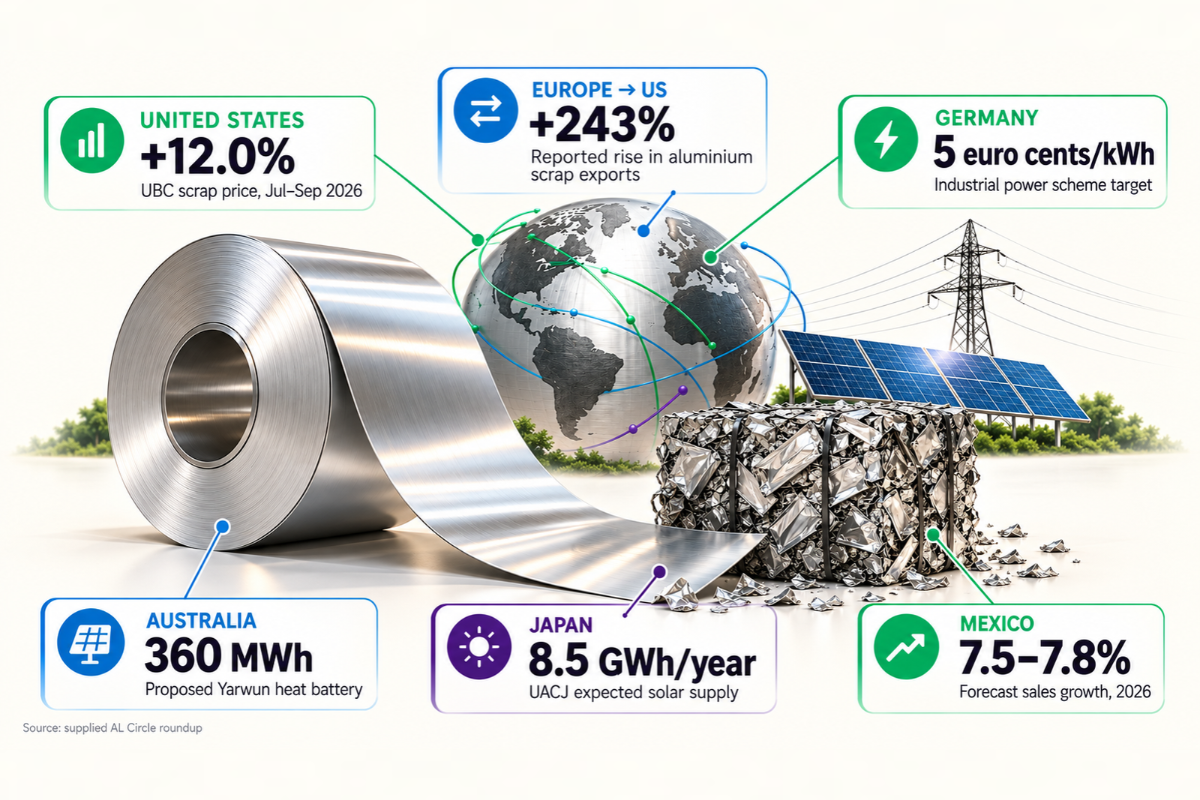
The image used in this article is generated with an AI tool and does not depict any real-time moment
Aluminium’s trade map is no longer drawn by smelters alone. Scrap flows, power contracts, industrial policy and specialist grades now shape who secures metal, at what cost and under whose rules. Ten recent developments across Europe, the US, Australia, Japan and Mexico show how recycling, energy and regulation are becoming the new levers of aluminium competitiveness. They also show where traders, exporters and policymakers may need to adjust.
Scrap tug-of-war: the US pull, Europe’s leak and the recycling base at stake
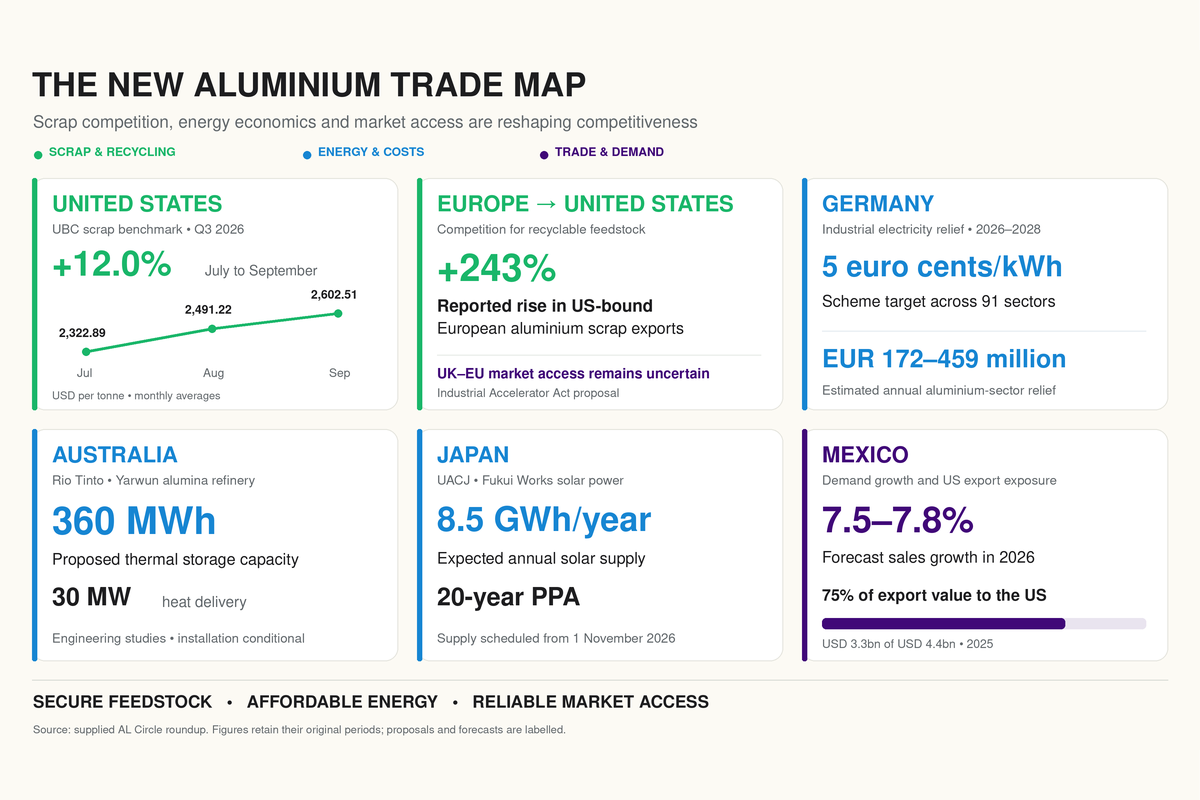
The pull starts with price. The US UBC scrap benchmark averaged USD 2,322.89 a tonne in July, USD 2,491.22 in August and USD 2,602.51 in September. That is a 12 per cent climb, and it came after a July that opened at USD 2,464.98 and fell to USD 2,270.76 within two days.
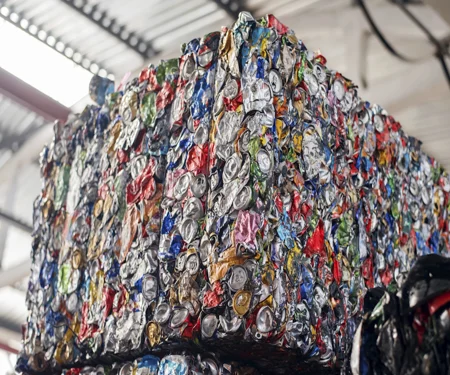
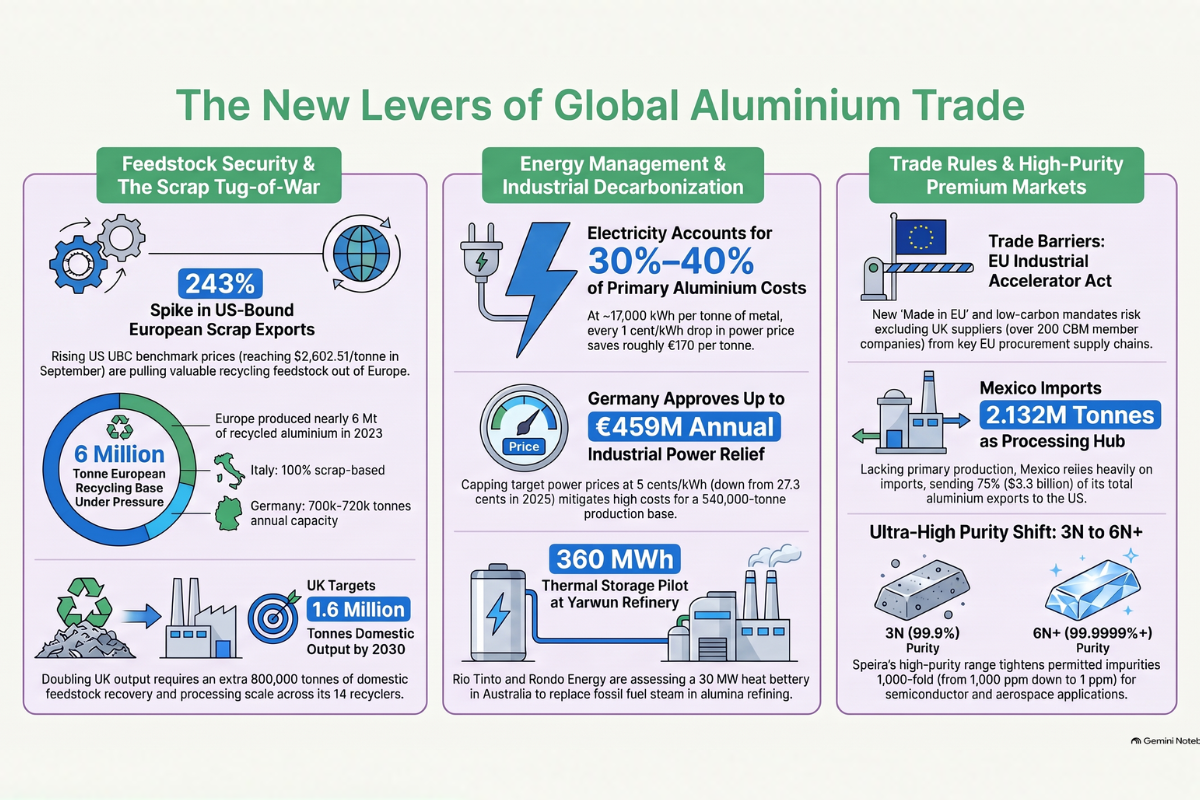
Europe feels that pull most. Aluminium scrap exports to the US have risen 243 per cent, and METLEN’s Evangelos Mytilineos asked whether the continent can build its industrial base while valuable raw material walks out. The stake is large. Europe produced nearly 6 million tonnes of recycled aluminium in 2023. Germany’s annual capacity is 700,000–720,000 tonnes, and Italy’s aluminium output is entirely scrap-based. The UK exported 450,000 tonnes of scrap in 2019 against 800,000 tonnes of recycled production, and it is forecast to reach 1.6 million tonnes domestically by 2030.
The supply contest is also surfacing at shop counters. Nespresso’s New Zealand expansion added 25 JB Hi-Fi stores, taking its network to 138 retail locations. The model is simple: make returns easy, then split the aluminium from the grounds so both find a second use. An estimated 75 per cent of all aluminium ever produced is still in use, which is the argument for getting capsules back.
Join the fourth edition of the webinar "Hedging for recyclers - Become an expert in 6 hours" by Jorge Dyszel.
Key takeaways
- The 243 per cent increase in US-bound European aluminium scrap exports highlights the growing supply-security competition for recyclable feedstock.
- Recycled aluminium made up 58 per cent of Germany’s 2019 aluminium production. Collection infrastructure is the edge.
- The UK’s 14 mostly small recyclers will need scale to double output to 1.6 million tonnes by 2030.
- The UK’s projected increase to 1.6 million tonnes represents an additional 800,000 tonnes. That expansion requires corresponding feedstock and metal recovery, not just processing capacity.
Energy is the new raw material: Germany’s relief, Rio’s heat battery, UACJ’s solar
If aluminium scrap decides who has feedstock, power decides who can afford to process it.
Electricity can account for 30–40 per cent of primary aluminium cost. A 2025 comparison placed Germany’s industrial price at 27.3 cents/kWh against Norway’s 10.2 cents, and the H1 2026 figure was 15.72 cents. 15.72 cents. The European Commission’s approval of the 2026–2028 scheme, which targets 5 cents/kWh across 91 sectors, aims at that weak spot. AL Circle’s estimates put potential annual relief for a 540,000-tonne base between EUR 172 million and EUR 459 million, against an implied gross power bill of about EUR 1.44 billion.
Companies are not waiting for ministries. Rio Tinto is assessing a 360-MWh thermal storage system with Rondo Energy at its Yarwun alumina refinery in Queensland, delivering heat at 30 MW to cut fossil-fuel steam. ARENA has committed AUD 3.6 million for engineering studies, with a further AUD 38 million possible for installation. It would be a first for the alumina industry.
In Japan, UACJ’s 20-year solar PPA will deliver about 8.5 GWh a year to its Fukui Works from November 1, 2026. The panel mounts are made from UACJ’s own recycled aluminium. Subsidy lowers the bill, while storage and long-term contracts change how it behaves.
Looking for UBC aluminium scrap? Browse through global suppliers on AL Biz.
Key takeaways
- At roughly 17,000 kWh per tonne, every 1 cent/kWh is worth about EUR 170 a tonne. Energy contracts deserve board-level attention.
- ARENA’s contingent AUD 38 million is more than 10 times its AUD 3.6 million study grant. Storage and long-term solar contracts reshape the power bill, not just its size.
- Germany’s approved industrial electricity relief, with annual savings of EUR 459 million for aluminium producers, could improve domestic production economics.
- Rio Tinto’s proposed 360 MWh heat battery at Yarwun highlights the growing role of thermal storage in reducing reliance on conventional energy sources.
Trade rules and premium demand: UK-EU, Mexico and the purity play
Rules decide who gets to sell into these markets. The CBM’s Stephen Morley warns that the EU’s Industrial Accelerator Act, published on March 4, 2026, could treat British suppliers as outsiders. The proposal includes ‘Made in EU’ and low-carbon requirements for selected public procurement and support schemes, covering aluminium, steel and automotive. CBM, with 200-plus members employing 75,000 people, wants clarity on rules of origin, carbon-border measures and how UK-origin materials will be treated. Reports of a France-Germany compromise on UK participation remain conditional.
Demand remains steady at finding new homes. Mexico’s Canalum expects 7.5–7.8 per cent sales growth in 2026, led by AI data centres, electromobility, automotive and aerospace. Yet the country makes no primary aluminium and was projected to import 2.132 million tonnes in 2025. Exports to the US were worth USD 3.3 billion in 2025, against USD 1.1 billion to Europe and Latin America.
At the premium end, Speira’s CORIS range runs from 99.9 per cent (3N) to 99.9999 per cent or higher (6N+) for semiconductors, electronics, aerospace and medical technology. In that niche, purity sets the terms, not the price per tonne.
Showcase your brand, aluminium recycling initiatives and sustainability vision in our upcoming magazine: Sustainability & Recycling: Aluminium’s Commitment 2026.
Key takeaways
- About 75 per cent of Mexico’s USD 4.4 billion in 2025 aluminium exports went to the US, which is a concentration risk.
- Moving from 3N to 6N+ tightens permitted impurities about 1,000-fold, from about 1,000 ppm to 1 ppm. Specifying the grade, not just “high purity” is essential.
- Mexico’s 2.132 million tonnes of imports point to a processing hub that must secure metal from outside.
- The Industrial Accelerator Act remains in the EU legislative process, with no UK provisions agreed. Early engagement is more beneficial than seeking exemptions later.
As market continues to monitor the aluminium industry movements, competitiveness will depend not only on how much aluminium a region can produce, but also on whether it can secure the right feedstock, affordable energy, stable trade access and the capabilities in order to serve the higher-value markets.

Grow with
AL Circle