
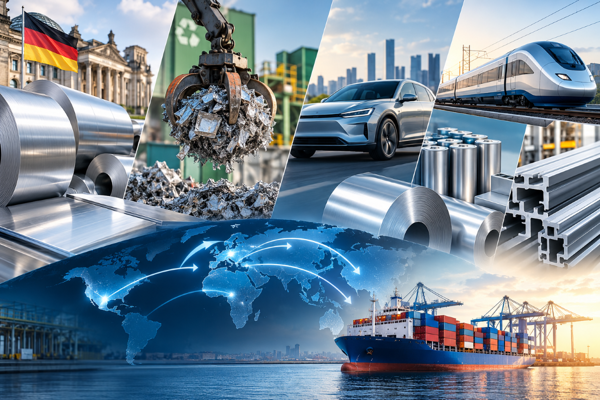
AL Circle analysis: Germany’s aluminium trade surplus, Novelis’ US expansion, Asia’s EV demand & India’s underutilised downstream capacity
Aluminium’s next growth phase is increasingly being shaped by downstream processing, supply-chain resilience and demand from specialised applications. Germany continues to generate a substantial trade surplus in flat-rolled products despite a shrinking primary aluminium base, while North America is investing in recycling and rolling. Across Asia, new manufacturing capabilities and growing demand from electric vehicles, railways and batteries are creating further opportunities. However, declining exports, underutilised capacity and uneven profitability show that investment alone does not guarantee success. For industry leaders, the challenge is to identify where demand is shifting, develop products that meet customer requirements and ensure that new investments translate into sustainable...
AL Circle Analysis: From Guinea to Gulf, how bauxite, tariffs and logistics redraw aluminium map
Aluminium markets in late 2026 are being shaped by more than the headline LME aluminium price. Bauxite security, alumina availability, geopolitical disruptions, tariff negotiations, logistics diversification and regional premiums are increasingly determining where metal moves and what buyers pay. From RUSAL reassessing Caribbean assets and Vedanta securing Odisha bauxite to Brazil extending mine life and EGA rebuilding its Guinea supply chain, producers are strengthening control over critical raw materials. At the same time, the US remains heavily dependent on imported bauxite and alumina, while Europe and Asia are experiencing sharply different premium dynamics. These developments point to a market where physical availability is becoming a regional factor even as aluminium itself remains...
Grow with
AL Circle

AL Circle x Elliot Mari: The journey of aluminium towards decarbonisation, 25% of low-carbon target achieved and way to go
In conversation with Elliot Mari, a Technical Lead for material industries at the Industrial Transition Accelerator (ITA), wherein he has shed his insights into the aluminium industry's decarbonisation journey. He has several years of experience working on industry decarbonisation roadmaps with a focus on the cement, steel and aluminium sectors in France. Elliot also worked as a reservoir engineer at Oil & Gas major TotalEnergies in Angola. He holds a Master of Engineering Science from the Ecole Centrale de Nantes in France and a Master of Sustainable Energy from the University of Queensland, Brisbane. AL Circle: What notable progress has the global aluminium industry made in its decarbonisation journey so far? How does the Industrial Transition Accelerator (ITA) contribute to the...

Imports surge, premiums fall: Brazil’s aluminium industry faces new rivals
Brazil’s aluminium industry is under pressure from overseas suppliers after recent tariff changes. India’s largest producer Vedanta has been sending more metal into Brazil, increasing shipments to local buyers. Traders also reported that Russia’s top producer, Rusal has also entered the market with small trial sales. Traders also noted that Rusal, Russia’s top producer, has entered the market with small trial sales. A trader said, “I have been hearing a lot of rumours about Rusal’s approach. I heard that it had already made some sales and the cargo was about to arrive, and they would do a test [of the material].” Alumar, one of Brazil’s largest smelters, confirmed the shift, “The Brazilian market has attracted the attention of various producers, which increases competition,” a...

German power cost up even with 75% solar capture! Europe’s aluminium runs with 78% renewable
Europe’s renewable boom has a two-faced economy. On long, bright, windless days, it floods grids with cheap or even negative-priced power; when the weather turns, capture prices, as in the money actually earned by wind and solar assets after weighting by when they produce, recover sharply. That swing is not academic for aluminium. The metal’s primary production is among the industry’s hungriest electricity consumers, and swings in capture and wholesale power prices cut straight to smelters’ margins, investment plans and decarbonisation pathways. S&P Global’s Platts Renewable Energy Price Explorer shows exactly this dynamic playing out through mid-2025. Solar and wind output across Europe’s five largest markets rose about 10 per cent year-on-year in July, but output eased from June’s...

Guinea edges toward 199M tonnes of bauxite exports amid refining gap
Guinea is tightening its grip on the global bauxite trade, shipping record volumes even as its own alumina refining sector lags far behind. According to sources, Guinea mined about 123 million tonnes of bauxite in 2023, up from 103 million tonnes the year before. Exports grew even faster, jumping to 127 million tonnes—a year-on-year rise of nearly 25 per cent. The momentum carried into 2024. Output rose to roughly 141 million tonnes, while exports reached 145 million tonnes, cementing the West African nation’s place as the world’s largest exporter. The surge has continued this year. In just the first half of 2025, Guinea shipped 99.8 million tonnes, almost as much as its entire 2022 total. For a broader view of the global bauxite market click: A Comprehensive Analysis of Bauxite Residue -...

Germany leads global aluminium foil exports in 2025 while China falls out of top 5
As per UN Comtrade data, Aluminium foil (whether or not printed or backed with paper, paperboard. plastics or similar backing materials) of a thickness (excluding any backing) not exceeding 0.2mm saw a notable reshuffle between 2024 and 2025. From January to May 2025, Germany led the market with a trade value of USD 770 million and an export of 117.14 thousand tonnes, followed by Italy at USD 362 million and 61.69 thousand tonnes, the USA at USD 308 million and 56.09 thousand tonnes, Turkiye at USD 265 million and 61.29 thousand tonnes, and Japan at USD 245 million and 27.64 thousand tonnes. In contrast, during January to May 2024, China dominated the market with USD 1,476 million and an export of 479.44 thousand tonnes, while Germany stood second at USD 621 million and 117.17 thousand...

Between revolving funds & Russian oil: India’s energy security remains hostage to geopolitical churn
India’s energy transition is not a linear march from coal to renewables. It is a high-wire act where efficiency, geopolitics, and industrial decarbonisation collide. From the creation of a revolving fund for energy efficiency to the scramble for discounted Russian oil, and from solar and hydrogen pushes to aluminium’s green makeover, the country’s choices are shaping both domestic industry and global trade flows. Image source: JMK Research Revolving capital, not one-off grants At the heart of India’s efficiency strategy is the Energy Efficiency Revolving Fund (EERF), seeded with USD 13 million from the Global Environment Facility (GEF). Managed by Energy Efficiency Services Limited (EESL) with support from the Asian Development Bank (ADB), the fund deploys capital into efficient motors,...

India-UK FTA sparks aluminium growth but CBAM threatens to reverse it
India’s free trade agreement with the UK is expected to be a big win for aluminium exporters, as it will remove the import duties. But there is also a catch. From January 2027, the UK will bring in its Carbon Border Adjustment Mechanism (CBAM) — a tax linked to carbon emissions. Industry executives warn this could claw back much of the benefit, leaving Indian producers struggling to keep prices competitive in the British market. Role of FTA The FTA eliminates import duties on aluminium products, which previously ranged from 2 per cent to 10 per cent in the UK market. Industry players expect this change will improve India’s competitiveness. Vedanta Aluminium Chief Executive Officer Rajiv Kumar said, “With the FTA now in place, the aluminium industry aims to treble its export to the UK by...

AL Circle x Alfiniti: Aluminium tubing innovation through precision, sustainability, automation & strong customer collaboration in evolving industrial markets
Steve James (also published as Richard S. James) is Managing Director of Alfiniti, Inc., steering the company’s aluminium-tubing operations to strong operational and financial results. A veteran of aluminium extrusions, heat-treated sheet and plate, and casthouse processes, he has driven growth and turnarounds across automotive, HVAC, aerospace, and distribution markets worldwide. Known for clear manufacturing plans and accountable teams, Steve focuses on delivering sustained value for customers and stakeholders alike. AL Circle: Alfiniti has carved out a unique niche in aluminium extruded tubing. How do your proprietary expertise and vertical integration give you a technological or competitive edge in today’s evolving industrial landscape? Steve James: We spend a lot of time upfront with...

Is Tesla’s robotaxi dream slipping away—or just getting started?
Tesla’s vision for an autonomous, robotaxi-powered future is as controversial as it is ambitious. For some, it signals the next big leap in mobility; for others, it’s a risky bet dragging down Tesla’s numbers and its stock. The ripple effect even touches suppliers like aluminium manufacturers. The robotaxi idea isn’t new. It first appeared in Tesla’s “Master Plan Part Deux” back in 2016. By 2019, Elon Musk was boldly predicting a million robotaxis on the road by 2020, but that target went unmet Between 2020 and 2024, Tesla rolled out its Full Self-Driving (FSD) beta. It got attention, but true autonomy remained elusive. Then came a big splash in October 2024: the Cybercab, a vehicle with no steering wheel or pedals, pitched as Tesla’s purpose-built robotaxi. The production is expected...
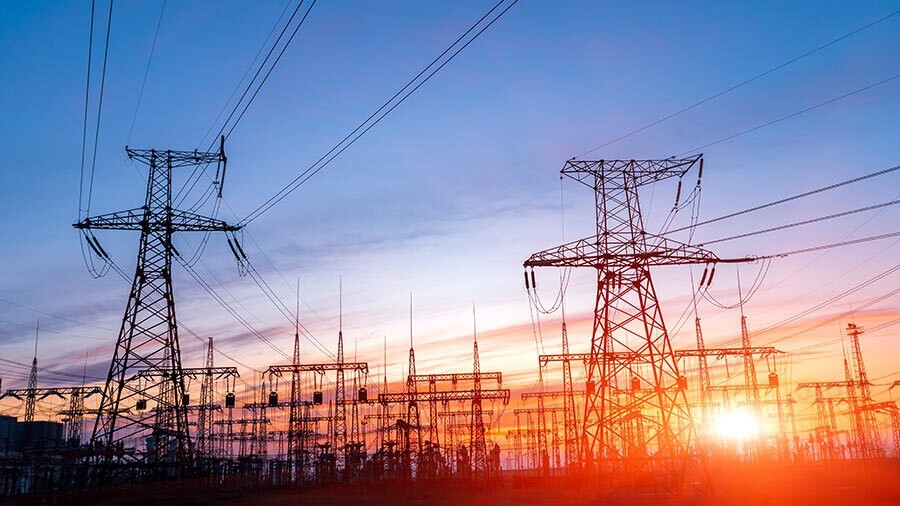
NEA: China's power consumption in July hits record high
China's electricity consumption surged to an all-time high of 1.02 trillion kilowatt hours (kWh) in July, up 8.6 per cent compared to the same month last year, according to data from the National Energy Administration (NEA). The record – mainly driven by scorching heatwaves across China and the country's resilient economic activity was also the first time any country's monthly power consumption surpassed the 1-trillion-kWh threshold, market analysts noted. Notably, China's household power consumption jumped 18 per cent on year to 203.9 billion kWh in July as summer heatwaves blanketed much of the country, which nearly doubled from 129.1 kWh a month earlier, the NEA data showed. Household power use in major provinces such as Central China's Henan province, Northwest China's Shaanxi...

US primary aluminium imports rise during Jan-May 2025 despite Canada’s slump; UAE and India step in to fill the gap
According to the latest data from the US Geological Survey, the United States’ aluminium crude metal and alloys imports increased over the year during January-May 2025, even as shipments from Canada - the country’s top supplier - declined. The data highlights two key trends: (1) Canada retained its position as the leading exporter despite a drop in volumes, and (2) the United Arab Emirates (UAE) stepped in to offset the shortfall, driving overall import growth. Canada holds lead but volumes erode From January to May 2025, Canada exported 1.02 million tonnes of aluminium crude metal and alloys, compared to 1.17 million tonnes during the corresponding period of the previous year, reflecting a Y-o-Y decrease of 12.8 per cent. To be noted, Canada’s primary aluminium exports to the US remained...

US aluminium faces shutdowns and tariff pressures as Canada expands exports
US aluminium exports keep shrinking. In the first half of 2025, volumes plunged to 562.17 thousand tonnes down from over 804.67 thousand tonnes a year earlier, same period. It continues the downward trend from 679.20 thousand tonnes in H1 2023 and 593.52 thousand tonnes in H1 2022, as reported in the Mineral Commodity Summaries 2025 by the US Geological Survey. In H1 2024, the main destinations for US aluminum exports were Malaysia, Mexico, Canada, India , and Thailand. By H1 2025, the top markets shifted to Japan—leading with 66,000 tonnes of unwrought aluminum alloy—followed by India, South Korea, Mexico, and Vietnam. This sharp fall underscores a worsening crisis in the US aluminium industry, driven by a combination of factors such as smelter and refinery shutdowns, rising energy...

LME aluminium inventory's truth: Numbers up, but metal missing!
The aluminium markets have just seen another twist in what’s become a long-running stocks carousel. But this time, the spin may be nearing its end. As reported by Reuters on August 20, over the past six weeks, a hefty 156 thousand tonnes of aluminium found its way into London Metal Exchange (LME) warehouses. Yet, this wasn’t fresh metal entering the system. It was almost exclusively a reclassification of existing off-warrant supplies already stashed away in Port Klang, Malaysia. Image for representational purposes only So, when you read ‘reclassification of existing off-warrant supplies’, it means the metal was already physically sitting in the warehouse (say, Port Klang in Malaysia). But it was being kept off the books in private storage deals. Now, some of that same aluminium has been...

Rare earths market turns volatile as US intervenes and China tightens control
The global rare earth metals market is undergoing a major market shift, as US price interventions, Chinese export restrictions, and surging demand disrupt supply chains and compel countries to rethink their strategies. In mid-July, the US took a bold step to challenge China’s dominance in rare earths. The Department of Defence signed a multi-billion-dollar deal with MP Materials, guaranteeing a minimum price of USD 110 per kilogram for neodymium-praseodymium (NdPr) oxide. This figure is almost double the prevailing China-based market price of around USD 60 per kilogram. The move is designed to boost domestic production of key materials for EV motors, wind turbines, and defence systems. Analysts are calling it a game-changer, predicting that this new price floor will become a global...
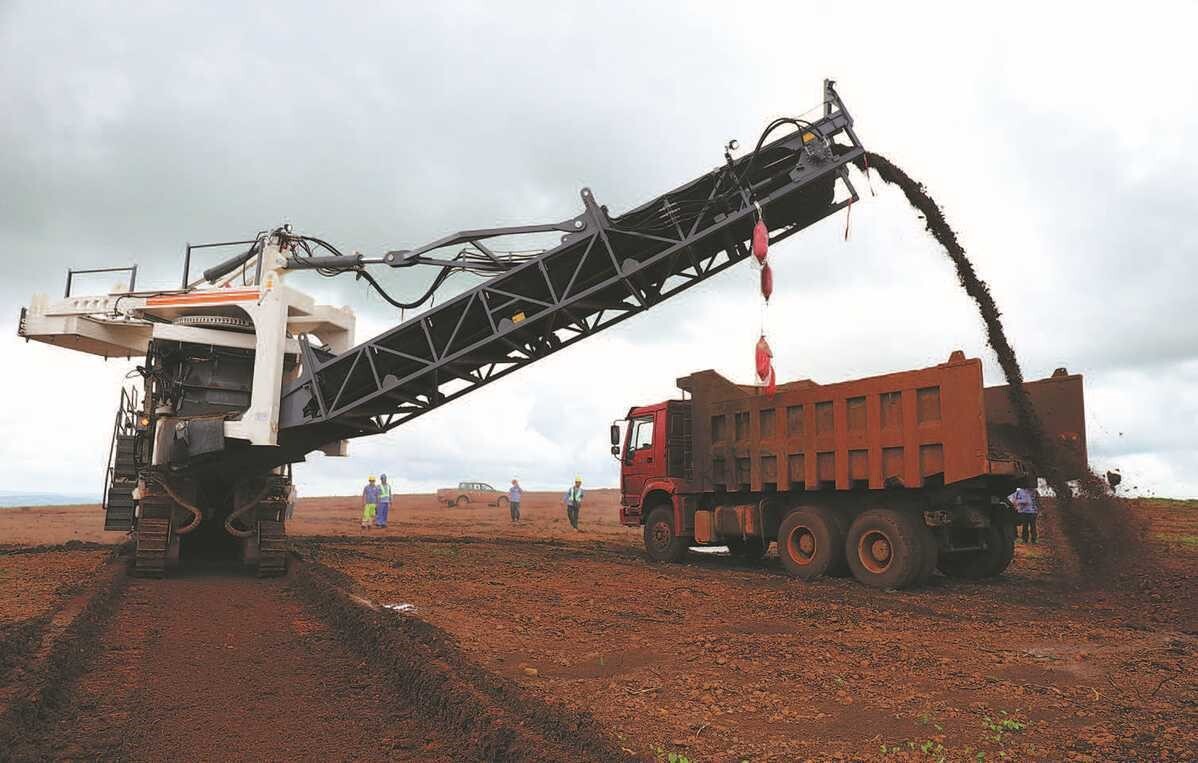
GACC: China's bauxite imports climb 34% Y-o-Y in July
China imported 20.06 million tonnes of all types of bauxite in July, higher by 34.2 per cent from the same month last year and by 10.7 per cent from June, according to the latest data from the country's General Administration of Customs (GACC). For the first seven months, total bauxite imports reached 123.3 million tonnes, marking a surge of 33.7 per cent from last year's January-July period, the GACC data showed. Guinea remained China's largest bauxite supplier for the seventh month, accounting for 79.5 per cent of July's total by shipping 15.94 million tonnes. The volume was higher by 19.6 per cent from June and by 52.7 per cent from a year earlier. The on-month increase was mainly attributed to accelerated bauxite shipments in mid-May ahead of the West African country's rainy season,...

From €15.6B to €2.8B: Eurozone’s June trade surplus collapses under tariff pressure
The European Union’s vaunted export engine is sputtering under the combined weight of tariffs, softer demand, and eroding competitiveness. June 2025 marked a dramatic turning point: according to ING’s latest analysis, the bloc’s seasonally adjusted trade surplus collapsed to just EUR 2.8 billion, down from EUR 15.6 billion in May. Eurostat’s official, unadjusted figures tell a similar story, showing the surplus narrowing to EUR 7.0 billion in June from EUR 20.7 billion a year earlier. Image source: https://wjjh.blog/ The headline numbers mask an even more telling shift. Exports from the single currency area rose a negligible 0.4 per cent year-on-year to EUR 237.2 billion, while imports surged by nearly 7 per cent to EUR 230.2 billion. On a monthly basis, exports contracted by 2.4 per...

India eases SRVA rules, fuels rupee trade and de-dollarisation talk
India is at the centre of global trade discussions after reports suggested that the Reserve Bank of India (RBI) had issued a circular enabling BRICS nations to settle 100 per cent of their trade in Indian Rupees (INR). Analysts argued that such a shift could weaken the US dollar’s dominance in international trade and strengthen BRICS’ collective bargaining power. Though there is no such official mandate for BRICS to conduct all trade in rupees. Instead, several outlets noted that the RBI has relaxed norms by allowing banks to open Special Rupee Vostro Accounts (SRVAs) without prior approval, a move aimed at promoting INR-based trade at a time when US tariff measures continue to create uncertainty for BRICS countries. The latest circular, issued on August 5, 2025, builds on an earlier...

Aluminium dross recovery and metal extraction: What to expect in 2025
The global aluminium industry stands at a critical juncture where efficiency, sustainability, and resource recovery are shaping new business priorities. As per recent business market research, the aluminium sector — formed of primary aluminium smelters, secondary aluminium facilities, and downstream processing plants — generated an estimated 4.78 million tonnes of dross in 2024. Source: AL Circle This figure reflects the inescapable byproduct of aluminium melting, but it also highlights opportunities for resource recovery and value creation. Aluminium dross generation: Regional market analysis China, the world's largest producer of aluminium, continues to dominate global dross output as per rule, accounting for nearly 47 per cent of total generation in 2024. The Rest of Asia-Pacific...

