Asia-Pacific, where labour is affordable, setup costs of plants are cheaper and regulations are more friendly for business owners and stakeholders, have grown to become the focal point of the aluminium industry in the past decade. But what seems like a regional jump is a fruit of longstanding geopolitical blips and economic volatility. From culture to couture, production to market capture, the west has led the game for centuries. But as we approach the half of the ongoing century, a single question nags the mind. Why is the east now replacing the west (for aluminium or not)? And the answer is simple — availability beats class.
Image source: https://www.eurofound.europa.eu/
The macro tectonics have shifted. The United States has downgraded from a high-octane, demographic-fuelled growth model to a slower, ageing-and-productivity constrained one. At the same time, large parts of Asia-Pacific, inclusive of India, Vietnam, Indonesia and others still run on rising labour, above-average investment and a catch-up productivity story. For aluminium producers, traders and other stakeholders, that pivot matters as demand centres, capex flows, tariff exposure and supply-chain geography will all reprice over the coming decade.
Start with the headline numbers. The Congressional Budget Office’s long-run baseline now pegs the ‘new normal’ US real GDP growth at roughly 1.6 per cent per year from 2025 to 2055. It’s a far cry from the 3 per cent era.
The Bureau of Labor Statistics projects the US labour force will expand at only 0.4 per cent annually through the 2022–2032 window, with the participation rate falling from 62.2 per cent (2022) to 60.4 per cent (2032) as baby boomers (born between 1946 to 1964) retire.
Au contraire, S&P laid out at its August 2025 APAC conference that the potential output growth in many Asian EMs materially above advanced-economy peers, driven by higher investment rates and still-positive productivity convergence. Countries such as India, Vietnam and Indonesia look set to deliver GDP growth in the mid-to-high single digits over the near term, while China’s growth — though moderating — remains significant.
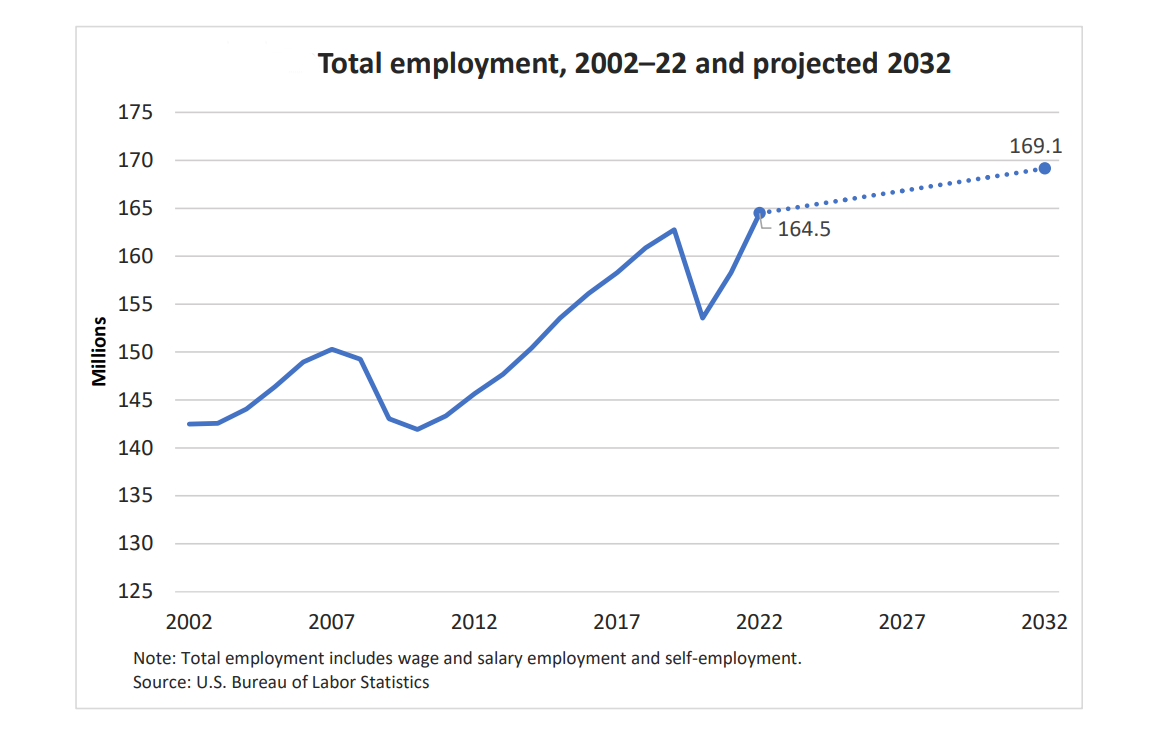
This image represents US employment forecast (Source: https://www.bls.gov/)
European crisis of power (both literal and dialectic)
Europe does not sit on the sidelines as the US downshifts and Asia-Pacific revs up. It occupies the awkward middle: older, slower-growing and more exposed to trade shocks than Asia, but richer, policy-active and structurally focused on green and industrial upgrades in ways that matter for metal markets and global supply chains.
Start with the numbers. The European Commission’s Spring 2025 forecast projects only about 1.1 per cent real GDP growth for the EU in 2025 (0.9 per cent for the euro area), which can be considered a modest expansion, not a boom. The Commission explicitly flags the recent rise in trade frictions and tariff uncertainty as a driver of the downgrade.
Demography and the labour story explain much of Europe’s structural constraint. The EU’s median age is now about 44.7 years, and working-age shares are projected to shrink over coming decades. Europe’s labour-force growth is therefore limited compared with the young, expanding populations of South and Southeast Asia.
Energy, green investment and industrial policy are the policy levers that could tilt Europe’s fate. The European Green Deal and REPowerEU remain live programmes: Brussels is pushing accelerated permitting for renewables, an industrial push for clean tech and major investment needs to meet net-zero targets. The ECB and other EU agencies estimate that meeting green transition targets will require very large and unequally distributed investment flows through 2030. That investment thesis is important for metals (aluminium, copper, steel) because renewables, grids, EVs and building retrofits are metal-intensive.
But policy ambition collides with fiscal reality and risk. The EU’s Spring forecast and IMF regional outlook both warn that trade shocks, geopolitics and uneven fiscal space across member states could blunt the green push or make it more expensive.
Germany has proven to be the pivot. Berlin’s 2025 plan, a historic investment push that relaxes parts of its ‘debt brake’ and mobilises hundreds of billions for infrastructure and defence, could materially lift European demand if implemented at scale. The German package earmarks large sums for infrastructure, climate transition and defence over the coming decade, wherein some estimates and corporate pledges now suggest lump sum private co-investment.
Monetary and inflation dynamics shape near-term industrial demand. The ECB projects inflation moving back toward its 2 per cent target and has hinted that trade-driven price shocks (tariffs, input costs) and geopolitical uncertainty are upside risks to inflation and that policy must balance resilience with returning to target.
Contrast that with the Asia-Pacific picture
When discussing specifically about aluminium, Asia already dominates production and demand. China is the 800-pound gorilla in the metal value-chain. It produced roughly 43 million tonnes of primary aluminium in 2024 (about 60 per cent of global output) and remains the world’s consumption engine.
Outside China, India is the largest APAC producer, at roughly 4.1–4.2 million tonnes in 2024, with Russia, Canada and the Gulf states trailing behind. Those headline volumes matter because any re-routing of manufacturing or a surge in India/ASEAN demand quickly swaps global flows and price premia.
Digging into a recently published S&P’s insight deck, it is discovered 40 tariff-driven rating actions as of early August 2025, concentrated in consumer products, retail and autos, is a direct signal that trade policy now has bite and that tariff risk is real both for producers and the metals value chain that supplies them. The same deck shows that manufacturing FDI into ASEAN from China and the US grew substantially over the last decade. On the other hand, industry experts caution that the overall FDI shift into Asian EMs remains ‘modest’ in scale so far.
Regarding overall supply chains, OEMs and EMS firms have started diversifying capacity outside China (notably into Vietnam and India) before the 2025 tariff moves. Non-current assets shifting to Vietnam or India on select EMS line items. But the broader, economy-wide role of China remains dominant and supply-chain reallocation is still partial. It matters equally for aluminium and fabricated metal trades because it shapes where input demand grows fastest.
Trade imbalances with China surface repeatedly
Several EM Asian economies run rising bilateral deficits with China — imports broadly outpacing exports in many cases — which makes those countries sensitive to Chinese demand cycles and to shifts in Chinese industrial policy. India stands out with a pronounced deficit in the slides’ scenario charts. For metal buyers, that means upstream commodity flows (and pricing) will continue to be influenced heavily by China-linked dynamics.
The financing backdrop supports the growth story, but also flags vulnerabilities. A strong onshore and offshore issuance in APAC in 2025 is reported by S&P in its APAC conference, with China, India and others showing notable cumulative issuance through July 2025. Portfolio flows are mixed month-to-month, with China often dominating inflows and other EMs seeing episodic starts and stops. That liquidity supports capex and refinancing, but the financing picture is uneven across countries and sectors; higher leverage in some real-estate and metals segments raises credit sensitivity to global tightening and risk premia.
Sectoral winners and losers are visible. Consumer products, autos and chemicals have seen tariff- and demand-driven rating pressure; metals and mining carry their own headaches — sharp swings in commodity prices, cyclical demand and balance-sheet stresses show up in negative outlooks in the deck. For stakeholders, the overall translates to a checklist:
(a) where are export markets shifting?
(b) which jurisdictions show durable capex financing? and
(c) which downstream sectors are most exposed to tariff shocks?
What does all this hold for the future of the metal in question?
First, demand geography will tilt. Incremental demand for housing, autos, appliances and infrastructure will increasingly originate in Asia’s emerging markets — not only from China but from India’s urban build-out and Vietnam/Indonesia’s factory expansions.
Second, supply-chain resilience premiums will rise. Buyers value shorter, local supply lines that reduce tariff and delivery risk; that raises the value of local downstream capacity.
Third, financing and credit health matter: regions and firms with healthy access to onshore issuance and stable portfolio flows will more easily fund plant upgrades and inventory buffers. S&P’s issuance and portfolio charts are an explicit reminder that liquidity availability varies across the region.













_md.webp)








