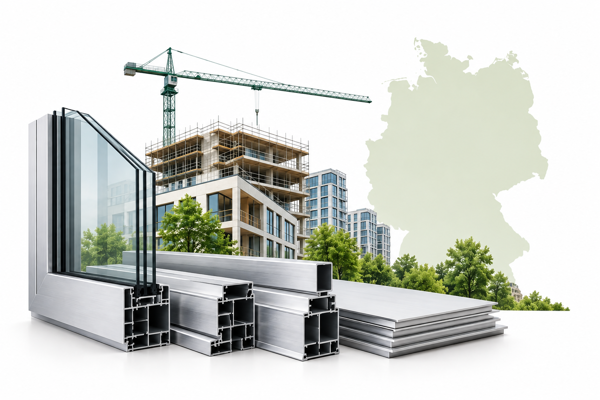
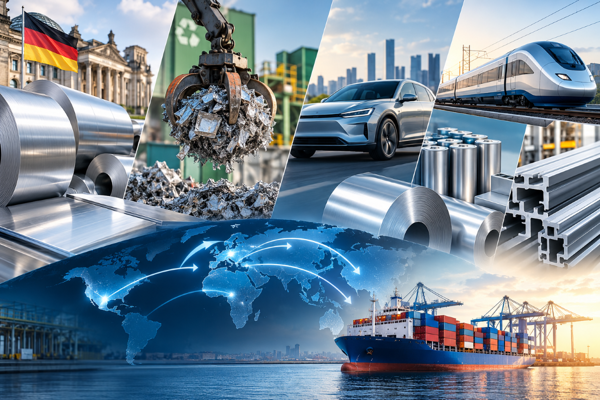
AL Circle analysis: Germany’s aluminium trade surplus, Novelis’ US expansion, Asia’s EV demand & India’s underutilised downstream capacity
Aluminium’s next growth phase is increasingly being shaped by downstream processing, supply-chain resilience and demand from specialised applications. Germany continues to generate a substantial trade surplus in flat-rolled products despite a shrinking primary aluminium base, while North America is investing in recycling and rolling. Across Asia, new manufacturing capabilities and growing demand from electric vehicles, railways and batteries are creating further opportunities. However, declining exports, underutilised capacity and uneven profitability show that investment alone does not guarantee success. For industry leaders, the challenge is to identify where demand is shifting, develop products that meet customer requirements and ensure that new investments translate into sustainable...
AL Circle Analysis: From Guinea to Gulf, how bauxite, tariffs and logistics redraw aluminium map
Aluminium markets in late 2026 are being shaped by more than the headline LME aluminium price. Bauxite security, alumina availability, geopolitical disruptions, tariff negotiations, logistics diversification and regional premiums are increasingly determining where metal moves and what buyers pay. From RUSAL reassessing Caribbean assets and Vedanta securing Odisha bauxite to Brazil extending mine life and EGA rebuilding its Guinea supply chain, producers are strengthening control over critical raw materials. At the same time, the US remains heavily dependent on imported bauxite and alumina, while Europe and Asia are experiencing sharply different premium dynamics. These developments point to a market where physical availability is becoming a regional factor even as aluminium itself remains...
Grow with
AL Circle
DAILY: Chinese alumina spot, futures prices track lower
On Thursday, the national average spot price for smelter-grade alumina with over 98.6 per cent purity slipped by RMB 14 per tonne (USD 2 per tonne) from Wednesday to RMB 3,187 per tonne, extending its decline for a third straight working day, Mysteel's daily price assessment showed. The price drop stemmed from reduced trading prices and seller quotations across the country's five major alumina production bases. Among those, the sharpest on-day fall was in Shandong province, with average prices there dropping by RMB 20 per tonne to RMB 3,110 per tonne. Prices in Shanxi and Henan provinces decreased by RMB 15 per tonne each from the prior day to RMB 3,125 per tonne and RMB 3,150 per tonne, respectively, while those in Guizhou province and the Guangxi autonomous region both slid by a smaller...

From packaging to automobiles: aluminium sheets, foils and cans to reach 2.5M tonnes by 2033
At the start of September 2025, primary aluminium is trading on the London Metal Exchange at a fairly narrow range of USD 2,591.75 per tonne to USD 2,606 per tonne. While primary aluminium prices influence global trade dynamics, the downstream market of sheets, foils, and cans demonstrates the metal’s broader economic significance across packaging, construction, transport, and consumer industries. Aluminium sheets is considered as one of the most common rolled forms of the metal. Light, durable and resistant to corrosion, they are cut into body panels for cars, roofing and cladding for buildings, and even kitchen appliances. Foil takes on a different role. Thin and ductile, it wraps food, protects medicines and, more recently, lines lithium-ion batteries in electric vehicles. Cans,...

If aluminium exports are rising, why is South Korea crying foul over US tariffs and rushing to offer support funds?
Among many countries being affected by the United States’ steep aluminium and steel tariffs, South Korea claims to be one of them. The country that was once an important trade partner of the United States, back from 2007 with the signing of the Free Trade Agreement (FTA), is now one of the major victims of the United States’ latest protectionist measures. Firstly, the implementation of 25 per cent duty was enough to blow the country, while the subsequent hike by another 25 per cent has proved to be the final nail in the coffin. Being a significant aluminium and steel exporter to the United States (valued at USD 851 million in 2024), South Korea says it has taken a major hit on its economy due to Donald Trump’s tariff regime. Its exports to the US in the month of August slid 12 per cent...

AL Circle x Jagannath Prasad: Runaya charts 5x growth path, backed by partnerships, tech & green energy
With nearly two decades of rich industry experience, Jagannath Prasad Routray serves as the CEO of Green Aluminium Recovery & Diversified Metal Recovery Businesses. His steadfast dedication to building a greener, empowered, and sustainable future has been the driving force behind the many milestones he has achieved throughout his career. In this interview, He highlighted Runaya’s rapid growth from INR 500 crore in FY24 to a target of INR 2,500 crore by FY28, which is driven by a clear focus on circularity, efficiency, and sustainable practices backed by capital investments, partnerships, in-house technology, and renewable energy. Side by side, Mr Jagannath Prasad also shared his vision of how Runaya’s legacy is proving that Indian manufacturing can be clean, inclusive, and globally...

US Appeals Court rules tariff mostly illegal! Now, Trump pleas to the Supreme Court
In a surprise twist for those watching global trade, a divided US appeals court has determined that Donald Trump's tariffs are illegal, further weakening one of the Republican President's scripts for using levies as a linchpin of international economic policy. This ruling may have wide-ranging impacts across sectors that depend on tariff-enabled protections and disrupt import-export planning. With a legal lens becoming clearer, the fight over the independence of the Federal Reserve appears on course for the Supreme Court, keeping alive the prospect of a historic showdown this year that could challenge the full breadth of Trump's economic agenda. As of now, the court has permitted the tariffs to stay in effect until October 14, providing the Trump administration a window to escalate the...

Electricity behind aluminium’s price tag? Then, why does Europe’s “green” metal costs so much?
Whenever there is a question of pricing, the aluminium industry has pointed towards a single influx inducer — electricity. If you’ve ever toured a smelter or skimmed an investor deck, you’ll hear the same refrain, “power is king, and aluminium is electricity in solid form”. But, as Maros Durka, Area Sales Manager at Grupa Kety, states, that is only half the truth. Yes, electrolysis eats megawatts like popcorn, but if power were the only story, Europe’s aluminium would be cheap and cheerful by now. After all, Europe boasts the cleanest smelters on earth, with over 78 per cent of output powered by renewables. And yet, paradoxically, European primary aluminium is still the world’s priciest. So, what gives? Why are Europe’s ‘green’ tonnes also the most expensive ones? Also read: China, a...

Alba chooses Egypt for its first alumina refinery; here’s an explanation to why Egypt
Egypt is in the forefront with a new strategic partnership embarked on to develop an alumina refinery. As of September 3, 2025, Aluminium Bahrain (Alba), a manufacturer and distributor of aluminium and its related products, has officially, in the presence of HRH the Crown Prince and Prime Minister, signed a non-binding Memorandum of Understanding (MoU) with the Metallurgical Industries Holding Co., a company that operates through its subsidiaries to produce aluminium and other metals. The MoU has been signed to explore and get into a collaborative relationship that will provide the opportunity to develop an alumina refinery in Egypt in accordance with an offtake agreement and equity participation. His Excellency Shaikh Salman bin Khalifa AL Khalifa, the Minister of Finance and National...

China Aug anode material production up 3% MoM
According to Mysteel OilChem's survey, China's anode material production reported 223,500 tonnes in August, up 3.19 per cent from the previous month and 63.50 per cent from the same period last year, with a monthly average capacity utilisation rate of 62.71 per cent. The anode material producers generally maintained active production in August, and some raised the production based on orders received. In addition, the favorable hydropower prices in the wet season prompted the top-tier producers to produce at full capacity, which build up finished products stocks for the upcoming traditional peak season. From the raw material side, the domestic prices of low-sulfur petroleum coke (petcoke) edged up from RMB 3,500-3,600 per tonne to RMB 3,600-3,700 per tonne, with high-quality resources...

From Guinea to China: bauxite demand fuels $126B global market outlook
The bauxite market is expanding steadily, with analysts predicting the market will be worth nearly USD 126 billion by 2033. This sharp climb from USD 84.5 billion in 2025 is equal to a compound annual growth rate of 5.11 per cent. Aluminium demand lies at the heart of this surge. Yet, the outlook is not all smooth. Supply bottlenecks, tougher environmental rules and geopolitical rivalries are there. Aluminium’s expanding reach Most of the world’s bauxite, about 85 per cent, ends up as alumina, which is then refined into aluminium. The metal has become hard to replace. In cars, the story is striking. Back in 1980, an average vehicle carried only about 120 pounds of aluminium. By 2030, that figure is expected to hit 252 kilograms. For a broader view of the global bauxite market click: A...

Here’s how to turn 9Mt of car waste into aluminium alloy for next-gen EVs
Imagine a world where scrap cars no longer pile up in landfills, but instead help build the electric vehicles of tomorrow. That is what a team of researchers in Europe are busy with. Stefan Pogatscher and his team have pioneered an exciting new process to recycle scrap metals from cars (amounting to 7 to 9 million tonnes in Europe annually) into a high-grade aluminium alloy perfect for building a variety of components for new electric vehicles. Get industry specific insights from - ALuminium in Packaging: Consumer Trends and Market Dynamics How will this new innovation be carried out? The secret to this innovative solution is preserving a diverse mix of alloys found in scrap cars to create a superior product. Typically, when cars are dismantled, materials like aluminium, plastics, fabrics...

China, a decade-old ally, unharmed in Guinea’s bauxite game. But why?
Over 100 mining licences were cancelled in Guinea, where big names like EGA have made headlines. But how many China-owned firms have been the target of Guinea’s ‘mine here, refine here regime’? The answer is a big-n-bold ZERO. The only report that deep search found when AL Circle was investigating the matter was of the single active operation affected by this crackdown of a joint venture in the Boffa-Fria corridor that included the Chinese-backed company SD Mining SA, which held a 42 per cent stake. Naturally, the question arises as to why Guinea has been cooperating with China when it comes to mining (we are mainly concerned about bauxite). For over 30 years, China has actively supported Guinea in various aspects. But why? As we dig deep, it seems to be clearing layer by layer. Also...

China falls, Turkey rises: aluminium bars and rods exports reshape global trade
The global trade in aluminium bars and rods profiles during the first half of 2025 painted a picture of divergence, with some exporters expanding their reach while others struggled under regulatory and market pressures. China, still the largest player, endured the steepest fall. Its export volume slipped 21.09 per cent, dropping from 520,144.8 tonnes in H1 2024 to 410,485 tonnes in H1 2025. The financial blow was even harder, as net trade value fell by 27.4 per cent — from USD 1.8 billion to USD1.328 billion. Germany too found itself weighed down by weaker flows. Exports through May 2025 came to 107,240.4 tonnes, from 134,596.5 tonnes shipped in May 2024, a contraction of 20.29 per cent. The country’s export revenues followed the same path, tumbling 15.6 per cent from USD 932 million in...

Guinea bauxite prices edge higher on low spot supply
As of August 29, Mysteel's daily assessment for Guinea bauxite (Al:45 per cent,Si:3 per cent) was USD 74.5/dry metric tonne, rising USD 0.5 per dry metric tonne from a week ago. The assessment for Australia bauxite (Al:50 per cent,Si:6.5 per cent) remained flat at USD 69 per dry metric tonne. China's domestic bauxite supply remained constrained by the wet season and environmental policy, supporting prices at high levels. Market participants are optimistic about the supply and stability of bauxite in Shanxi after policy adjustments, but it is unlikely to see significant improvement in the short term. In terms of seaborne bauxite, Guinea bauxite (45 per cent,Si:3 per cent) prices continued to edge higher last week amid low supply of spot cargo from the top supplier. On the supply side,...

H1 2025: Top 5 trends to watch in the global aluminium value chain
The first half of 2025 marked a turning point for the global aluminium industry, arguably its most turbulent period in recent memory. The trigger was the United States’ imposition of steep tariffs on aluminium imports, a move that set off ripple effects across global supply chains. What began as a trade policy measure quickly escalated into a broader disruption, reshaping cross-border trade dynamics, injecting volatility into global aluminium prices, and diverging demand patterns from primary aluminium to aluminium scrap. Supported by stable supply chains, prices within a reach of USD 2,200 per tonne, and tariff exemptions, the demand for scrap has attained a new high. Thailand emerged as a new hotspot of aluminium demand, fuelled by its expanding automotive manufacturing sector, and thus...

WEEKLY: Chinese thermal coal prices lose steam as seasonal demand wanes
Chinese domestic thermal coal market closed last week (August 25-29) on a bearish note, as demand diminished seasonally despite lingering supply constraints. On Friday, Mysteel assessed 5,500 kcal/kg NAR thermal coal at RMB 695 per tonne (USD 97.5 per tonne) FOB northern ports with VAT, down RMB 7 per tonne from the previous week. Prices for 5,000 kcal/kg and 4,500 kcal/kg NAR grades also slipped RMB 18 per tonne and RMB 22 per tonne to RMB 615 per tonne and RMB 540 per tonne, respectively. Last week, chilling weather dented household power demand in North China, leading to a notable decline in coal consumption at utilities. But temperatures in the southern and eastern regions remained high, which, coupled with weak hydropower generation, continued supporting coal burns at high levels,...

Primary aluminium production growth slows down in July’25 – energy crisis behind it
July has historically been the strongest month for primary aluminium production, and 2025 was no exception. Global output exceeded 3.8 million tonnes, a month-on-month increase of 3.17 per cent. Although this marked a record high, the growth rate was slightly weaker than the 4.07 per cent recorded a year earlier. In total, global primary aluminium production reached 6.373 million tonnes in July, lifting year-to-date (YTD) output to 42.724 million tonnes, up 1.3 per cent from 42.177 million tonnes in the same period of 2024. The pace of growth, however, was slower than the 3.83 per cent rise during January–July 2024. Oceania & China behind the momentum dip While evaluating what dampened the momentum, a series of causes popped up. One among them was increased production costs due to surging...

FORECAST DATA: US & Europe slowed, Asia-Pacific's aluminium future shot to frontline
Asia-Pacific, where labour is affordable, setup costs of plants are cheaper and regulations are more friendly for business owners and stakeholders, have grown to become the focal point of the aluminium industry in the past decade. But what seems like a regional jump is a fruit of longstanding geopolitical blips and economic volatility. From culture to couture, production to market capture, the west has led the game for centuries. But as we approach the half of the ongoing century, a single question nags the mind. Why is the east now replacing the west (for aluminium or not)? And the answer is simple — availability beats class. Image source: https://www.eurofound.europa.eu/ Also read: From €15.6B to €2.8B: Eurozone’s June trade surplus collapses under tariff pressure US economic fallout...

From Nothing to iPhone – Top 5 smartphone brands using aluminium in H1 2025
As the years are passing, ALuminium is not only evolving as a metal but also becoming a hero that is making a comeback with a bang. From the surface of the moon to the inside of a smartphone, the metal with the atomic number 13 is redefining strength, sustainability and innovation in our world. Talking about comeback, one such example is the iPhone, about which we will discuss in detail a little later in the article. Now comes the question – WHY ALuminium and not any other metal? In today’s digital world, a smartphone is so much more than just a gadget; it’s an extension of our lives. The right phone isn’t just about flashy looks or clever folding tricks; it’s about finding that sweet spot where power, design, and comfort all come together. It should dazzle when you want it to, perform...

