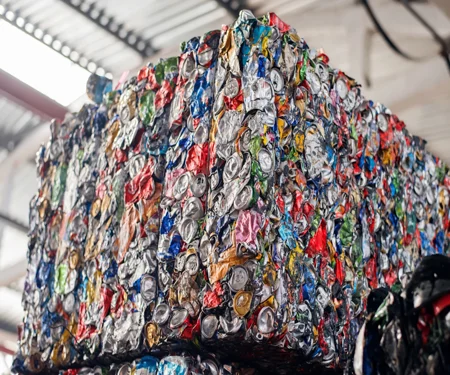
Among many countries being affected by the United States’ steep aluminium and steel tariffs, South Korea claims to be one of them. The country that was once an important trade partner of the United States, back from 2007 with the signing of the Free Trade Agreement (FTA), is now one of the major victims of the United States’ latest protectionist measures. Firstly, the implementation of 25 per cent duty was enough to blow the country, while the subsequent hike by another 25 per cent has proved to be the final nail in the coffin.
Being a significant aluminium and steel exporter to the United States (valued at USD 851 million in 2024), South Korea says it has taken a major hit on its economy due to Donald Trump’s tariff regime. Its exports to the US in the month of August slid 12 per cent year-on-year to USD 8.7 billion, the steepest fall since May 2020 when COVID-19 broke out. Also, the figure, for the first time, stood below the USD 9 billion threshold.
South Korea’s factory activity also weakened for the seventh consecutive month in August, coming in at 48.3, down below the 50 mark. This sluggish factory activity is also a resultant of lower export orders.
"According to manufacturers, challenging domestic economic conditions and the impact of US tariffs weighed most on the sector, stymieing sales and production levels," said Usamah Bhatti, economist at S&P Global Market Intelligence.
Solution? The government’s emergency financial aid announced for this year of up to 570 billion won ($408.8 million). This aid has been announced two days ago to help South Korean companies cushion the impact of the 50 per cent US tariffs on all steel and aluminium imports.
What is the aid all about?
The aid is packaged in three benefits – 1) low interest rate loan programme for all the companies in the aluminium and steel industry, 2) trade insurance to 270 trillion won, up from the initially planned 256 trillion won, and 3) expanding companies’ access to the 13.6 trillion won fund for emergency liquidity.
Besides these funds, the government will also work to boost domestic demand for the country’s key export items, such as automobiles, home appliances, and steel to mitigate the decrease in overseas demand. The initiative will be rolled out by offering subsidy and creating a pool of 100 trillion-won fund to promote investment in South Korea’s heavy industries that majorly use aluminium and steel.
How is South Korea impacted by 50 per cent US tariff on aluminium and steel?
To understand the whole situation of South Korea’s economy that how it is impacted by the United States’ 50 per cent tariff on aluminium and steel, it is essential to follow the country’s track record of aluminium and steel exports to the US. In terms of volume, South Korea’s aluminium export volume to the United States maintained an upward trend till the first half of 2025, amounting to 139,425 tonnes versus 105,619 tonnes of exports recorded during the same period of the previous year. That reflected an increase of 76 per cent year-on-year. Coming to the value, it saw an increase of 74 per cent Y-o-Y from USD 382 million in H1 2024 to USD 517 million in H1 2025.
So, if both volume and value have shown growth, then how South Korea is impacted due to the 50 per cent US tariffs on aluminium and steel? More than aluminium, it is steel that has taken the major blow because South Korea’s steel exports to the US fell 32.1 per cent Y-o-Y last month. For July 2025, the Korea International Trade Association (KITA) posted that the value of South Korean steel exports to the US dropped to USD 283 million from USD 382 million a year ago, hitting the lowest level since March 2021 - a four-year-and-four-month low. Simultaneously, export volume declined by 24 per cent year-on-year to 194,000 tonnes, marking the lowest level since January 2023.
Compared to aluminium, steel, with its far higher export value compared to aluminium, plays a more critical role in sustaining the domestic economy. Under this mounting pressure, South Korea’s leading steelmakers, POSCO and Hyundai Steel, have announced substantial investment plans in the US market. In March, Hyundai Steel announced plans to build an integrated steel plant using an electric arc furnace in Louisiana at a cost of USD 5.8 billion, with production set to begin in 2029.
Auto industry facing a double-edged sword
Besides the decline in steel imports, the fall in South Korea’s automobile shipments have also significantly impacted its economy, given it is valued much higher than steel exports. Sources have reported that South Korea’s car shipments to the US fell 3.5 per cent Y-o-Y in August, while auto parts tumbled 14.4 per cent. Both cars and car parts have substantial aluminium and steel content. If automobile exports are facing hit, the ripple effects are evidently faced by the metal sectors. In April, the value of South Korean automobile exports fell by 19.6 per cent Y-o-Y to USD 2.89 billion. The percentage of decline expanded in May, sliding by 27.1 per cent to USD 2.5 billion. The pace of decline slightly eased in June and July, posting a downfall of 16 per cent and 4.6 per cent Y-o-Y to USD 2.33 billion.
It is important to note that the automobile industry is currently facing a double-edged sword – one side of which is the 50 per cent tariff on its aluminium and steel raw materials and the other side is the same percentage of duty on more than 400 additional aluminium and steel products, including auto parts and auto components. That’s not all! There is 15 per cent implemented on imports from South Korea as part of an agreement to avoid even higher levies. So, the cumulative export duty is reaching 115 per cent on the content of an automobile.
To gain insights into the aluminium market for the transportation sector, read our report: Future of Aluminium in Transportation Sector An Industry Analysis with Forecasts to 2027
Brief overview of South Korea’s present economy – will the financial aid be of any help?
South Korea’s economy is showing weakness in exports, investment, and consumption, constraining economic growth. Exports have slipped due to sluggish global demand owing to stupendous tariffs imposed on various products and their raw materials. These conditions, in addition to the base effect of strong export performance in the previous year, conspired to produce a negative growth rate (-2.1 percent) in exports in the first half (H1) of 2025. This is the first time exports have actually fallen since the third quarter (Q3) of 2023.
Despite tens of billions of dollars in extra spending and interest rate cuts rolled out by the South Korean’s government, it still cuts its 2025 economic growth forecast in half from its earlier expectation, saying the economy will expand just by 0.9% this year. This new projection marks the country’s weakest growth outlook since 2020, when the economy shrank 0.7 per cent during the pandemic.
Yet the Korea Development Institute and the International Monetary Fund considers the growth projection slightly over ambitious as they foresee a development of 0.8 per cent. They also reason out that the government’s goal would be slightly unfeasible as it would require more than 1 per cent growth in the second half of 2025.
The central bank forecasts the country’s third- and fourth-quarter growth at 0.7 per cent and 0.6 per cent, respectively.
Alternatively, Seoul is now betting on artificial intelligence as the engine of future growth. The finance ministry has rolled out a series of projects designed to establish South Korea as a global leader in AI and advanced technologies, part of a broader push to revive the slowing economy.
The plan aligns with President Lee Jae Myung’s campaign pledges: to place South Korea among the world’s top three AI powers, raise the country’s potential growth rate to 3 per cent, and secure a spot among the five most influential global economies.
“We are in a desperate moment, with no anchor industries left to support our economy,” the government said in a statement. “The era of AI transformation will offer a golden opportunity for us to leap forward as a leading nation, and the next five years will be our critical window to seize it.”












_md.webp)
_md.webp)
_md.webp)