The story of alumina in 2025 saw every up and down possible and at the same time raced to re-engineer itself to minimise shortfall. The global alumina industry moved in jolts with a plethora of incidents like capacity added in one geography while written off in another, environmental scrutiny tightening just as governments chased self-sufficiency, and supply chains re-routed not by demand, but by policy and power costs.
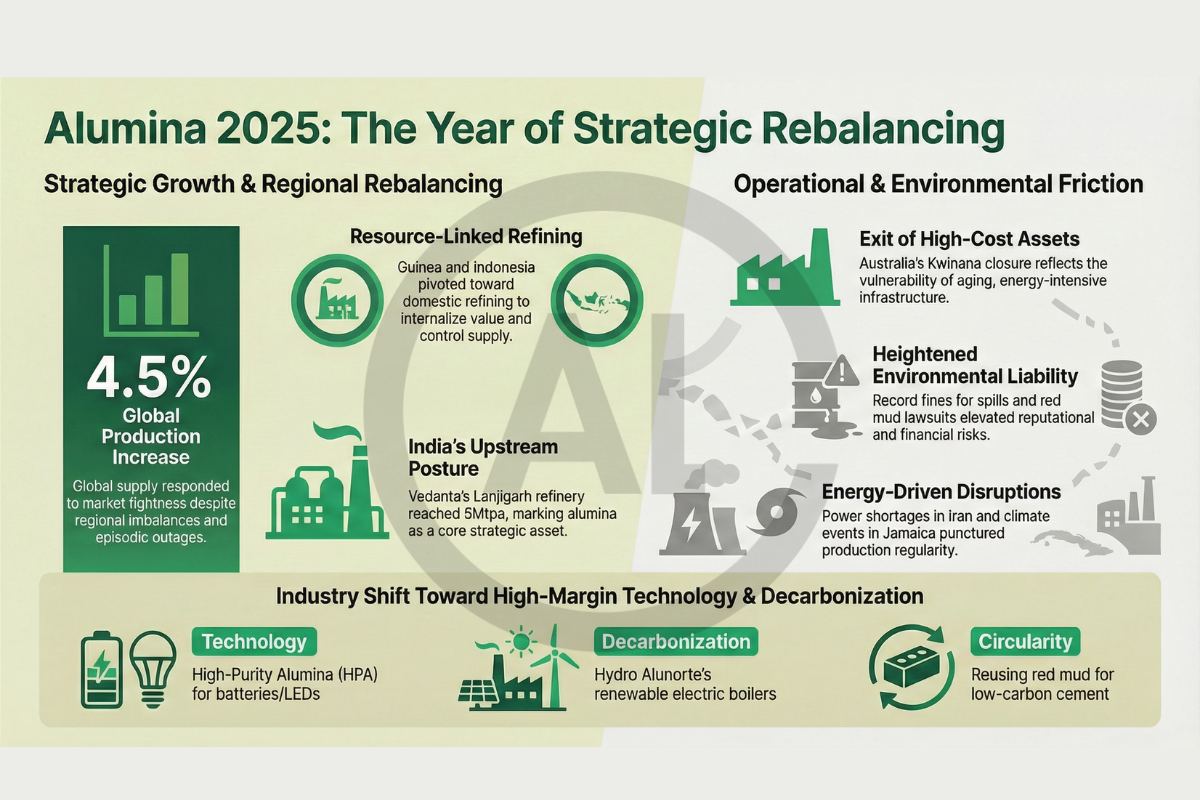
One of the key pieces of good news came from India. Vedanta’s Lanjigarh refinery reaching 5 million tonnes per annum capacity marked India’s shift in upstream posture. Alumina could no longer be tagged as a supporting input but as a core strategic asset for rapidly developing economies like the aforesaid nation. That intent sharpened with Vedanta’s INR 1 lakh crore aluminium-alumina expansion blueprint, positioning the country to reduce exposure to imported intermediates while anchoring domestic smelting growth.
Explore- Most accurate data to drive business decisions with our Outlook 2026 insights across the value chain
That same strategic instinct played out more forcefully in West Africa. Guinea’s Boké alumina refinery construction and the parallel Boffa alumina project ground-breaking reflected a long-anticipated pivot away from raw bauxite exports. For decades, Guinea supplied ore while value addition happened elsewhere. In 2025, that equation began to tilt. Refining capacity closer to the mine meant new freight flows, different risk profiles, and tighter control over supply, especially relevant for buyers accustomed to cheap, uninterrupted Guinean bauxite.
Southeast Asia reinforced this upstream rebalancing. Indonesia’s alumina production surge and refinery build-out continued to reshape regional trade, tightening bauxite availability for traditional importers and accelerating fears of demand destruction among exporters. Inalum’s Mempawah Phase II expansion lay emphasis on Jakarta’s determination to internalise value, even at the cost of short-term trade friction.
But while new capacity grabbed headlines, 2025 also delivered decisive exits. In Australia, Alcoa’s permanent closure of the Kwinana alumina refinery stressed the growing vulnerability of older, high-cost assets. Energy intensity, ageing infrastructure and tightening environmental standards converged into a simple conclusion that not all refineries are worth saving. That reality coexisted uncomfortably with Western Australia’s approval of the Worsley expansion, drawing attention to the fact that there were uneven economics even within a single jurisdiction.
Australia’s contradiction ran deeper. WA alumina export sales touching $8.2 billion despite lower production volumes revealed how inflated price brackets and legacy contracts could mask production decline (at least temporarily). At the same time, Alcoa’s Huntly mine expansion plans and a major Australian tax ruling in Alcoa’s favour supported the global business through regulatory and fiscal outcomes to rapidly adjust project viability.
Must read: Key industry individuals share their thoughts on the trending topics
Environmental pressure refused to stay abstract. In March 2025, Alcoa’s conviction and fine over a caustic chemical spill served as a blunt reminder to the global industry that compliance failures now carry reputational and financial costs. And the same message got transmitted to the US. Atalco facing a lawsuit over red mud disposal dragged alumina’s most persistent waste problem into legal focus.
Yet 2025 also showed the industry experimenting with solutions. Bayer’s push to reuse red mud in low-carbon cement applications offered a counter-narrative — one where residue becomes resource, not liability. The contrast between courtrooms and pilot projects defined the year’s environmental discourse.
Adding another layer of strain, the European Union’s anti-dumping duties on Chinese fused alumina narrowed access for Chinese exporters just as Brussels rolled out CBAM — notably excluding alumina from the initial CBAM scope.
That omission sparked industry debate. Alumina’s emissions intensity is well known, yet it remains outside the EU’s carbon tariff net. In 2025, that gap preserved trade flows. Whether it endures is another question!
China, meanwhile, tightened its own grip. Beijing’s curbs on new alumina and copper project approvals beckoned a desire to control overcapacity rather than chase volume. But during the same calendar year, prior logistics data told a different story. While the curb came later in December, in July, Guangxi’s first full-load alumina container train highlighted continued investment in domestic transport efficiency, reinforcing China’s ability to re-route material internally even as exports face barriers.
Operational disruptions punctured the year with uncomfortable regularity. Jamalco’s production restart after Hurricane Melissa exposed alumina’s vulnerability to climate events, while Century Aluminum’s USD 30 million capital injection into Jamalco accentuated the cost of resilience.
In Iran, the picture was fragmented. A rise in aluminium hydrate output contrasted with a decline in alumina powder production due to energy shortages, illustrating how power availability has become a decisive upstream constraint.
Against this volatility, global numbers crept upward at the beginning. A roughly 4-4.5 per cent increase in global alumina production in early 2025 suggested supply was responding — but only just. The increase masked deep regional imbalances and episodic outages, keeping the market tight and sentiment fragile.
Technology and product differentiation emerged as strategic hedges. Impact Minerals’ Lake Hope high-purity alumina PFS, Alpha HPA’s USD 20 million construction contract, and Almatis’ plan to double calcined alumina capacity at Huangdao all pointed in the same direction: producers are chasing margin insulation, not just tonnes. High-purity alumina offered exposure to batteries, LEDs and advanced ceramics — markets less forgiving of supply disruption, but far more rewarding.
Decarbonisation, too, edged closer to execution. Hydro Alunorte installing two electric boilers powered by renewable energy marked one of the few tangible process-level emission cuts in alumina refining during the year. Such projects remain expensive and site-specific, but 2025 showed they are no longer theoretical.
Corporate strategy quietly adjusted in parallel. Glencore hiring a senior alumina trader from Gunvor implied intensifying competition for physical flows and customer relationships, even as margins compressed. The opposites of ABx’s termination licensing agreement with Core Refining and L&T securing a major alumina refinery EPC contract reflected how technology and engineering capabilities key in strategising as are ore access.
By year-end, alumina’s trajectory was clear — if uncomfortable. Capacity is migrating closer to resources and sovereign control. Environmental and legal risks are climbing faster than output. Trade rules remain uneven but are tightening. And alumina, long treated as aluminium’s quiet backbone, is now firmly in the spotlight.
To put it all in a nutshell, 2025 voyaged in a pattern wherein alumina, the key input material for primary aluminium, took the centre stage as a political, operationally fragile, and strategically indispensable substance.
Don't miss out- Buyers are looking for your products on our B2B platform













_md.webp)








