AL Circle Analysis: Regional output & trade reflect bauxite-alumina supply contrast in aluminium market

The image used in this article is generated with an AI tool and does not depict any real-time moment
If aluminium has a pressure point right now, it sits one step upstream of the metal itself - in alumina. China’s appetite for imported ore remains elevated, alumina markets diverge between regions, and disruptions in Guinea and Australia expose logistics risks. At the same time, tariffs and regional premiums are reshaping the economics of aluminium, making access to competitively priced alumina and metal increasingly dependent on geography, trade routes and policy.
Bauxite supply: Sourcing, scrutiny and shifting trade flows
Jamaica and Ghana are negotiating a USD 60 million arrangement in which Jamaican bauxite would be refined into alumina at ATALCO’s Gramercy, Louisiana plant before shipping to Ghana’s aluminium industry. Talks, backed by Ghana’s President Mahama, began in March 2026 and built on a decades-old bauxite-alumina relationship, with Ghana having imported roughly 26,250 tonnes of Jamaican alumina worth USD 11.1 million in 2024.
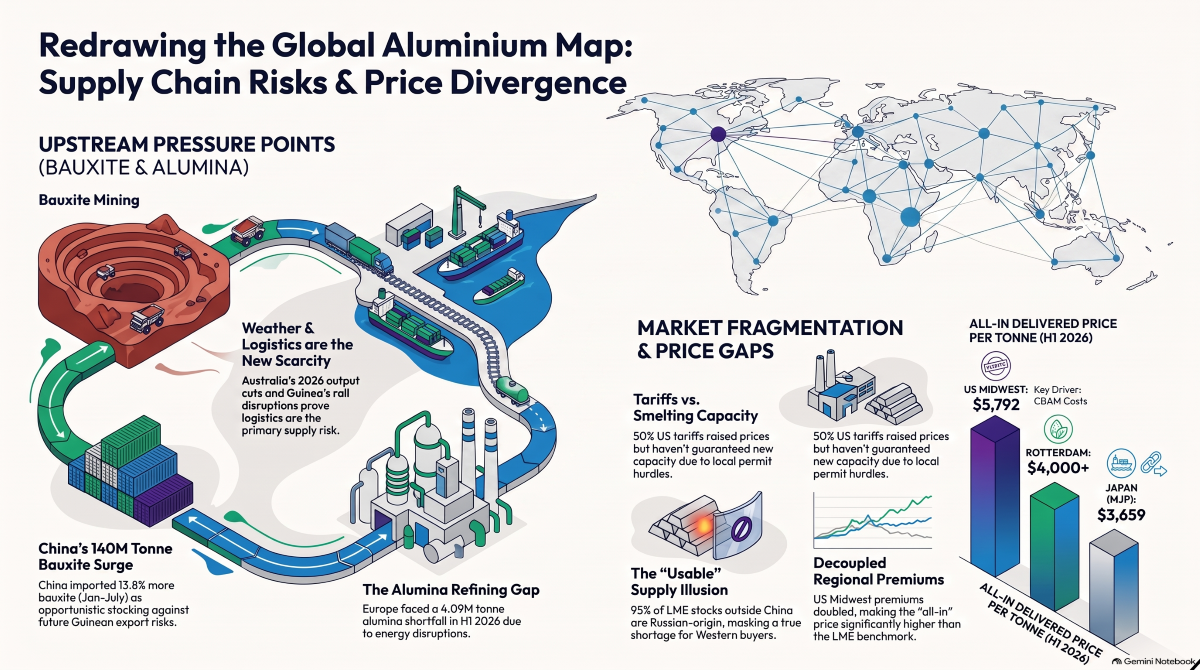
Australia produced 102.4 million tonnes of bauxite in 2025 and exported 44.23 million tonnes, but record Weipa rainfall and Cyclone Narelle cut Q1 2026 output sharply. Prices swung between USD 82 per tonne and USD 66.5 per tonne across 2024-26, while Guinea’s export-curb concerns and Middle East shipping disruptions pushed more Chinese buying toward Australian cargoes despite the weather-driven supply hit.
To know the futuristic market and value proposition of red mud, explore the report A Comprehensive Analysis of Bauxite Residue (Red Mud): Sustainability, Resource Recovery and Strategic Recommendations
China imported 121 million tonnes of bauxite in H1 2026, up 17.5 per cent year-on-year, even as the country nears its 45-million-tonne aluminium production cap. Lower prices, averaging USD 66.37 per tonne versus a year earlier, Guinean export-quota concerns, and Strait of Hormuz-driven shipping diversions collectively explain why import volumes kept climbing despite capacity constraints.
Comparing monthly figures, China’s bauxite imports fell 6.3 per cent month-on-month to 19.04 million tonnes in July. Rising domestic alumina capacity, up 5.44 per cent to 120.95 million tonnes per annum (MTPA), kept demand for feedstock elevated. In comparison, non-mainstream source shipments collapsed 74 per cent as Guinea and Australia continued dominating supply.
A Solomon Islands investigation found the government cannot verify the quality, value or payment trail for 33 Rennell Island bauxite shipments exported between 2019 and 2021 by two companies, with consignment permits, customs files and central-bank payment records largely missing. The inquiry continues, with officials facing further questioning over how exports proceeded without documentation.
Key takeaways:
- Weather is a supply-chain variable, not a footnote: Australia’s 2026 disruptions show that even top-tier, diversified suppliers carry real climate exposure.
- Falling prices can mask risk, not falling demand: China’s increased importing attitude, even as prices fall, indicates opportunistic stocking against future Guinean export-policy risk, bearing significance for other buyers, too.
- Weak-documentation-concern hiding in plain sight: The Solomon Islands case shows that independent verification of origin, value and payment matters more than supplier assurances alone.
- New bilateral corridors formation: Jamaica-Ghana signals mid-sized producers building routes around the dominant China-Guinea-Australia axis, worth tracking as an alternative sourcing route.
Alumina faces pressure: Refining gaps, price divergence, disruption
European primary aluminium output rose 4.9 per cent to 3.648 million tonnes in H1 2026 even as alumina production fell 1.8 per cent to 2.846 million tonnes, a gap tied to Middle East-linked energy disruptions early in the year. The resulting theoretical 4.09-million-tonne alumina shortfall is being bridged through RUSAL’s integrated supply chain and seaborne imports from Brazil, India and Guinea.
A train derailment near Kagbelen in Guinea halted alumina exports from RUSAL’s 600,000-tonne Friguia refinery, disrupting both outbound shipments and inbound fuel and caustic soda supplies. RUSAL had already cut output before the accident due to fuel shortages, compounding challenges the company has faced since the Middle East conflict disrupted its shipping routes.
Overseas alumina spot prices climbed on smelter restocking, Hormuz-related logistical bottlenecks and bagged-alumina premiums reaching USD 30 per tonne. However, China’s export window remained shut, with Chinese FOB prices about USD 30 per tonne above Australian benchmarks. Alumina restarts are expected to outpace aluminium restarts globally, limiting any sustained shortage despite temporary price volatilities.
Domestic Chinese alumina prices eased as operating capacity rose to 99.4 MTPA and refinery restarts, including a major Shanxi facility, lifted supply. Traders’ inventories climbed to 6.565 million tonnes, and with China’s export window still closed, prices are expected to keep grinding lower toward a RMB 2,550-2,650 (USD 379.47-394.35) per tonne range.
Key takeaways:
- The weak link has moved upstream: Europe smelts more aluminium than its refineries can feed with alumina, proving refining capacity, not smelting capacity, is now the chain’s real constraint.
- A one-track railway can move global markets: A single derailment near a Guinean refinery halted exports overnight, showing how little physical redundancy backs the world’s alumina supply.
- Price gaps are the market’s early-warning system: China’s USD 30-per-tonne alumina, remaining above Australian benchmarks, is worth watching for export-related pointers.
- Concentration risk hiding inside reliable suppliers: Friguia’s rail dependency and Aughinish’s Russian ownership indicate buyers reliant on concentrated refining sources should consider contingency sourcing.
Explore buying & selling leads of alumina and trade opportunities on AL Biz
Primary aluminium’s supply squeeze: Tariffs, sanctions, tight availability
Section 232 tariffs, raised to 50 per cent in 2025, aim to revive US primary aluminium, spurring Century Aluminum and EGA’s planned Inola, Oklahoma smelter, the first new US smelter in decades. Although President Trump has backed the project, Oklahoma’s Attorney General cited pollution and foreign-ownership concerns, illustrating tariffs alone cannot guarantee new capacity without permits and local political support.
Canada’s aluminium exports fell 1.86 per cent to 2.68 million tonnes in H1 2026, driven by a 25 per cent plunge in shipments to the US as Section 232 tariffs widened to cover full customs value. Only about 42 per cent of the lost US volume was recovered elsewhere, though exports to the Netherlands and Mexico more than doubled over the period.
The LME cash aluminium price averaged USD 3,386 per tonne in H1 2026, up 33.4 per cent year-on-year, but regional premiums diverged sharply. The US Midwest premium more than doubled to push all-in prices to USD 5,792 per tonne, while Rotterdam topped USD 4,000 per tonne and Japan’s MJP-adjusted price reached USD 3,659 per tonne, reflecting tariffs, CBAM costs and Gulf supply disruption.
Aluminium returned to LME backwardation as 95 per cent of stocks outside China are now Russian-origin metal that Western buyers cannot use, masking true available supply. Production cuts, including a 61 per cent year-on-year fall at Aluminium Bahrain and a 50 per cent cut at Norsk Hydro’s Alunorte refinery, have tightened physical availability for a second straight quarter.
China’s alloy and semi-finished aluminium exports surged, with alloy shipments nearly doubling to 238,500 tonnes in H1 2026, cushioning Western markets after Gulf production losses from the Middle East conflict. But the relief risks shifting fabrication activity toward Chinese processors, as LME prices eased from a four-year high of USD 3,787.50 per tonne to around USD 3,270 per tonne.
Chinese traders’ aluminium inventories dropped below the closely watched 900,000-tonne threshold, defying typical summer seasonal buildup, as smelters ran at 98.4 per cent utilisation against a rigid 45.43-million-tonne capacity cap. Grid investment, EV penetration exceeding 60 per cent in a single month, and resilient exports are reinforcing demand even as real estate remains weak.
Unlock key insights from leading companies and experts across the aluminium ecosystem with our e-Magazine - Mine to Market: ALuminium Producers & Manufacturers 2026
Key takeaways:
- Tariffs protect prices, not smelting projects: The Oklahoma case indicates that permits and local politics matter as much as trade protection.
- Headline stock figures need assessment: With 95 per cent of non-China LME stock now Russian-origin metal most Western buyers won’t procure, usable global aluminium pool is shrinking faster than headline inventory data suggests.
- The real price is the delivered price, not the LME quote: US premiums approach nearly half the total cost of a tonne, suggesting that procurement teams should budget on the all-in delivered price (LME plus premium), not the headline LME quote.
- Relief today can mean dependency tomorrow: China’s alloy and semis exports are cushioning Western shortages now. Nonetheless, every tonne bought that way is a tonne of fabrication work that may not come back.

India’s alumina trade surplus nearly quadruples to 1.72 Mt in H1 2026 as exports hit 2.5 Mt
Next articleUS invests another $100m to secure last remaining domestic alumina refinery
Grow with
AL Circle