Europe’s aluminium output climbs 4.9% as alumina falls 1.8% in H1 2026: Inside the supply gap and how it is bridged
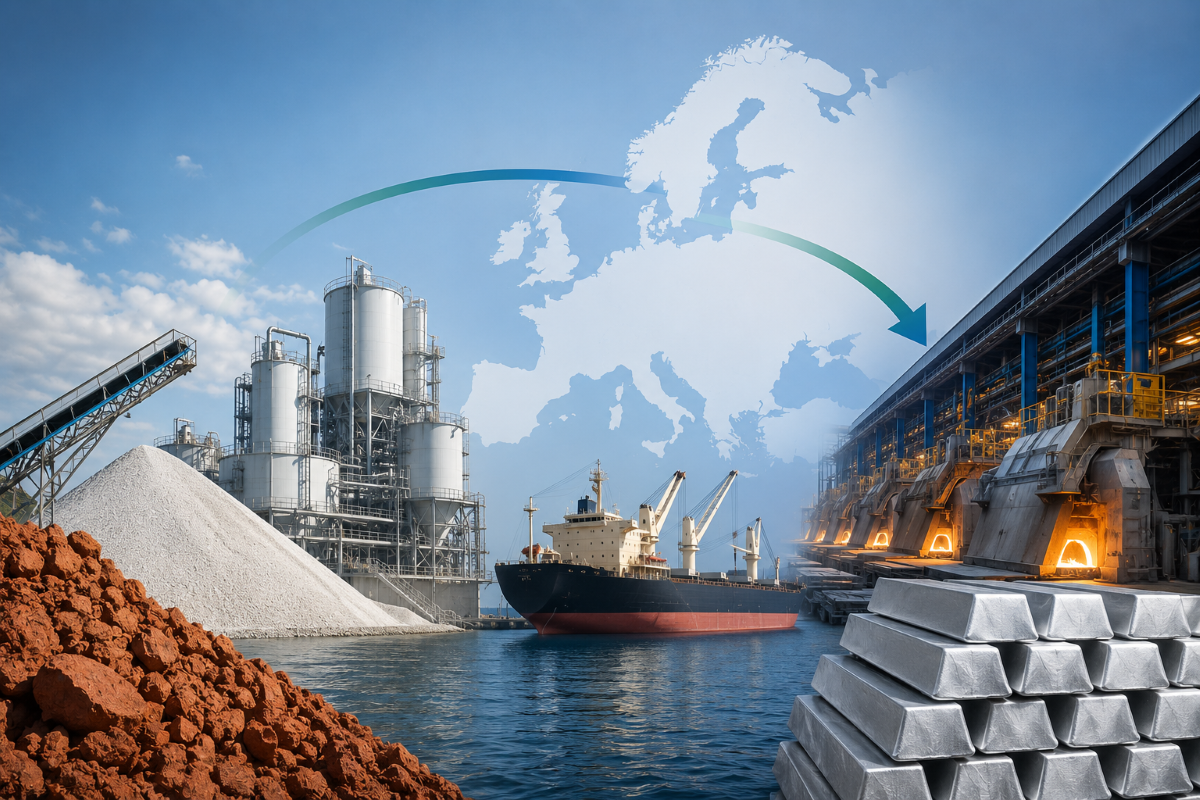
The image used in this article is generated with an AI tool and does not depict any real-time moment
Europe’s aluminium industry produced more metal in the first half of 2026, but the numbers hide a more complicated story. Primary aluminium output rose 4.9 per cent year on year to 3.648 million tonnes, while metallurgical-grade alumina production fell 1.8 per cent to 2.846 million tonnes.
At first glance, the numbers may seem contradictory. If aluminium production is rising, why is alumina production falling?
The answer lies in what happened during the first quarter. Alumina production was hit by energy and logistics disruptions linked to the Middle East conflict, while aluminium output benefited from smelter restarts. By Q2, however, alumina production had started to recover.
Aluminium grows 4.9 per cent while alumina slips 1.8 per cent
Europe, including Russia, produced 3.648 million tonnes of primary aluminium in H1 2026, up from 3.477 million tonnes in H1 2025. The increase of 171,000 tonnes includes, 1.795 million tonnes in Q1 and 1.853 million tonnes in Q2, compared with 1.728 million tonnes and 1.749 million tonnes, respectively, a year earlier.
Alumina could not match that performance. Production declined from 2.899 million tonnes in H1 2025 to 2.846 million tonnes in H1 2026. The weakness was concentrated in the first quarter, when output fell 6.7 per cent year on year to 1.380 million tonnes.
That immediately raises the question: what changed between the first and second quarters?
The answer can be seen in the monthly production pattern.
To know the futuristic market and value proposition of red mud, explore the report "A Comprehensive Analysis of Bauxite Residue (Red Mud): Sustainability, Resource Recovery and Strategic Recommendations"
February exposed the alumina problem - June showed the recovery
Alumina production fell from 482,000 tonnes in January to 414,000 tonnes in February, a 14.1 per cent month-on-month decline. But the setback did not last.
March brought a 16.9 per cent rebound to 484,000 tonnes, followed by 466,000 tonnes in April and 482,000 tonnes in May. Then came June, when production jumped 7.5 per cent to 518,000 tonnes, the highest monthly level of H1.
What caused such a sharp turnaround?
The timing points towards the easing of the energy and logistics disruption created by the Middle East conflict. Alumina refining is particularly sensitive to gas availability because calcination requires substantial amounts of energy. Disruptions around the Strait of Hormuz therefore created pressure on refineries and the wider aluminium supply chain.
The conflict also pushed LME aluminium prices sharply higher in March. The Middle East supplies around 20 per cent of Europe’s aluminium-related material flows, while Bahrain’s Alba was operating at around 50 per cent capacity by late April and EGA declared force majeure on contracts in late March.
As the acute disruption eased, a US-Iran ceasefire led to a partial reopening of the Strait of Hormuz during Q2. Improved energy and feedstock flows allowed gas-dependent refining operations to increase output, helping explain why alumina production recovered 3.2 per cent year on year in Q2, after the Q1 decline.

Energy cost problem
Energy costs have already forced difficult decisions. Alcoa’s San Ciprián refinery in Spain has operated at reduced rates since 2022, with escalating natural gas prices weighing on its economics. More broadly, Europe has permanently or semi-permanently lost more than 1 million tonnes of aluminium capacity since 2022, after power prices surged above USD 0.50/kWh, affecting smelters in Germany, France, the Netherlands and Slovakia.
Iceland-based Century Aluminium also cut two-thirds of its output again by the end of 2025 because of grid constraints. Similar energy-related pressures have emerged outside Europe, with Indonesia, India and Africa revising preferential power regimes, resulting in operating curtailments, project delays or outright shutdowns.
Yet there is some potential for new supply. The planned expansion at Aluminium of Greece could add 400,000 tonnes per year, providing some upside for Europe's constrained alumina refining base.
Explore buying & selling leads of alumina and trade opportunities on AL Biz
Aughinish adds another layer of uncertainty
Europe's largest alumina refinery also faces a different kind of pressure.
Aughinish Alumina in Ireland, which has a nameplate capacity of 1.9 million tonnes per year, exports around half of its output directly to Russian smelters. Its Russian ownership has therefore put the refinery under increasing commercial and political scrutiny.
In June 2026, Aughinish faced increased attention over internal staff discussions linked to its Russian ownership and sanctions exposure. However, the immediate threat of disruption did not materialise, while the EU's latest sanctions package left alumina outside the restricted list.
That removed an immediate sanctions-related risk for the refinery and helped clear one of the uncertainties surrounding Europe's largest alumina producer.
Aluminium keeps growing - but not all smelters can follow
While alumina production was recovering, primary aluminium followed a steadier upward path. Output rose from 614,000 tonnes in January to 622,000 tonnes in March, dipped to 604,000 tonnes in April, and then reached a H1 high of 630,000 tonnes in May.
June brought a 1.7 per cent month-on-month decline to 619,000 tonnes, but output remained above the levels recorded in January, February and April.
The reason for this relative resilience is partly structural. Aluminium smelting is far more electricity-intensive and slower to restart than alumina refining. That means improvements in energy availability do not immediately translate into full smelter output.
Some European capacity, however, is already returning. Hydro reported all-time high casthouse production in Norway and announced plans on July 1 to restart 75,000 tonnes of capacity at Slovalco in Slovakia after reaching a new agreement with the Slovak government on carbon cost compensation.
Alcoa’s San Ciprián smelter in Spain has also restarted and is operating close to full capacity after securing energy hedging through 2027. These restarts helped support the 4.9 per cent year-on-year increase in European primary aluminium production in H1.
But Gulf-linked smelters remained under pressure. Qatalum, half-owned by Hydro, was operating at around 60 per cent of capacity because reduced gas supplies from QatarEnergy pushed up costs.
For producers, simply having access to energy was not enough. During the energy spike, some chose to throttle production rather than sell aluminium at a loss, showing how production economics continued to limit the pace of recovery even after energy flows began to improve.
Unlock key insights from leading companies and experts across the aluminium ecosystem with our e-Magazine - Mine to Market: Aluminium Producers & Manufacturers 2026
The bigger question: how much alumina does Europe actually have?
The H1 figures reveal the most striking imbalance in the regional aluminium chain.
Europe, including Russia, produced 2.846 million tonnes of alumina, against 3.648 million tonnes of primary aluminium. At the industry benchmark of around 1.9 tonnes of alumina required for every tonne of aluminium, producing that volume of aluminium would require approximately 6.93 million tonnes of alumina.
Against reported regional alumina production of 2.846 million tonnes, that leaves a theoretical gap of around 4.09 million tonnes.
In other words, the reported domestic alumina production could theoretically support only around 41 per cent of Europe's primary aluminium output in H1 2026 at a 1.9:1 conversion ratio.
The gap does not mean Europe physically lacks the alumina needed to produce its aluminium. Rather, it shows that a large part of the alumina feeding the region's smelters must come from sources outside the reported regional production figure, such as imports or existing inventories.
How is the 4-million-tonne gap being covered?
The roughly 4.09 million tonne theoretical gap is being managed through a mix of RUSAL’s vertically integrated supply chain and seaborne alumina purchases, rather than a single source. RUSAL’s stake in China’s Hebei Wenfeng refinery provides alumina that can be shipped to Russian smelters, while its Guinea bauxite operations feed the wider RUSAL network, including Aughinish in Ireland.

Guinea also has domestic alumina refining capacity that can supply international markets. When captive supplies are insufficient, producers can turn to seaborne purchases from Brazil, India and other major producers. This dependence is reflected in Europe’s 7–10 million tonnes of alumina imports in 2025, underscoring the region’s reliance on external supply to support its aluminium production.
Note: This is exclusive coverage by AL Circle and may not be reproduced, republished or shared without prior permission.
Norsk Hydro's Alunorte production cut lifts aluminium shares in Asia
Next articleNorsk Hydro restarts Alunorte output after gas deal, expects $75 to 100 million Q3 hit
Grow with
AL Circle