66% and counting: China leads aluminium extrusions as India’s demand nears 858,000 tonnes
The images used in this article are generated with an AI tool and does not depict any real-time moment
The centre of gravity of the global aluminium extrusion market is increasingly difficult to locate anywhere but Asia.
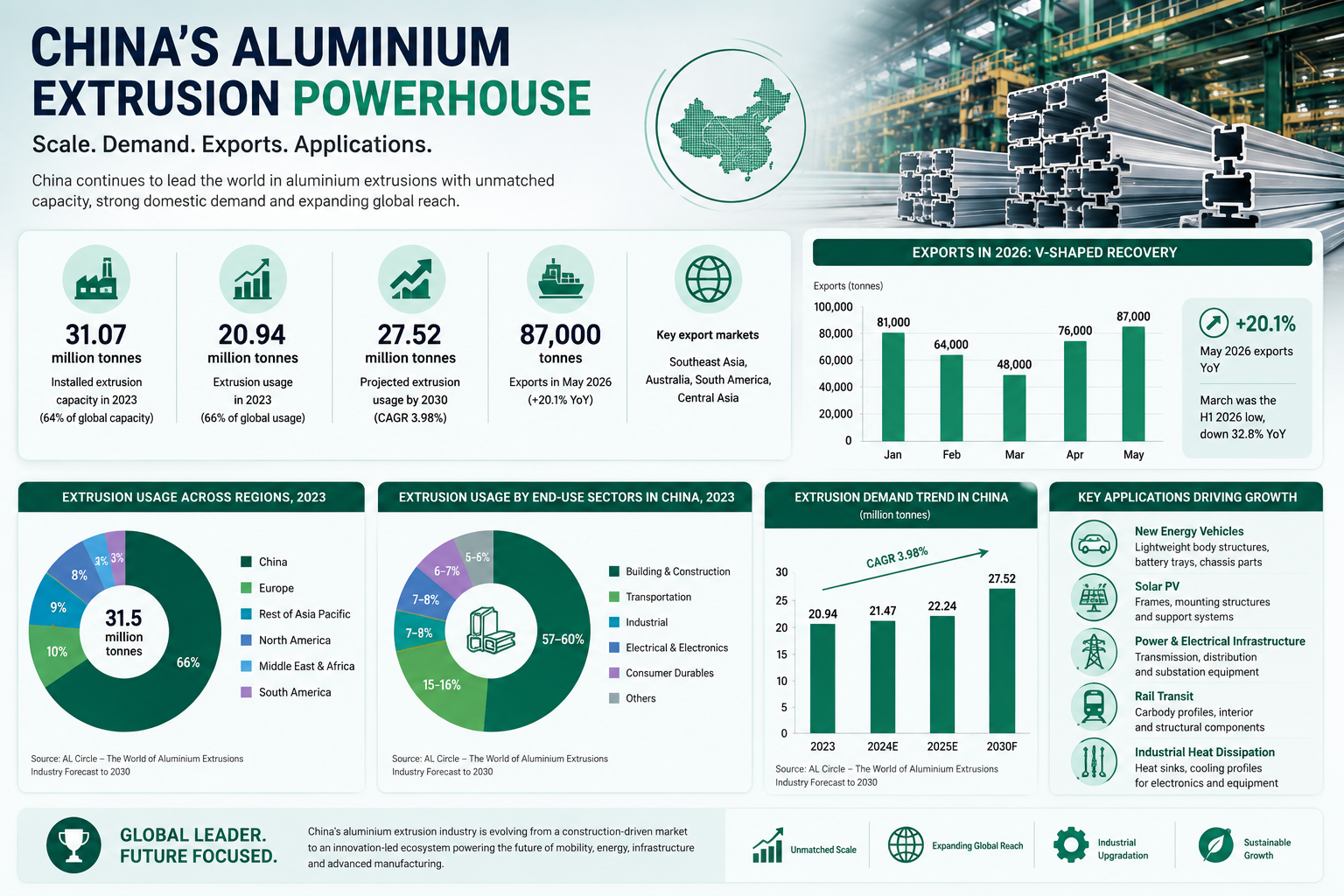
China already sits at a scale that no other extrusion-producing country approaches. AL Circle's The World of Aluminium Extrusions – Industry Forecast to 2030 estimated China's aluminium extrusion usage at 20.94 million tonnes in 2023, against global consumption of approximately 31.5 million tonnes. That means, roughly two out of every three tonnes of aluminium extrusions consumed worldwide were used in China. The same study estimated that Chinese extruders had more than 30 million tonnes of annual capacity, while China's extrusion demand could approach 27.5 million tonnes by 2030.
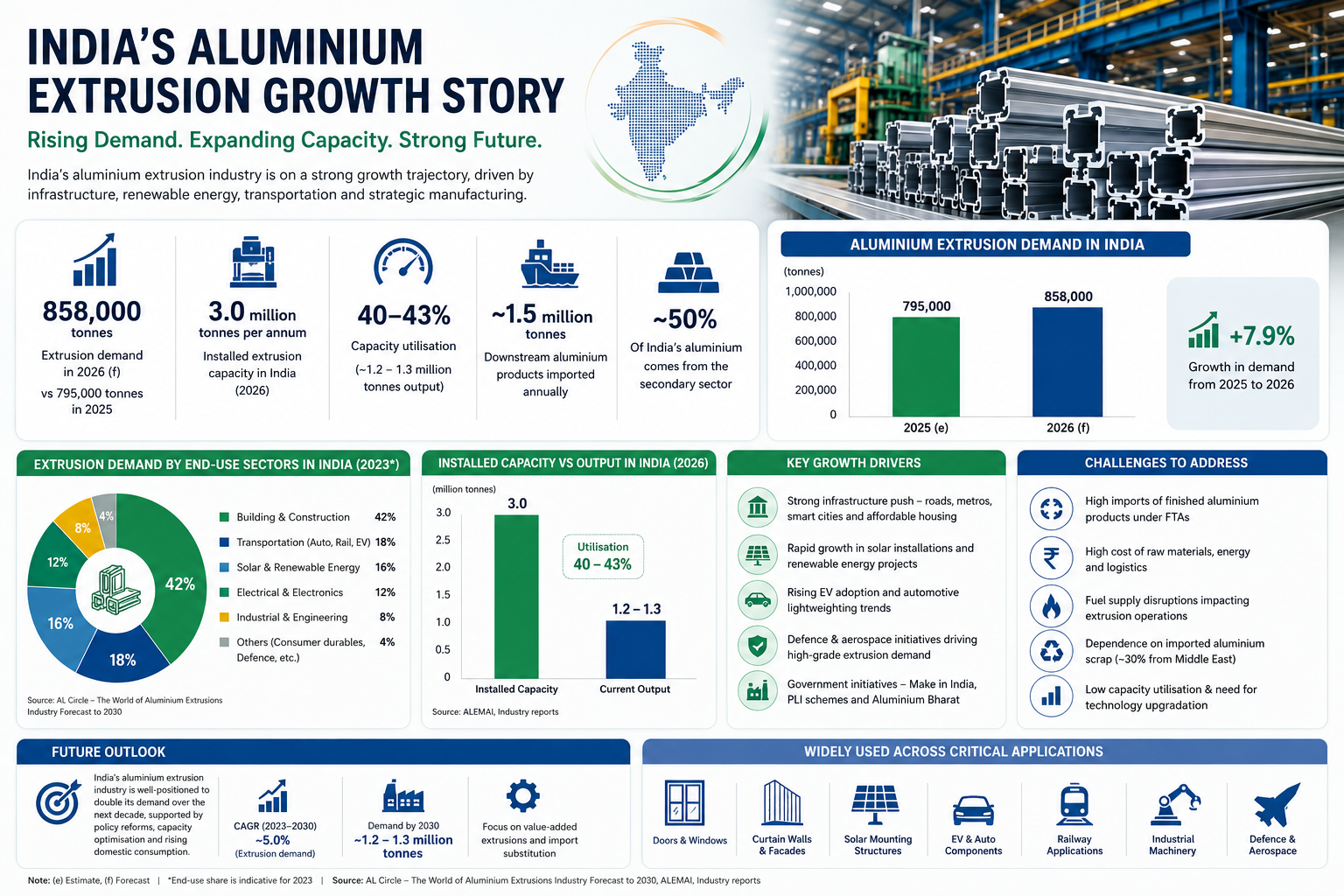
On the other hand, India operates on an entirely different scale, but perhaps on a more interesting growth curve. Industry data available to AL Circle puts India's aluminium extrusion demand at approximately 795,000 tonnes in 2025, increasing to an estimated 858,000 tonnes in 2026 — a year-on-year rise of about 7.9 per cent.
China’s consumer sector is migrating away from dependence on traditional architectural profiles towards EV lightweighting, solar PV, energy storage, electrical systems, rail transit and thermal-management applications, while exporters increasingly target emerging economies as Western trade barriers rise. India, meanwhile, has substantial installed capacity but low utilisation, even as domestic requirements from infrastructure, renewable energy, transport and strategic industries accelerate.
Together, they are reshaping where aluminium profiles are produced, where they are consumed and increasingly which markets global buyers depend upon for value-added aluminium products.
China still sets the global extrusion benchmark
China's dominance has been decades in the making. AL Circle's extrusion industry study estimated worldwide extrusion capacity at approximately 49 million tonnes per annum in 2023, of which China alone accounted for about 64 per cent, or 31.07 million tonnes. Global extrusion usage stood at 31.5 million tonnes, with China representing approximately 66 per cent of consumption.
That concentration is projected to increase rather than disappear. AL Circle estimated China's extrusion consumption at 20.94 million tonnes in 2023, rising to 21.47 million tonnes in 2024 and approximately 27.52 million tonnes by 2030, implying a CAGR of about 3.98 per cent.
But China's 2026 extrusion market shows why headline tonnage alone no longer explains the industry.
According to SMM's H1 2026 aluminium extrusion review, traditional architectural extrusion demand remained weak during the first half of the year, while industrial extrusions linked to new energy, electricity infrastructure and heat dissipation provided the principal support to the industry. In early June, SMM put the operating rate among aluminium extrusion producers it tracks at 57.6 per cent. Demand remained firm in power systems, automotive lightweighting and photovoltaic frames even as the property market continued to weigh on architectural profiles.
Connect with verified aluminium extrusion buyers and suppliers through the AL Biz marketplace.
From windows to watts: China's consumption mix is changing
Construction remains enormous. AL Circle's report estimates that 57-60 per cent of Chinese extrusion consumption has historically gone into building and construction, with transportation accounting for roughly 15-16 per cent. Aluminium holds approximately 55 per cent of China's doors and windows market, supported by more than 8,000 companies involved in aluminium door and window manufacturing and supply and around 1,500 curtain-wall fabricators.
That exposure also explains the industry's current vulnerability.
China's prolonged property correction has weakened one of extrusion's largest traditional outlets. Yet industrial demand is filling part of the hole.
Transportation is particularly important. China accounts for an estimated 56 per cent of global aluminium extrusion usage in transportation, according to the AL Circle study. The country's dominance of electric vehicle production creates a large domestic market for aluminium profiles used in body structures, chassis components and other lightweight applications.
Electrical and industrial applications are another sizeable demand pool. In 2023, China was estimated to consume approximately 1.46 million tonnes of extrusions in electrical and electronics applications and another 2.09 million tonnes in industrial applications. China's position in solar manufacturing adds another layer: the country accounted for an estimated 71 per cent of global solar PV manufacturing capacity in the AL Circle report.
SMM's 2026 assessment suggests those structural trends are strengthening. Demand for power transmission and transformation equipment, energy-storage structural components, industrial heat sinks and rail transit profiles remained relatively resilient in H1. PV frames and mounting profiles also received a temporary Q1 boost as overseas customers brought orders forward before China's export tax rebate cancellation for PV-related products took effect on April 1.
China's extrusion exports stage a V-shaped recovery
The second pillar of China's dominance is trade.
Its extrusion exports went through an unusually volatile first half of 2026. SMM data shows exports at approximately:
|
2026 |
China aluminium extrusion exports |
|---|---|
|
January |
81,000 tonnes |
|
February |
64,000 tonnes |
|
March |
48,000 tonnes |
|
April |
76,000 tonnes |
|
May |
87,000 tonnes |
March represented the H1 trough, with shipments down 32.8 per cent year-on-year, before April exports jumped 56.8 per cent month-on-month to 76,000 tonnes. May shipments subsequently reached 87,000 tonnes, up 20.1 per cent year-on-year.
SMM identified Southeast Asia, Australia, South America and Central Asia as four core growth markets. Chinese producers have increasingly used overseas warehouses, cross-border stocking arrangements and overseas processing strategies to capture demand as European and US markets become more difficult.
The broader aluminium-semifabricated trade reinforces that picture. China's aluminium semis exports reached 535,700 tonnes in April 2026, rising 20.9 per cent month-on-month and 9.8 per cent year-on-year. Cumulative semis exports during January-April reached 1.1555 million tonnes, 6.2 per cent higher year-on-year.
India is the smaller giant with a capacity problem
India presents almost the inverse picture. The country’s extrusion consumption remains a fraction of China's, but domestic demand is accelerating while the country possesses considerably more manufacturing capability than it currently uses.
Recent industry estimates cited by ALEMAI put India's installed aluminium extrusion capacity at around 3 million tonnes per year, while output is only around 1.2–1.3 million tonnes, implying capacity utilisation of roughly 40-43 per cent. At the same time, approximately 1.5 million tonnes of downstream aluminium products are imported annually, although this import figure covers downstream aluminium products rather than extrusions alone.
Meanwhile, India's extrusion challenge is that it needs to make the existing domestic downstream ecosystem more competitive.
ALEMAI has argued that imports of finished value-added aluminium products under FTAs can enter at zero or near-zero duty in some cases, while primary aluminium imported by Indian processors attracts higher duties. The association's Aluminium Bharat 2026 campaign consequently calls for tariff rationalisation, lower energy and financing costs, greater domestic billet availability and policies encouraging domestic consumption of value-added aluminium.
India's 858,000-tonne demand story is being built sector by sector
India's extrusion demand is estimated to rise from 795,000 tonnes in 2025 to 858,000 tonnes in 2026, equivalent to nearly 8 per cent annual growth.
The demand base is also becoming broader.
AL Circle's industry study estimated India's building and construction sector alone used approximately 280,000–300,000 tonnes of aluminium in 2023, with doors and windows representing an important demand source. The report expected India's construction industry to expand at around 8–10 per cent annually over the following five years, supported by infrastructure investment and consumption growth.
At the wider Asia-Pacific level excluding China, building and construction accounted for approximately 1.54 million tonnes of extrusion usage in 2023, transportation 431,000 tonnes, industrial applications 269,000 tonnes and electrical and electronics 189,000 tonnes. Transportation was forecast to grow the fastest among those major categories at 5.18 per cent CAGR through 2030, with India, South Korea and Southeast Asia among the growth markets.
AL Circle is coming up with a new Magazine "ALuminium’s Frontline: OEM Edition 2026." Feature your brand and opinion in the edition
Defence and aerospace push India up the extrusion value chain
In June 2026, India laid the foundation stone for a 10,000-tonne aluminium extrusion press at Yantra India Limited's Ordnance Factory Ambajhari in Nagpur. The facility is intended to manufacture large and complex aluminium alloy profiles for defence platforms, aerospace and aviation structures, missiles, railways and other strategic applications.
India's extrusion expansion has traditionally been associated with buildings, general engineering and increasingly renewable energy. The Nagpur project moves the conversation towards high-strength, precision and large-section aluminium extrusions, where import substitution carries both commercial and strategic value.
But 2026 exposed India's supply-chain vulnerabilities
India's rapid downstream growth is occurring alongside a reminder that having installed presses does not guarantee uninterrupted production.
The West Asian conflict caused severe fuel shortages earlier in 2026. By March, at least 25 Indian extrusion units had completely shut operations, while nearly 200 were operating at sharply reduced capacity. Industry output dropped from approximately 70,000 tonnes per month to 45,000 tonnes, according to ALEMAI figures reported by Business Standard. The association represents around 250 companies out of an estimated 450–500 extrusion units nationally.
The disruption exposed extrusion's dependence on LPG and piped natural gas for heating and processing.
Raw material security produced another warning. India generates almost half of its roughly 4.2 million tonnes of aluminium through the secondary sector, while remaining heavily dependent on imported aluminium scrap. Around 30 per cent of those scrap shipments originate in the Middle East, according to Reuters. Following supply disruption from the conflict, some secondary aluminium plants cut production by 20–40 per cent, while scrap prices increased by almost 30 per cent.
This has direct downstream consequences because India's automotive sector consumes around 60 per cent of domestically produced secondary aluminium.
The episode highlights an uncomfortable reality: India may have the presses and demand, but billet, scrap, fuel and energy security determine how much of that extrusion capacity can actually become reliable supply.

The global supply chain is moving downstream — and east
The next phase of Asia's aluminium extrusion dominance may therefore look different from the last one. China built its position largely through enormous manufacturing scale and construction-led consumption. The emerging Asian model is more diversified — combining Chinese industrial extrusion expertise and export reach with India's infrastructure-led demand, renewable energy expansion and move towards strategic high-value manufacturing.
Note: This is exclusive coverage by AL Circle and may not be reproduced, republished or shared without prior permission.
AL Circle Analysis: The new downstream aluminium investment map – where investors should watch
Next articleIndia’s 8.25% aluminium import levy pushes MSME raw material costs higher despite domestic metal surplus
Grow with
AL Circle