India’s 8.25% aluminium import levy pushes MSME raw material costs higher despite domestic metal surplus
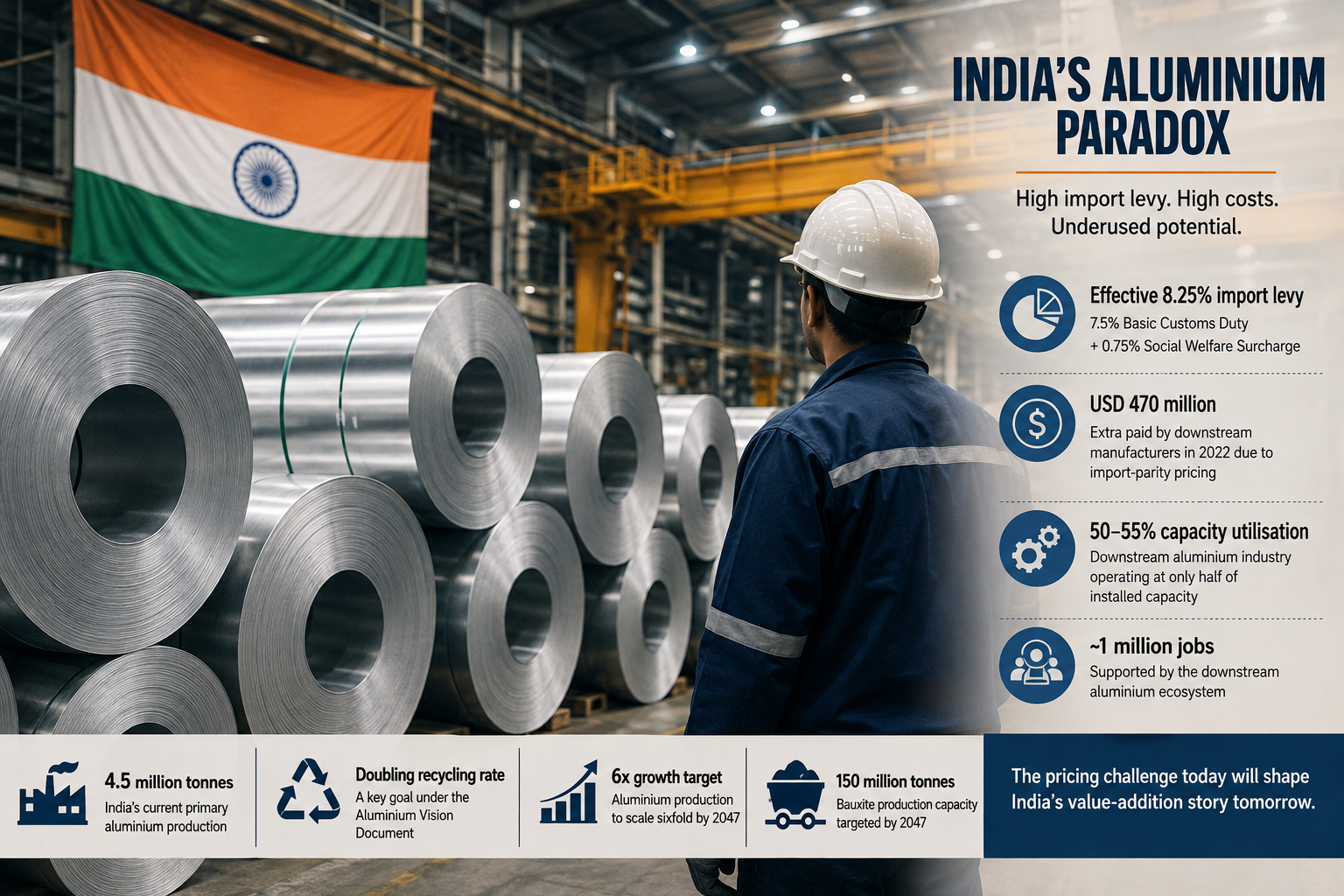
The image used in this article is generated with an AI tool and does not depict any real-time moment
India may be the world’s second-largest producer of primary aluminium, but for thousands of small manufacturers further down the value chain, access to domestically produced metal at globally competitive prices remains a pressing concern. The issue has returned to the centre of India’s aluminium policy debate, with import-parity pricing and the effective 8.25 per cent import levy on primary aluminium increasingly being cited by downstream manufacturers as factors raising their raw material costs.
The concern is growing as primary aluminium can account for as much as 80 per cent of the production cost of downstream manufacturers. For micro, small and medium enterprises (MSMEs) operating on thinner margins, even relatively small movements in the cost of metal can therefore have an outsized effect on profitability, capacity utilisation and competitiveness.
A recent report highlighted the pressure faced by smaller aluminium manufacturers because domestic primary aluminium prices are linked to import-parity pricing. Under this mechanism, the domestic price can reflect the international benchmark price of aluminium together with costs associated with importing the metal into India, even when the material itself is produced domestically.
The 8.25% at the heart of the debate
India currently levies a 7.5 per cent Basic Customs Duty on primary aluminium. With a 0.75 per cent Social Welfare Surcharge, the effective import levy reaches approximately 8.25 per cent.
The downstream industry’s argument is that this tariff does more than make imported primary aluminium expensive. Since domestic aluminium prices are benchmarked against international prices and can be aligned with import-parity levels, the tariff can indirectly influence the price paid for domestically produced metal.
The Federation of All India Aluminium Utensils Manufacturers (FAIAUM) and the Cable and Conductor Manufacturers Association of India (CACMAI) recently brought the issue directly before the Ministry of Mines. In a joint representation submitted on July 14, 2026, the two associations sought rationalisation of the effective 8.25 per cent Customs levy on primary aluminium.
Their concern is particularly relevant to aluminium-intensive manufacturing segments such as electrical conductors, cables, utensils, extrusions and other fabricated aluminium products, where the cost of metal constitutes a substantial share of total manufacturing expenditure.
The Aluminium Secondary Manufacturers Association (ASMA) and other downstream stakeholders have also repeatedly sought policy intervention over the tariff structure.
To know the production, demand and consumption forecasts of aluminium casting, explore our report "Global Aluminium Casting Market 2026-2032"
USD 470 million: The number that puts the problem into perspective
Perhaps the strongest numerical indication of the scale of the issue comes from the Ministry of Mines’ Aluminium Vision framework.
Industry stakeholders citing the Aluminium Vision Document have said that import-parity pricing resulted in India's downstream aluminium manufacturers paying approximately USD 470 million extra to domestic primary aluminium producers in 2022.
What may initially appear to be a disagreement over an 8.25 per cent import levy becomes a broader question about where value addition should occur within India's aluminium value chain.
Additional raw-material expenditure for MSMEs can mean less capital available for new machinery, capacity expansion, product development, technology upgrades and working capital.
India produces millions of tonnes of aluminium, yet downstream capacity is underused
India's primary aluminium industry is already globally significant. The country is the world's second-largest producer, with current production of around 4.5 million tonnes per annum.
However, India's downstream aluminium industry is estimated to be operating at only around 50-55 per cent of installed capacity, according to recent representations by industry stakeholders.
The segment nevertheless supports nearly one million direct and indirect jobs, highlighting how strongly the downstream aluminium ecosystem is linked with India's broader MSME and manufacturing economy.
India possesses domestic bauxite resources, alumina refining capacity, large-scale aluminium smelters and an extensive downstream manufacturing base. Yet downstream manufacturers contend that the pricing structure for primary metal prevents them from fully converting those upstream advantages into competitively priced value-added aluminium products.
The FTA equation adds another layer
The tariff structure becomes more complicated when finished aluminium products are considered.
Downstream industry representatives have pointed out that while primary aluminium entering India attracts Customs duty, some finished aluminium products can enter the country at lower or zero tariffs under applicable free trade agreements.
Under the ASEAN-India Free Trade Agreement, for example, qualifying products can receive preferential tariff treatment subject to applicable rules of origin.
This can create a difficult competitive equation for Indian manufacturers: the raw material required to manufacture a product domestically can carry an import-duty-linked pricing burden, while certain competing finished products manufactured abroad may receive preferential market access.
Connect with verified aluminium extrusion buyers and suppliers through the AL Biz marketplace.
Why import-parity pricing matters
Primary aluminium prices globally are typically influenced by the London Metal Exchange (LME), regional premiums, currency movements and other commercial factors.
Import-parity pricing broadly considers what an equivalent quantity of metal would cost if imported. Depending on the pricing methodology, this can incorporate the international benchmark, import duty and associated costs.
Downstream manufacturers argue that when domestic producers price aluminium with reference to import parity, Indian consumers effectively lose part of the cost advantage that might otherwise arise from having large-scale primary aluminium production within the country.
A large downstream manufacturer may have greater purchasing power, stronger working-capital access, sophisticated hedging mechanisms and longer-term supply arrangements. A small extrusion, conductor, utensil or fabrication unit has considerably less financial room to absorb sharp raw-material movements.
But primary aluminium producers have a different argument
India's primary aluminium producers have maintained that tariff protection is necessary to protect domestic smelting capacity and investment against lower-cost imports and international market distortions.
Primary aluminium production is exceptionally capital- and energy-intensive. Indian producers must also compete in a global market affected by energy costs, carbon policies, government support mechanisms, excess capacities in certain markets and fluctuating international aluminium prices.
Reducing tariffs on primary aluminium could increase competition from imported metal, potentially putting pressure on domestic producers.
The policy challenge for New Delhi, therefore, is to strike a balance between protecting India's upstream aluminium production capacity and ensuring that downstream manufacturers receive raw material at prices that allow them to compete internationally.
AL Circle is coming up with a new Magazine "ALuminium’s Frontline: OEM Edition 2026." Feature your brand and opinion in the edition
India's 2047 aluminium ambition makes the MSME question difficult to ignore
The Ministry of Mines' Aluminium Vision Document, released in July 2025, envisages a dramatic expansion of the country's aluminium economy.
The government wants India to scale aluminium production roughly sixfold by 2047. The roadmap also calls for bauxite production capacity to reach 150 million tonnes per annum, a doubling of the national aluminium recycling rate, wider adoption of low-carbon technologies and stronger raw-material security.
Industry estimates associated with the vision indicate that aluminium production may need to increase from approximately 4.5 million tonnes per annum to nearly 37 million tonnes per annum by 2047, requiring additional investment exceeding INR 20 trillion.
But simply producing more primary aluminium will not automatically make India a global aluminium manufacturing powerhouse.
A notable portion of the economic opportunity lies further down the chain — in aluminium extrusions, rolled products, foils, conductors, cables, castings, automotive components, packaging, building systems, renewable-energy applications and other value-added products.
These are also segments capable of generating substantially more manufacturing activity and employment around every tonne of aluminium consumed.
India faces two parallel challenges
The first is to expand upstream capacity sufficiently to supply a rapidly growing economy.
The second is to ensure that enough of that aluminium is transformed into high-value products inside India rather than allowing the country's competitive advantage to stop at the primary-metal stage.
The second objective is where MSMEs become crucial.
However, any tariff revision would also need to account for its potential impact on India's primary aluminium producers, future smelting investments and import dependence.
66% and counting: China leads aluminium extrusions as India’s demand nears 858,000 tonnes
Next articleSilicon market slump prompts Press Metal to reposition PMBT towards aluminium alloys
Grow with
AL Circle