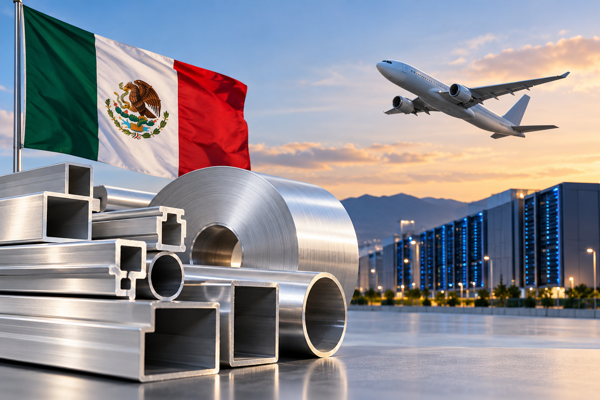
Mexico’s aluminum industry is looking to capitalize on rising demand from artificial intelligence (AI) infrastructure, electric mobility, automotive manufacturing, and aerospace. Expanding technology investments and international market opportunities are expected to support sales growth, while the country’s reliance on imported aluminum highlights the importance of strengthening domestic processing capabilities. Ramón Beltrán, president of Mexico’s National Chamber of the Aluminum Industry (Canalum), expects the country’s domestic and international aluminum sales to gain momentum in 2026, supported by demand from advanced technology applications and established manufacturing sectors. “We expect to close out this year with growth of between 7.5% and 7.8% in domestic and international...
The Confederation of British Metalforming (CBM) has called for closer UK-EU relations, warning that proposed European industrial policies could affect British manufacturers supplying the aluminium, steel and automotive industries. Stephen Morley, CBM President and Chair of the Euroforge Automotive Sector, made the call at the organisation's autumn meeting in Munich. He said stronger cooperation between the UK and EU was important for protecting manufacturing jobs, investment and cross-border supply chains. He stated, “ We need to protect British industry, but we also need to recognise that the UK and European automotive sectors are deeply connected. What damages one part of the supply chain will inevitably affect the other. ” Join the fourth edition of webinar " Hedging for recyclers -...
Grow with
AL Circle

Paper-based packaging company Elopak has begun using low-carbon aluminium produced with renewable electricity in carton packaging manufactured at its facilities in the Netherlands, Denmark and Ukraine, as part of its efforts to reduce the environmental impact of its products. The company said the switch lowers the carbon footprint of its standard packaging by nearly 8 per cent. Based on cradle-to-gate calculations, the carbon footprint of a standard aseptic Pure-Pak carton has been reduced from 53 grams of CO₂ to 49 grams per carton. Emilie Olderskog, Global Head of Sustainability at Elopak, said, "The introduction of low-carbon aluminium delivers an immediate and measurable reduction in the footprint of our standard ambient cartons, while allowing us to retain the functional properties...

Waaree Renewable Technologies has received a contract to develop a 300 MW solar project, planned to be completed by FY27. The company has received the new order from its wholly owned subsidiary, Sunsational Power Private Limited (SPPL), for the development of the large-scale solar project. Under the agreement, Waaree will handle the construction of a 300 MW/450 MWp ground-mounted solar power project. The contract also includes operation and maintenance services for two years after the project is commissioned. The company said the project is expected to be completed during FY 2026-27. The order comes at a time when investors have been closely watching the company's project pipeline and order inflows. Explore: The most comprehensive and forward-looking industry-focused report – Global...

Germany-based energy drink producer Red Bull is reinforcing its sustainability agenda by prioritising aluminium packaging, expanding support for circular economy initiatives and pursuing long-term emissions reduction targets across its operations and supply chain. Manufacturing over 12 billion cans annually across more than 175 countries, packaging inevitably sits at the centre of its environmental footprint. Concurrently, over the years, Red Bull has increasingly positioned aluminium not merely as a container for its beverages but as a strategic material anchoring its long-term sustainability ambitions. Delve deeper into the recycled aluminium and secondary aluminium market with our World Recycled ALuminium Market Analysis Industry forecast to 2032 Red Bull’s mantra: “Circularity is the...

A plant manager running a highly efficient aluminium extrusion facility in Guangdong or an advanced die-casting hub outside Pune currently operates under a comfortable, yet highly precarious, illusion. They produce complex window frames, automotive structural castings, and precision-machined parts bound for the European market. Currently, they watch the headlines about the European Union Carbon Border Adjustment Mechanism and assume it is a problem exclusively for the primary smelters. They believe that the raw material giants will absorb the carbon taxes, enabling their finished goods to cross European borders without any scrutiny. This illusion will remain no longer on the 1st of January, 2028. The European Union launched the transitional phase of the Carbon Border Adjustment Mechanism...

While observing the World Environment Day on June 5, 2026, celebration and upkeep of environmental values and sustainability goals become a must. A key takeaway emerges as we look at the sustainability initiatives adopted by Vedanta Limited and its branch, Hindustan Zinc Limited, recognising and advocating measures to achieve climate goals for a greener future. Throwing light on the renewed approach of the mining and metals sector in contributing to environmental well-being, the Chairperson of Hindustan Zinc, Priya Agarwal Hebbar, notes, “At Hindustan Zinc, we believe the future of mining is about producing the metals the world needs while leaving a lighter footprint on the planet.” Delve deeper into the recycled aluminium and secondary aluminium market with our World Recycled ALuminium...

Rio Tinto, one of the leading global mining companies, is applying automation technology in addition to developing new processes for zero-emission aluminium products. The giant has partnered with Sandvik on new automated drill rigs, which have been designed for use in open-cut mining. These technologies will deliver more productive and efficient operations while enhancing worker safety. Rio Tinto is introducing automated drill rigs with data-driven operational systems to improve the operating performance of its existing mining operations with increased levels of operational precision and less manual input. This announcement highlights the industry’s continued push toward automation and smarter mining tech for better efficiency and cost savings. Alongside that, Rio Tinto has a USD 1.5...

Australian unions have called on the federal government to establish a state-owned renewable energy company to provide low-cost electricity to aluminium smelters and other energy-intensive industries, arguing that private power markets are failing to deliver affordable long-term energy supplies. The proposal, outlined in a report by the McKell Institute and backed by the Electrical Trades Union (ETU), would create a new government-owned entity called "Sovereign Power" to build, own and operate renewable energy and storage projects and supply electricity to major industrial users at cost. According to the report, Sovereign Power could provide electricity at around AUD 65-66/MWh, significantly below current market contract prices of about AUD 117/MWh. The lower cost would stem from...

It has been over a month since we released our flagship magazine " ALuminium LeaderSpeak 2026 ", bringing together industry leaders, executives and decision-makers from across the global aluminium value chain. Through interviews and articles, the magazine explores the opportunities, challenges and market developments shaping the industry’s future. The aluminium industry has always adapted to changing market conditions. Today, however, policy developments are becoming just as influential as supply, demand and production costs. In this magazine, the industry leaders from across the value chain shared their views on the growing impact of measures such as CBAM, tariffs, trade restrictions and the evolving sustainability regulations. While these policies differ across regions, one message...

High energy prices continue to pressure the European aluminium industry, with market participants warning that costs could rise further if disruption risks around the Strait of Hormuz persist. Europe’s summer energy restocking season could add further strain to supplies and increase the risk of additional price spikes, market analysts said. Aluminium production is heavily dependent on electricity. The International Aluminium Institute estimates that producing one tonne of aluminium requires around 14–15 megawatt-hours of electricity. The European Commission said on May 8 that there were no immediate concerns regarding EU energy security, although it warned that “global price spikes remain a concern.” High power prices continue to affect aluminium producers across Europe. According to...

Novelis has published Environmental Product Declarations (EPDs) for selected products in its European portfolio used in architectural and construction applications, aiming to provide customers with verified environmental data for sustainable building projects. The EPDs cover a range of aluminium solutions, including primary-grade materials, high-recycled-content alloys, advanced products such as HRC57S, and anodised aluminium products containing more than 90 per cent recycled content. According to the company, the declarations were developed in line with international standards and independently verified by a third party to ensure transparency and consistency in environmental reporting. Michael Hahne, Vice President Commercial at Novelis Europe, said transparent and reliable environmental...

For more than a century, aluminium producers have lived by a simple rule of securing the cheapest electricity possible, and everything else becomes manageable. The logic was straightforward. Aluminium smelting is one of the most electricity-intensive industrial processes on earth. Every tonne of primary aluminium requires enormous volumes of power to separate aluminium from alumina through the Hall-Héroult process, a technology that has remained fundamentally unchanged since the late nineteenth century. The industry's fortunes have therefore been determined less by geology and more by what happens on power grids. For decades, coal represented the backbone of global aluminium production. It was abundant, dispatchable and, in many regions, cheap enough to support large-scale smelting...

European aluminium sector warns that excess aluminium volumes, particularly from China, are distorting competition, weakening profitability and threatening the long-term resilience of Europe’s upstream and downstream value chains. As global overcapacity and unfair trade practices continue to mount and pressure Europe’s industrial base, its aluminium industry seeks a stronger and more effective EU trade defence framework. Delve deeper into the recycled aluminium and secondary aluminium market with our World Recycled ALuminium Market Analysis Industry forecast to 2032 In a joint industry statement backed by multiple European industrial associations, signatories stressed that the EU’s existing Trade Defence Instruments (TDIs) remain critical but are no longer sufficient to address the scale...

Aluminium has proved indispensable to modern industry, being lightweight and recyclable, with global demand projected to grow from 106 million tonnes in 2025 to 130 million tonnes by 2035. Although playing a critical role in the global energy transition, the sector remains carbon-intensive, emitting nearly 270 million tonnes of CO2 in 2022, or about 3 per cent of global industrial emissions. European primary aluminium production had a carbon footprint of 6.6 kg CO2 per kg of aluminium based on 2023 data gathered by European Aluminium, versus a global average of 14.8 kg CO2 per kg. Europe’s aluminium industry has unveiled a comprehensive innovation roadmap aimed at combating climate change and accelerating the sector’s transition toward climate neutrality, circularity and industrial...

ABx Group Limited has outlined new developments across its resource and technology operations after hosting representatives from the Australian Aluminium Council at its ALCORE Technology Centre in Tasmania. The visit placed attention on the company’s work to recover useful fluorine chemicals from waste generated by aluminium smelters, an area ABx believes could become increasingly important as industries look for cleaner production methods. Much of the discussion centred on the pilot plant being developed at Bell Bay. Rather than treating smelter by-products as disposal material, the company is attempting to process them into industrial chemicals with commercial value. The project reflects a broader shift within the resources sector towards recycling waste streams and improving...

Norsk Hydro has remained in focus after releasing recent quarterly results and updating investors on dividends, spending plans and market conditions.The company is still dealing with a mix of weaker aluminium prices, unstable energy costs and uneven industrial demand, while at the same time trying to strengthen its position in low-carbon aluminium and recycling. Norsk Hydro is one of the few aluminium companies that operates across almost the full chain of production. Its business includes bauxite mining, alumina refining, primary aluminium production, extrusion, rolling products and recycling operations. A big advantage for the company is its hydropower business in Norway. The electricity generated there supports its smelting operations and also helps Hydro market itself as a...

The Ministry of New and Renewable Energy (MNRE) has revised the approved material list for module mounting structures (MMS) used in residential rooftop solar systems under the ‘PM Surya Ghar: Muft Bijli Yojana’ (Prime Minister’s free electricity scheme). Among the latest additions is Zinc Aluminium Magnesium (ZAM) alloy, which can now be used alongside galvanised iron, aluminium, hot-dip galvanised mild steel, and conventional mild steel for the fabrication of these structures. The change was introduced through an official memorandum issued by the ministry after repeated representations from industry stakeholders. Recommendations and technical feedback from the National Institute of Solar Energy (NISE) also played a role in the decision-making process. The amendment applies to the...

China is exploring how coal waste could become a new domestic source of critical metals used in batteries, semiconductors, electric vehicles and defence-related industries, as the country moves to secure supplies of strategic raw materials. A recent report said fly ash and gangue produced during coal mining, washing and combustion may hold recoverable amounts of germanium, aluminium, lithium and gallium. These metals are used in sectors ranging from electronics and optics to energy storage, advanced manufacturing and military equipment. The study suggested coal should no longer be treated only as an energy resource, as waste generated through mining and power generation can also contain valuable metallic elements. Fly ash left behind after coal combustion and gangue removed during mining...

Hydro has partnered with Parsons Healthy Materials Lab to examine how recycled and low-carbon aluminium can support more sustainable building and construction practices. The collaboration will explore how advances in recycling technology and renewable energy-powered aluminium production are reshaping aluminium’s role in the built environment and influencing material choices across the construction sector. Aluminium has traditionally been viewed as a carbon-intensive construction material because of emissions linked to primary production. However, increasing use of recycled aluminium and cleaner energy sources is helping lower the material’s carbon footprint significantly. According to Hydro, recycled aluminium is increasingly being recognised as a lower-emission option for...