AL Circle Analysis: How geopolitics, trade and strategy reshaped the upstream aluminium market

The image used in this article is generated with an AI tool and does not depict any real-time moment
When aluminium prices moved this year, demand was not always the driving force. Sometimes the catalyst was a Guinean bauxite export terminal. At other times, it was a power contract in South Africa, tensions in the Strait of Hormuz.
Taken together, these developments reflected a broader shift in the upstream aluminium industry. Geopolitics, government policy and supply-chain resilience are increasingly shaping raw material flows, investment decisions and long-term market strategy.
Strait of Hormuz disruption reshaped trade
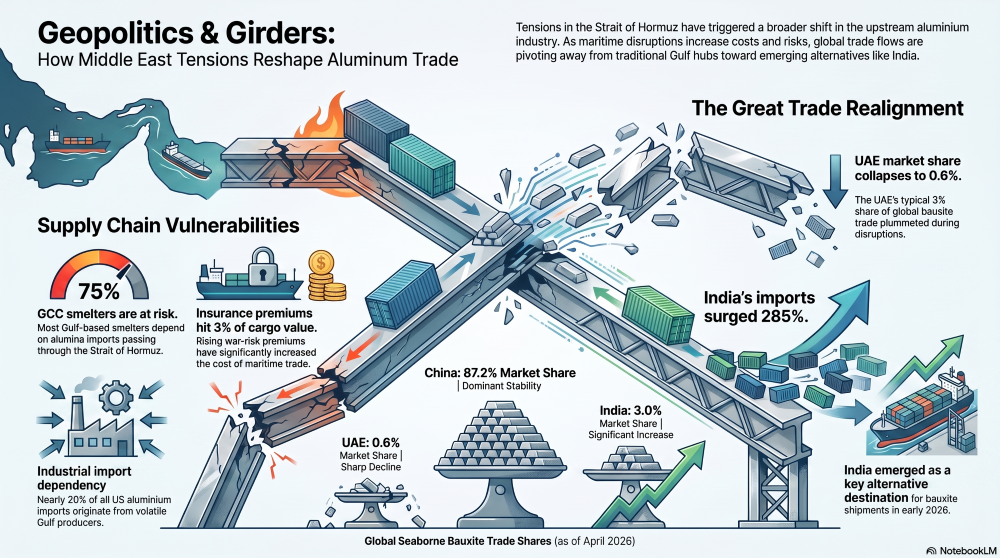
The Middle East conflict highlighted the vulnerability of the aluminium supply chain to maritime disruptions. Tensions in the Strait of Hormuz caused higher freight costs, rising war-risk insurance premiums and shipping uncertainty disrupted bauxite movements into the Gulf, particularly the UAE.
As cargoes were redirected, global trade flows shifted. India emerged as a key alternative destination, significantly increasing its bauxite imports, while China maintained its dominant position as the world's largest buyer of Guinean ore.
Key takeaways
Middle East supply-chain risk
- Around 75 per cent of GCC smelters depend on alumina imports passing through the Strait of Hormuz, which is under risk.
- Nearly 20 per cent of US aluminium imports originate from Gulf producers, also uncertain.
- War-risk insurance premiums approached 3 per cent of cargo value.
Trade routes shifted
- Signal Ocean recorded no bauxite shipments departing for the UAE in March 2026.
- Shipments resumed in April at 126,000 tonnes, but remained more than 71 per cent below the corresponding 2025 level.
- The UAE's share of global seaborne bauxite trade fell to 0.6 per cent, compared with its typical share of around 3 per cent.
- Trade routes shifted as Hormuz disruptions reduced UAE-bound shipments, boosting India's imports. India imported 2.5 million tonnes of bauxite in Q1 2026, up 285 per cent year on year, followed by 781,000 tonnes in April, an increase of 24 per cent.
- Commodity Radar also reported that India's higher bauxite imports coincided with a more than 66 per cent increase in alumina exports between January and April 2026.
- China remained the dominant destination, accounting for 87.2 per cent of global seaborne bauxite shipments in April 2026, highlighting its continued dominance in global raw material demand.
- Other destinations accounted for relatively small shares, led by India (3.0 per cent), followed by Ireland (1.9 per cent), Canada (1.6 per cent), Mauritius (1.3 per cent), the Philippines (1.1 per cent), the United States (1.0 per cent) and the UAE (0.6 per cent) due to trade route change. Read the full analysis here.
Guinea's export surge drove changes across the bauxite market
Guinea remained at the centre of the upstream aluminium market as exports continued to rise and reinforced its position as China's primary supplier. However, higher export volumes also pushed prices lower as supply outpaced demand.
Attention later shifted from growing exports to the possibility of export restrictions, highlighting how policy decisions in a single producing country could influence global raw material availability.
Key takeaways
Guinea dominated China's bauxite supply
- China imported 82.57 million tonnes of Guinean bauxite during January-May 2026, up 24 per cent year on year.
- Guinea supplied nearly 82 per cent of China's imported bauxite.
- Guinea and Australia together accounted for more than 97 per cent of China's imported bauxite, reinforcing their dominance in the country's supply chain.
Prices fell despite higher trade volumes
- China's average bauxite import price declined 27 per cent, from USD 88 per tonne to USD 64 per tonne, as expanding Guinean exports outpaced demand.
- FOB Guinea bauxite prices fell to USD 32-38 per tonne, their lowest level since March 2022.
Explore: The most comprehensive and forward-looking industry-focused report – Global Bauxite & Alumina Market Forecast to 2036: Supply–Demand, Trade Flows & Price Outlook
Export curb proposal created fresh uncertainty
- Signal Ocean estimated the proposed reduction could release capacity equivalent to around 46 Capesize vessels.
- Its analysis also indicated that if Guinea's exports to China reach around 100 million tonnes during the first half of 2026, a proposed 150-million-tonne annual export ceiling would leave only about 50 million tonnes available for the second half of the year before accounting for exports to other destinations.
South32's aluminium exit reflected a changing investment strategy
Corporate decisions during the period also reflected broader structural changes in the upstream industry.
Despite low LME aluminium inventories and expectations of a market deficit, South32 chose to reduce its exposure to aluminium by selling most of its business to Alcoa. The move underscored how rising electricity costs and long-term operating risks are increasingly influencing investment decisions.
For Alcoa, the acquisition strengthens its integrated mine-to-metal strategy and significantly expands its upstream presence.
Key takeaways
- South32 agreed to sell most of its aluminium business to Alcoa in a transaction worth up to USD 5.6 billion, including a USD 750 million price-linked earn-out.
- Alcoa expects approximately USD 900 million in synergies from the acquisition.
- The transaction will increase Alcoa's share of global bauxite production from 8.5 per cent to 13 per cent.
Unlock key insights from leading companies and experts across the aluminium ecosystem with our e-Magazine - Mine to Market: ALuminium Producers & Manufacturers 2026
CRISIL upgrades Vedanta, Vedanta Aluminium and Vedanta Oil & Gas ratings after demerger
Next articleLME aluminium prices slip as December 27 contracts drop 0.74%; alumina Platts price rises 0.54%
Grow with
AL Circle