

AL Circle analysis: Germany’s aluminium trade surplus, Novelis’ US expansion, Asia’s EV demand & India’s underutilised downstream capacity
Aluminium’s next growth phase is increasingly being shaped by downstream processing, supply-chain resilience and demand from specialised applications. Germany continues to generate a substantial trade surplus in flat-rolled products despite a shrinking primary aluminium base, while North America is investing in recycling and rolling. Across Asia, new manufacturing capabilities and growing demand from electric vehicles, railways and batteries are creating further opportunities. However, declining exports, underutilised capacity and uneven profitability show that investment alone does not guarantee success. For industry leaders, the challenge is to identify where demand is shifting, develop products that meet customer requirements and ensure that new investments translate into sustainable...
AL Circle Analysis: From Guinea to Gulf, how bauxite, tariffs and logistics redraw aluminium map
Aluminium markets in late 2026 are being shaped by more than the headline LME aluminium price. Bauxite security, alumina availability, geopolitical disruptions, tariff negotiations, logistics diversification and regional premiums are increasingly determining where metal moves and what buyers pay. From RUSAL reassessing Caribbean assets and Vedanta securing Odisha bauxite to Brazil extending mine life and EGA rebuilding its Guinea supply chain, producers are strengthening control over critical raw materials. At the same time, the US remains heavily dependent on imported bauxite and alumina, while Europe and Asia are experiencing sharply different premium dynamics. These developments point to a market where physical availability is becoming a regional factor even as aluminium itself remains...
Grow with
AL Circle

From bauxite to alumina: key projects redefining aluminium supply in 2025
2025 has marked a year of upstream momentum for the aluminium industry. Across continents, bauxite mines and alumina refineries are coming online, quietly redefining where global supply begins. This shift is being driven by a wave of projects that are expanding raw material capacity and reshaping countries’ positions within the aluminium value chain. Highlighting some of 2025’s key Bauxite project 1. Canyon’s Minim Martap enters commercial reality Cameroon’s bauxite story has moved out of the speculative stage. Commercial activity is now underway at Canyon’s Minim Martap bauxite project in the Adamawa Region, signalling that Central Africa is stepping into a more concrete supply role. The mine is designed to produce high-grade bauxite with low reactive silica, suitable for both low- and...

India-Canada’s energy reset with signing of joint statement: Trade, gas, nuclear and the math behind
The first two days of India Energy Week (IEW) 2026 were not short on announcements, but one development cut through the noise — India and Canada quietly reset their energy relationship, anchoring it in trade, supply security and investment logic rather than political symbolism. Explore- Most accurate data to drive business decisions with Global ALuminium Industry Outlook 2026 across the value chain The revival of the India-Canada ministerial energy dialogue and the signing of a joint statement between India’s Ministry of Petroleum and Natural Gas and Canada’s Ministry of Energy and Natural Resources came against a backdrop of tightening global energy markets and an increasingly explicit Indian strategy, one that treats hydrocarbons, gas, nuclear fuel and clean energy as parallel growth...

India’s transport energy balance: why petroleum, diesel and electricity must move in parallel, not in opposition
India’s transport transition is often framed as a contest between internal combustion engines and electric mobility. The data, along with the lived reality of energy demand, suggest something far less binary. As Dr Chanchal Samanta, DGM of Bharat Petroleum, made clear in his remarks at the ongoing India Energy Week 2026, India is not facing a fuel choice problem. It is managing a growth problem. Explore- Most accurate data to drive business decisions with Global Aluminium Industry Outlook 2026 across the value chain Electric vehicles are rightfully positioned as the sustainable endpoint for transport. But for a country like India, the energy system is expanding faster than substitution can realistically occur. “One is growth, and one is total growth,” Samanta said, pointing to the gap the...

Growing aluminium scrap consumption in China leads to a 5-year high import – Is this mirroring the US journey from primary to scrap?
For years, aluminium strength was measured in smelters and megawatts. Primary metal sat at the heart of industrial growth, and power determined who could scale and who could not. That formula is starting to lose its hold. In both China and the United States - the world’s two largest aluminium markets, the focus is shifting away from energy-intensive primary production and toward a material once treated as secondary material in literal sense: aluminium scrap . The US has already taken a decisive step in that direction. China has been found to be increasing its secondary aluminium consumption and hence its imports to a great extent – but the question remains whether the country is shifting its focus from primary aluminium to secondary metal. China’s aluminium consumption profile provides...

WEEKLY: China's alumina inventory build persists despite output cuts
China's alumina output edged down last week as several producers in Henan and Guizhou provinces and in the Guangxi autonomous region scaled back production to carry out 10-14 days of maintenance, either to curb atmospheric pollution or to control operating costs.News of the production curtailments provided brief support to the alumina futures market late last week. The most-traded May 2026 alumina contract on the Shanghai Futures Exchange jumped 1.8 per cent during Thursday's daytime trading session from the prior day's settlement price. To know the aluminium market outlook for 2026 and beyond, get an access to our report: Global Aluminium Industry Outlook 2026 In contrast, spot alumina prices continued to weaken over the same week, mainly weighed down by steady inventory accumulation....

Metro Mining’s 2025: tidy execution, but how durable is the payoff?
Metro Mining finished 2025 with a set of neat operational checkboxes, including a reported 6.2 million wet metric tonnes (WMT) shipped for the calendar year (December volumes were 543,000 WMT), a year-end cash position of AUD 57 million, and the grinding down of junior liabilities that management says improved net leverage. To know the aluminium market outlook for 2026 and beyond, get an access to our report: Global Aluminium Industry Outlook 2026 Those outcomes matter because Metro is a single-asset producer operating from Cape York’s Bauxite Hills, where the operation’s optionality is tightly tethered to a single logistics route and a finite reserve base. Metro’s own materials put Bauxite Hills’ reserve at roughly 83.2-89.5 million tonnes and total resources in the c.118Mt range, enough...

MYSTEEL: China's coking coal market to see mild recovery in 2026
The Chinese coking coal market is expected to undergo a new phase of rebalancing in 2026, shaped by both supportive and restrictive policy impacts. While these mixed forces are anticipated to drive up coking coal prices, a persistent uptrend is unlikely to be seen this year due to persistent capacity surplus of the feed coal and uncertainty in downstream demand, Mysteel's latest annual report of the commodity predicts. According to Mysteel's estimates, the price anchor of the leading brand Anze low-sulfur primary coking coal extracted in North China's Shanxi province may stand between Yuan 1,400-1,450 per tonne (USD 201-208 per tonne) EXW with VAT this year, marking a mild rise of around 2 per cent on year. The highest level for the grade could rise to Yuan 1,800 per tonne within the...

World primary aluminium production growth hits 5-year low in 2025 as GCC output weakens and China nears 45MT ceiling
Going by the world primary aluminium production trend since 2020, 2025 saw the slowest pace in half a decade, reflecting a structural shift rather than a cycling dip. According to the International Aluminium Institute, world primary aluminium production grew by only 1.06 per cent, a sharpest deceleration from the 3.24 per cent growth recorded in 2024. Between 2020 and 2023, the world primary aluminium production growth remained between 2.4 and 2.9 per cent, underscoring how exceptional 2025 proved to be. Yet despite this muted growth, 2025 became one of the most closely watched years for the aluminium industry, as it coincided with China nearing its long-anticipated 45‑million‑tonne production cap and a visible pivot across regions from primary production to recycling-led supply...

Rio Tinto’s 2025 scorecard: Record bauxite production despite uneven quarters reflects strong operational discipline
Resilient operational and financial performance defines Rio Tinto’s year-end report card for 2025. The London- and Melbourne-headquartered mining major closed the year with solid gains across its aluminium value chain, proving that deliberate strategy and disciplined execution are all it takes to offset market volatility and operational challenges. Rio Tinto’s broad-based improvement in production despite intermittent quarterly softness was primarily built on three core pillars: operational excellence, disciplined project delivery, and capital control. Rio Tinto Chief Executive Simon Trott said: “Our operations delivered exceptional production performance, both on a quarter-on-quarter and full year basis, as we leverage our strong foundation of operating excellence and project delivery...

GACC: China's 2025 alumina exports surge 43 per cent y-o-y
In December alone, China's alumina exports jumped by 22.6 per cent from November and rose by 9.3 per cent on year to 205,863 tonnes, the GACC data showed. By destination, Russia retained its position as the largest overseas buyer of Chinese alumina last year, with alumina exports there totalling 2.02 million tonnes, accounting for 79.3 per cent of China's total and representing a 24.7 per cent increase from 2024. Explore- Most accurate data to drive business decisions with Outlook 2026 insights across the value chain Indonesia and the United Arab Emirates ranked as the second and third largest export destinations last year, receiving 170,421 tonnes and 79,726 tonnes, respectively. Their volumes accounted for 6.7 per cent and 3.1 per cent of China's total exports. Read More: WEEKLY:...

EU wants aluminium and steel to power 20% of its economic growth - How real is the ambition?
Aluminium is everywhere in Europe’s economy, from power transmission and renewable energy systems to transport, defence, construction and packaging. Its importance has led the European Union to classify aluminium as a critical and strategic raw material. The challenge now is whether Europe’s aluminium supply chain is keeping pace with the scale of that dependence. Europe also likes to point out that it produces aluminium more cleanly than almost anyone else. Recycling rates are high. Carbon intensity is low compared with the global average. On sustainability metrics, the region performs well. But inside the industry, the picture looks far less comfortable. Energy costs remain structurally high. Global trade remains distorted. Scrap is increasingly leaving the region. Carbon leakage risks...
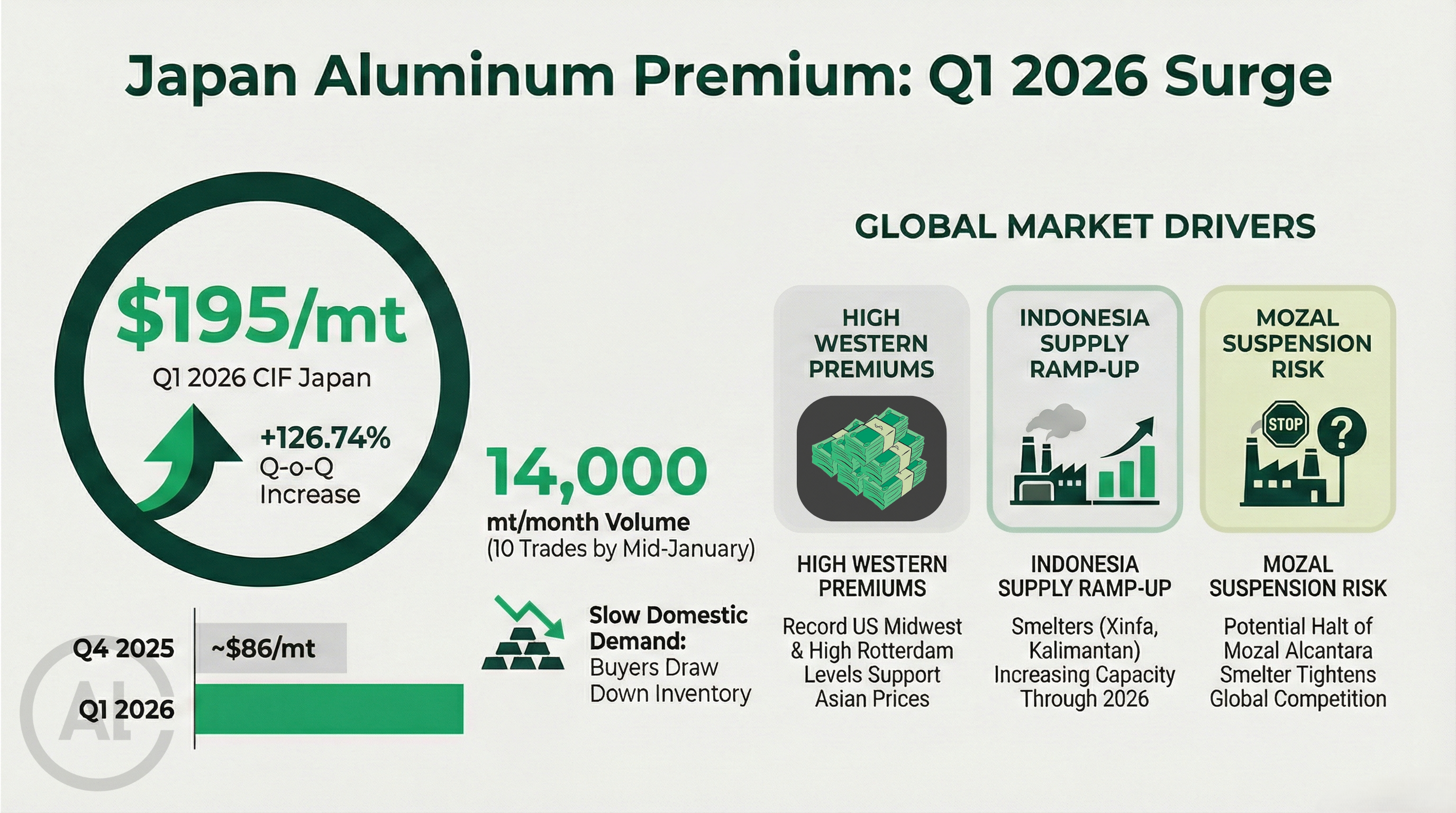
Japan’s Q1 2026 aluminium premium of $195 likely to continue in the same bracket in Q2
A single smelter has had immense impact on the global trade scenario. Mozal’s closure hit the CBAM impacted nations, tightened the global aluminium supply chain scenario and now is influencing the Japan’s Q1 2026 aluminium premium with around a 127 per cent hike quarter-on-quarter. After a year of buyer resistance and sliding settlements, the country’s benchmark aluminium premium has snapped back sharply. But is Mozal the only inhibiting factor for Japan? And why are analysts anticipating similar premium bracket for Q2 2026? Japan’s quarterly premium for imported primary aluminium surged to USD 195 per tonne CIF for January-March 2026 (Q1), a jump from the roughly USD 86 per tonne settled for Q4 2025. The market spent most of last year defined by weak demand, buyer pushback and collapsing...

WEEKLY: China's spot alumina slips further under rising inventories
According to Mysteel's latest survey, total alumina stocks across the country's 10 major ports, 44 alumina producers, 89 primary aluminium smelters, and rail yards or in transit increased by 1.4 per cent on a week-to-week basis to 5.4 million tonnes as of January 15. This was also 43.9 per cent higher than the year-prior level and marked a fresh record high since Mysteel began tracking the data in January 2022. To know more about the global primary aluminium industry 2026 outlook, book the report “ Global ALuminium Industry Outlook 2026 ”. The inventory build has persisted for more than seven consecutive months since early June last year, Mysteel Global noted, and last week also marked the 12th straight week in which alumina inventories hit a new historical high. Read More: DAILY: Chinese...

Nearly 8MT aluminium is used in solar photovoltaic – what is happening to its circularity at end-of-life?
End-of-life management of solar photovoltaic (PV) systems is fast emerging as a challenge and a strategic priority for manufacturing industries worldwide. Especially, aluminium circularity is becoming a focal point considering the metal accounts for more than about 85 per cent of PV component materials like frames and mounting structures. Truth to be told, solar waste is a growing concern now with the rapid rise in PV installations globally. In 2024, global installed capacity exceeded 2.2 TW, with nearly 600 GW added in a single year. Going by the International Renewable Energy Agency’s (IRENA) estimation, around 1.7-8 million tonnes of waste are likely to be generated from PV modules by 2030, and that by 2050, is expected to soar to between 60 and 78 million tonnes, a substantial share...

Global alumina output nears 143.5 Mt in 2025, leaving 0.8 Mt surplus - what’s driving the shift and how are top producers adjusting?
Global alumina production is increasing, although the drivers behind the rise are more layered than a straightforward growth story might suggest. Smelter-grade alumina output rose from 134.2 million tonnes in 2023 to 136.9 million tonnes in 2024, after which the curve steepened. For 2025, production is expected to reach between 143.3 and 143.6 million tonnes. That represents an increase of nearly seven million tonnes in a single year, translating into a compound growth rate of around 5 per cent. What’s driving it isn’t sudden optimism or a rush of new approvals. It’s backlog. Capacity that had been planned, financed, delayed, and reworked over several years is finally switching on. In many cases, the hard part - construction, permitting, logistics - is already behind operators. What’s...

Alumina’s journey through 2025: A year known for ambition, friction and recalibration
The story of alumina in 2025 saw every up and down possible and at the same time raced to re-engineer itself to minimise shortfall. The global alumina industry moved in jolts with a plethora of incidents like capacity added in one geography while written off in another, environmental scrutiny tightening just as governments chased self-sufficiency, and supply chains re-routed not by demand, but by policy and power costs. One of the key pieces of good news came from India. Vedanta’s Lanjigarh refinery reaching 5 million tonnes per annum capacity marked India’s shift in upstream posture. Alumina could no longer be tagged as a supporting input but as a core strategic asset for rapidly developing economies like the aforesaid nation. That intent sharpened with Vedanta’s INR 1 lakh crore...

DAILY: Chinese spot alumina prices inch lower, futures rebound slightly overnight
China's alumina prices for spot sales inched lower again on January 16, while those for futures contracts slightly rebounded during the nighttime trading session following marked daytime losses. The national average spot price for metallurgical-grade alumina with a purity exceeding 98.6 per cent dipped by RMB 5 per tonne (USD 0.7 per tonne) from the previous day to RMB 2,665 per tonne including the 13 per cent VAT last Friday, Mysteel's daily price assessment showed. Also read: Europe imposes anti-dumping duties on imported fused alumina from China The further decline was driven by broadly softer alumina pricing across China's five major alumina-producing regions, according to market watchers. The assessed prices for the same grade of alumina in Shandong, Henan, Shanxi, and Guizhou...

India: Aluminium prices gain w-o-w as futures remain firm, global supply concerns persist
Domestic aluminium prices in India continued to strengthen w-o-w, supported by upward revisions from primary producers amid firm LME and MCX aluminium futures and ongoing global supply concerns. The price increase came despite adequate domestic availability and only moderate downstream demand, highlighting the continued influence of global market signals on local pricing. Explore- Most accurate data to drive business decisions with Outlook 2026 insights across the value chain According to BigMint's assessment, domestic aluminium ingot prices in Delhi rose by INR 7,000 per tonne, or 2 per cent, w-o-w to INR 322,000 per tonne, while Mumbai prices increased by INR 13,000 per tonne, or 4.2 per cent, w-o-w to INR 325,000 per tonne as of 15 January. How did Indian and global exchanges perform?...

