The numbers tell a quiet but compelling story. Year after year, global aluminium foil consumption has moved steadily upward - not in bursts, but in a measured climb that signals durable, long-term demand that helps in aluminium market forecast. Back in 2018, worldwide aluminium foil usage was about 5.3 million tonnes. By 2023, that figure had climbed to 6.1 million tonnes. Current estimates place consumption at roughly 6.8 million tonnes in 2025, with volumes expected to move closer to 7 million tonnes in 2026.
Europe is following a similar path. Demand is gradually firming up, supported largely by pharmaceutical packaging and the region’s continued shift toward premium products. However, stricter regulations aimed at reducing packaging waste, along with elevated energy costs, are keeping the pace of growth measured rather than rapid.
But the bigger story lies in the type of aluminium foil Europe produces, imports and exports - and the gap between these categories is significant.
Consumption vs production: a widening gap
European aluminium foil consumption continues to edge higher. The region used around 1 million tonnes in 2024, accounting for roughly 16 per cent of global demand. Consumption is estimated at about 1.05 million tonnes in 2025 and is projected to grow another 2.86 per cent in 2026. Read Global Aluminium Industry Outlook 2026 for an indepth view.
Production has not kept pace. Installed manufacturing capacity is estimated between 1.1 million and 1.4 million tonnes per annum, yet actual output remains consistently below that range. Europe produced 967 thousand tonnes in 2021 and slightly more - 971.3 thousand tonnes in 2022. Output then dropped sharply to 831.7 thousand tonnes in 2023 before recovering to around 892.5 thousand tonnes in 2024. Even with the rebound, production is yet to return to earlier levels.
Imports stepped in to bridge the gap
Imports filled the structural deficit. Total EU aluminium foil imports were estimated at 812.3 thousand tonnes in 2024, marginally lower than the 826.8 thousand tonnes recorded in 2023. Deliveries reached 480 thousand tonnes by the end of the first half, representing a 7.7 per cent rise from the first six months of 2024. European buyers took more than 6 per cent extra volume in H1, while shipments to markets outside the region jumped nearly 20 per cent.
Trade within Europe itself remains substantial. Over 66 per cent of foil imported across the EU comes from Germany, Italy, Greece, France, and the United Kingdom, contributing approximately 30 per cent, 11 per cent, 14 per cent, 6 per cent, and 4 per cent respectively. The remaining 34 per cent arrived from outside the bloc.
China continues to strengthen its presence. Europe imported 86.3 thousand tonnes from the country in 2023, rising to 91.2 thousand tonnes in 2024.
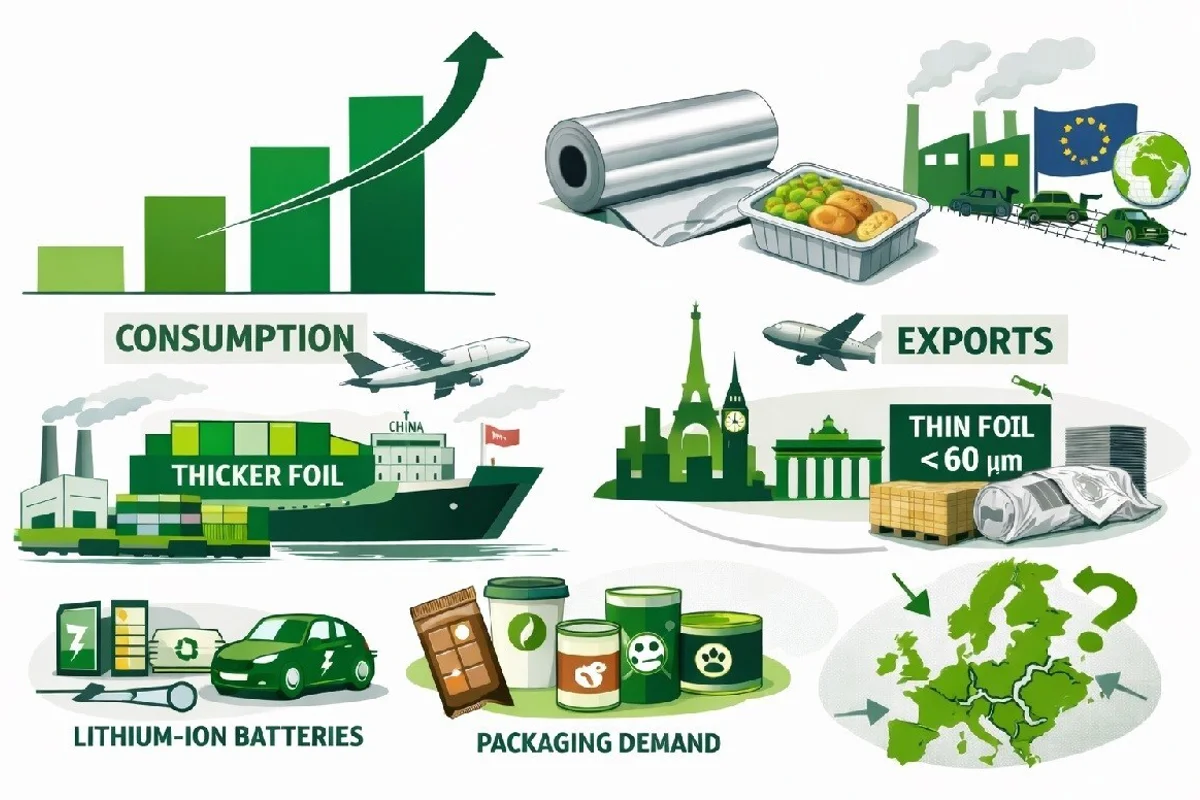
Much of what Europe buys is thicker foil - typically in the 61 to 200 micron range -along with bulk material used in container and other cost-sensitive industrial applications. China, India, and Turkey dominate this space, offering competitive pricing even with duties ranging from 30 to 48 per cent. Volumes are estimated at roughly 200,000–250,000 tonnes annually, particularly in segments where Europe’s high energy costs make domestic production less attractive.
Not only it imported, Europe also exported a large number but for a different kind of aluminium foil. The export type is linked with the kind of aluminium foil produced at home.
For 2026 aluminium market outlook, download our report TOC: Global Aluminium Industry Outlook 2026
Where Europe’s strength in aluminium foil lies
Europe’s strength is thin foil. Foils below 60 microns form the backbone of regional production and exports. Packaging alone accounts for about 60-70 per cent of total foil usage - spanning food and beverages, confectionery, coffee, and pet food. Sustainability debates and alternative materials are gaining attention, but thin foil continues to dominate these applications.
Semi-rigid packaging, including household trays and food containers, has proven equally resilient. Improvements in recyclability and material efficiency are helping sustain demand. Household foil remains a stable category as well, particularly for cooking and storage, with Austria and Italy standing out for higher per-capita consumption.
Industrial uses make up the remaining 30–40 per cent of demand, and this is where momentum is building - especially in lithium-ion batteries.
Battery foil demand is being driven by the European Battery Alliance and expanding electric vehicle production in Germany, France, and Hungary. Additional requirements come from HVAC finstock used in air-conditioning systems, heat exchangers, and radiators, along with insulation applications in both automotive and construction sectors.
Yet Europe still depends heavily on imports for battery-grade material. Production of ultra-thin lithium-ion foil - typically 10-15 microns for cathodes - remains limited to specialised facilities in Hungary and Sweden. Combined capacity is expected to reach around 38,000 tonnes in 2025. Even so, Europe imports three to five times more battery foil from Asia to support EV gigafactory demand, with China controlling roughly 80 per cent of global supply amid ongoing capacity constraints.
For now, thin packaging foil remains Europe’s most competitive export category.
European foil exports rose from 983.57 thousand tonnes in 2020 to 1.05 million tonnes in 2021. Volumes then eased to 1 million tonnes in 2022 before falling further to 880.91 thousand tonnes in 2023. A modest recovery followed in 2024, with exports reaching about 905.63 thousand tonnes. Overall, total export in the first nine months of the year reached 702 thousand tonnes, an increase of 5.4 per cent year-on-year.
Germany, France, Italy, Poland, and the UK continue to lead as key buyers, together accounting for 58 per cent of foil imports into Europe. Germany holds the largest share at 16 per cent, followed by France at 12 per cent, Italy at 11 per cent, Poland at 10 per cent, and the UK at 9 per cent. The remaining 42 per cent comes from countries outside Europe.
The 2026 market forecast remains optimistic, but uncertainty looms regarding current economic conditions and geopolitical factors.
Don’t miss out- Buyers are looking for your products on our B2B platform













_md.webp)