Guinea possesses a geological advantage few countries can rival. Beneath its terrain lies an estimated 7.4 billion tonnes of bauxite - nearly one-third of the world’s reserves. Yet despite this abundance, very little is refined domestically. Instead, the ore departs largely in raw form, feeding industrial chains abroad, mostly to China. As exports of bauxite continue to rise, a natural question follows: has Guinea’s mining engine begun to move in step with China’s industrial demand?
The numbers increasingly suggest a relationship shaped by consistency rather than coincidence. By 2025, Guinea’s exports to the world are estimated at 190 million tonnes, with China absorbing the majority. In just the first eleven months, roughly 138 million tonnes were shipped there - about 74 per cent of Guinea’s global exports, according to AL Circle research estimation, China Customs data, and the International Trade Council.
Looking back, the trajectory appears even clearer. In 2024, Guinea exported 145 million tonnes, of which 110.2 million tonnes went to China, accounting for 76 per cent of shipments. The dependence was even more pronounced in 2023, when exports reached 127 million tonnes and nearly 111 million tonnes were bound for Chinese buyers, representing an 87.4 per cent share.
China’s raw-material appetite provides important context to this. According to the General Administration of Customs, the country’s bauxite imports climbed 26.4 per cent year-on-year to 200.5 million tonnes in 2025. Domestic production contributed another 84 million tonnes, taking total available supply to approximately 284.5 million tonnes.
Processing capacity has expanded alongside these inflows. From this available bauxite, China produced 92.45 million tonnes of alumina across all grades in 2025, supporting an estimated 44 million tonnes of primary aluminium output - just under its established 45-million-tonne capacity ceiling.
This indicates that nearly all the bauxite China produces and imports is absorbed by its domestic industries. While aluminium remains the principal destination for bauxite, a portion of the ore also feeds the supply chain for gallium, a rare metal extracted during processing.
For 2026 aluminium market outlook, download our report TOC: Global Aluminium Industry Outlook 2026
Is Guinea’s production rising fast enough to match export momentum?
Guinea’s production growth has been difficult to overlook. Output is expected to land between 182 and 184 million tonnes in 2025, a notable climb from roughly 138–140 million tonnes in 2024 and about 123 million tonnes in 2023. Earlier, production stood near 103 million tonnes in 2022 and approximately 87 million tonnes in 2021.
Even so, not every cargo sailed toward China; other destinations collectively received about 47.8 million tonnes, indicating that while concentration is high, it is not absolute.
One year, however, stood apart. In 2023, exports actually exceeded production. Shipments touched 127 million tonnes against record mining of 123 million tonnes, with the roughly four-million-tonne gap supplied by stockpiles accumulated at mines and ports. From this time, the surplus began to grow, and Guinea has continued exporting more than it produces because of this overhang.
The surplus trend has remained intact, with exports exceeding production by 3.3 per cent in 2025, after similar surpluses of 3.5 per cent in 2024 and 3.2 per cent in 2023.
The drawdown reflected a moment of urgency. After Indonesia imposed its bauxite export ban in June 2023 to force domestic processing and boost its alumina industry, Chinese demand accelerated sharply. Producers such as Société Minière de Boké chose to prioritise dispatching available material rather than waiting for production to catch up.
Efficient rail and port infrastructure allowed stored ore - much of it built up when 2022 exports lagged capacity - to move swiftly into global trade, proving the value of inventory as a strategic buffer.
What the prices are signalling?
Market behaviour through 2025 hinted at a transition from tightness toward equilibrium. Early in the year, Guinea-origin ore commanded higher delivered prices into China than Australian cargoes, supported by demand for high-grade material, longer voyage distances, quality differentials, and relatively constrained Atlantic Basin supply.
By mid-to-late 2025, however, prices from both suppliers stabilised within a narrow range. Freight costs, supply risks, and quality spreads appeared largely priced in, suggesting Chinese buyers were becoming more deliberate in balancing Atlantic and Pacific sourcing strategies. Even as import volumes rose, the market showed signs of maturity.
Guinea’s bauxite prices opened the year at USD 115.11 per tonne before sliding to USD 70.7 per tonne by year-end. Mysteel reported that a major miner reduced its FOB price for fourth-quarter long-term contracts by USD 1 per dry metric tonne, pulling the CIF price down to USD 74. Chinese refineries attempted to negotiate further reductions, and although long-term agreements remain unresolved, the downward direction has become evident and is expected to influence spot markets.
The seaborne trade adopted a bearish tone, yet Guinea’s wet season curtailed shipments enough to provide temporary support. Transactions involving three vessels at roughly USD 74–75 per dry metric tonne illustrated how seasonal constraints can still lend firmness even in a cooling market.
Guinea expands corridors for future supply
At the same time, Guinea is preparing for larger flows rather than smaller ones. Six mining companies - CDM China, Ashapura Minechem, SMB, Cambia Mining, Dynamic Mining, and TBA - are collaborating to modernise the Dapilon corridor, a project designed to add 50 million tonnes of capacity, reduce haulage costs, and improve reliability while positioning the route as an ESG-oriented regional hub.
The 135-kilometre Dapilon–Santou railway, part of the SMB-Winning Consortium’s USD 3 billion investment plan, links Santou’s mines directly to the Port of Dapilon. With 23 bridges, two tunnels, and six depots, the line opens new mining zones and may eventually connect to the national rail system, widening access further.
Elsewhere, at the Boffa site holding more than 200 million tonnes of reserves, Ashapura Minechem and China Railway have partnered to expand output. China Railway is overseeing logistics and port development, while Ashapura emphasises sustainability and community engagement - an approach framed as balanced growth.
By the end of 2025, nine active ports were already in operation, with further upgrades and new road and rail links planned for 2026 to ensure higher volumes can move without congestion returning.
Who is powering Guinea’s export surge?
Mines ministry data shows that 23 companies shipped bauxite from Guinea in 2025, underscoring the scale the sector has achieved. China’s Chalco emerged as the largest exporter with 22.1 million tonnes, followed by CBG - majority owned by a consortium that includes Rio Tinto and Alcoa - at 17.4 million tonnes. SMB, recognised as Guinea’s first private bauxite exporter, and the largely Guinean-owned AGB2A/SDM joint venture each shipped 17.0 million tonnes.
Although exports slowed in the second half of the year, volumes still rose 16 per cent to 84 million tonnes, a reminder that underlying demand has remained resilient.
Why does Guinea favour bauxite exports to China?
China’s position as the dominant buyer of Guinean bauxite is not accidental; it reflects years of financial commitment that have become deeply embedded in the country’s mining ecosystem. While Guinea blocked EGA from accessing its ore this year, shipments to China continued largely uninterrupted - a contrast that highlights how strongly investment flows can shape trade decisions.
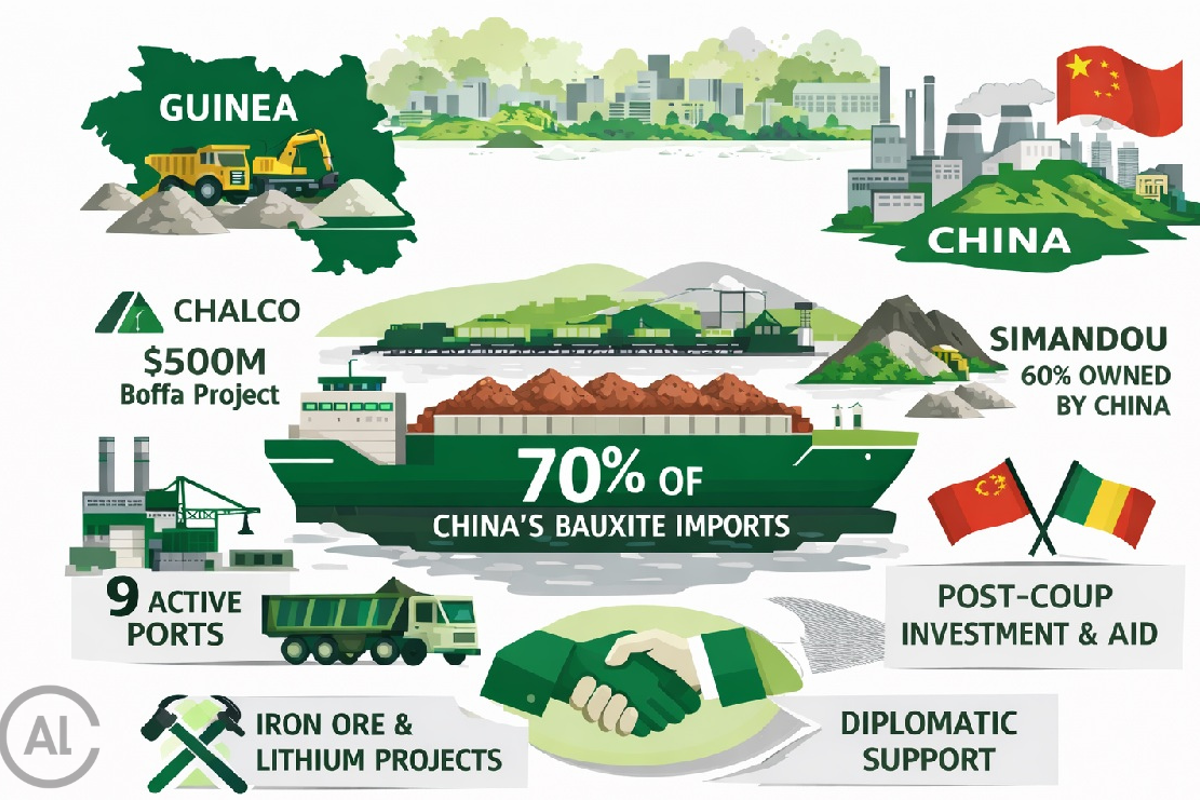
Chinese capital has helped build the very infrastructure that allows Guinea’s exports to move at scale. Chalco’s USD 500 million Boffa project, under phased expansion since 2018, the SMB-Winning Consortium’s more than USD 2 billion investment across Boké mines, rail, and port networks with capacity exceeding 50 million tonnes per year, and stakes in GB2/SDM operations have collectively strengthened the export chain - enabling about 135 million tonnes to be shipped to China in 2025 alone.
The relationship extends well beyond bauxite. Chinese interests hold roughly 60 per cent ownership in the Simandou iron ore project, valued at over USD 15 billion, alongside involvement in gold and lithium ventures. Diplomatic backing following the 2021 coup further deepened these ties at a time when Western engagement receded, providing financial support to Guinea’s junta while simultaneously helping secure nearly 70 per cent of China’s bauxite imports.
Seen from this angle, Guinea’s willingness to continue supplying China appears less like a short-term trade choice and more like the outcome of long-term strategic interdependence - where infrastructure, capital, and political alignment converge to influence the direction of mineral flows. The 2026 outlook largely mirrors this pattern, read Global Aluminium Industry Outlook 2026 for an indepth view.
Don't miss out- Buyers are looking for your products on our B2B platform














_md.webp)
_md.webp)







