2025 has marked a year of upstream momentum for the aluminium industry. Across continents, bauxite mines and alumina refineries are coming online, quietly redefining where global supply begins. This shift is being driven by a wave of projects that are expanding raw material capacity and reshaping countries’ positions within the aluminium value chain.
Highlighting some of 2025’s key Bauxite project
1. Canyon’s Minim Martap enters commercial reality
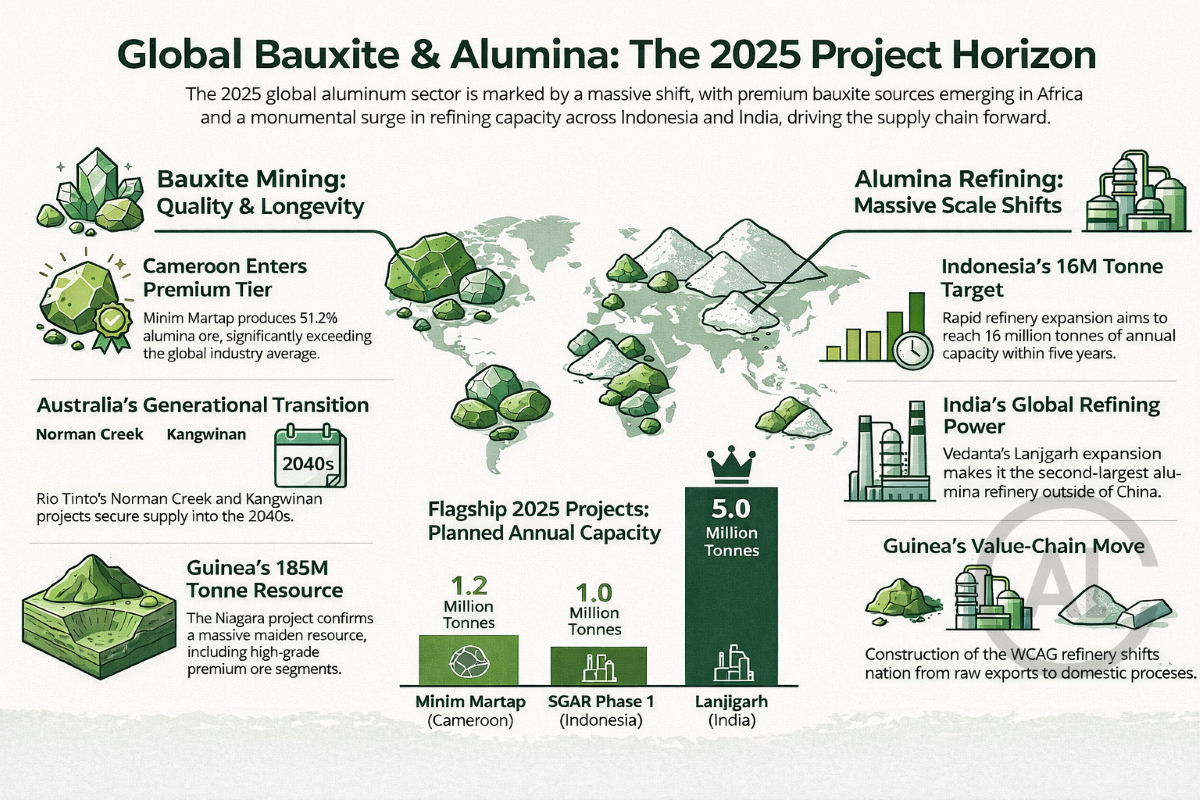
Cameroon’s bauxite story has moved out of the speculative stage. Commercial activity is now underway at Canyon’s Minim Martap bauxite project in the Adamawa Region, signalling that Central Africa is stepping into a more concrete supply role. The mine is designed to produce high-grade bauxite with low reactive silica, suitable for both low- and high-temperature refining routes. First shipment is targeted for mid-2026. Initial production of 1.2 million tonnes annually suggests a long operating runway, though real-world mining conditions will determine how quickly the project scales.
What truly defines Minim Martap, is the ore quality. Alumina content averages 51.2 per cent, well above the global industry range of 45-48 per cent. Higher grades reduce refinery energy intensity and lower the volume of raw material required for aluminium output.
Explore- Most accurate data to drive business decisions with our Outlook 2026 insights across the value chain
2. Norman Creek strengthens Rio Tinto’s Amrun base
In Australia, Rio Tinto is thinking in decades, not years. A USD 180 million commitment to the Norman Creek project is intended to extend the life of the Amrun mine on Queensland’s Cape York Peninsula and gradually replace ageing bauxite sources without disrupting supply.
Norman Creek contains around 466 million tonnes of high-grade bauxite, representing nearly half of Amrun’s 978 million tonne reserve base. Average alumina content stands at 54.4 per cent. Construction activity is already visible on the ground, including a 19-kilometre haul road, accommodation infrastructure and communications facilities. Production is expected to begin in 2027, with full construction completion scheduled for 2028.
3. Arrow Minerals defines scale at Guinea’s Niagara project
Guinea continues to reinforce its position as a cornerstone of global bauxite supply. Arrow Minerals has announced a maiden JORC-compliant resource at its Niagara bauxite project totalling 185 million tonnes, grading 42.3 per cent aluminium oxide and 2.7 per cent silicon dioxide.
Within that headline number lies a higher-grade centre that adds weight to the project’s economics: 138 million tonnes grading 44 per cent Al₂O₃ and a premium 48 million tonnes at 48.2 per cent Al₂O₃. Such grades are highly attractive to alumina refineries seeking consistency and efficiency, and they position Niagara for a scoping study later this year.
4. Kangwinan advances Weipa operations
Rio Tinto is also preparing for a structural handover within its Australian operations. Early works and a final feasibility study are underway at the Kangwinan bauxite project, designed to lift output from Weipa Southern by up to 20 million tonnes annually from the current 23 million tonne base.
The project is intended to replace production from the Andoom mine in Queensland and the Gove mine in the Northern Territory, both approaching closure toward the end of the decade. If approved, Kangwinan could begin production as early as 2029, effectively marking a generational reset in Rio Tinto’s supply architecture.
5. Amargosa links bauxite to critical minerals strategy
Brazil’s approach to bauxite is taking on a strategic dimension. Brazilian Rare Earth and Rio Tinto have agreed to advance the Amargosa bauxite–gallium project in Bahia, pairing aluminium feedstock with access to one of the world’s highest-grade undeveloped gallium prospects. The collaboration highlights how upstream aluminium projects are increasingly intersecting with critical mineral priorities rather than existing in isolation.
But mining is only the first chapter of the aluminium story, as countries race to convert expanding bauxite supply into alumina capacity - a shift visible in 2025’s key refining projects.
1. PT Borneo alumina Indonesia - SGAR project
Indonesia’s refining ambitions are now materialising at scale. The Smelter Grade Alumina Refinery (SGAR) in Mempawah, West Kalimantan by PT Borneo Alumina Indonesia, a joint venture between Inalum and Antam, began production in late 2024. The USD 900 million project is being rolled out in phases.
By 2025, SGAR alone has contributed around 1 million tonnes of alumina capacity. Its impact is already visible beyond output figures, creating employment and anchoring new industrial activity in the surrounding region. The refinery sits inside a broader national strategy. Seven additional alumina plants are planned, together adding 9 million tonnes of capacity. If all 11 projects move forward on schedule, Indonesia’s alumina capacity could reach 16 million tonnes within five years.
2. PT Bintan builds capacity in measured steps
PT Bintan Alumina Indonesia is also following an expansion path. The first 1 million tonne phase entered production in the third quarter of 2025. A second phase of equal size reached full operation on December 20, 2025. The ramp-up has been matched by infrastructure upgrades led by Nanshan Aluminium International, ensuring that logistics growth keeps pace with refining output rather than trailing behind it.
3. Lanjigarh expansion reshapes India’s refining balance
India has crossed a threshold in refining capacity through Vedanta Aluminium’s expansion of the Lanjigarh refinery in Odisha. The site now operates at 5 million tonnes per annum, making it the second-largest alumina refinery outside China.
National capacity has climbed to nearly 13 million tonnes annually, placing India third worldwide. Lanjigarh alone contributes 38 per cent of domestic output, underscoring its weight inside the country’s aluminium structure.
4. Huntly expansion secures long-term refinery feedstock
In Western Australia, Alcoa Corporation is aligning mining with refinery longevity. Public consultation has opened on a proposal to expand operations at the Huntly mine near Perth’s Serpentine Dam. The intention is to supply the Pinjarra alumina refinery through to 2045 and support higher output over the next twenty years.
The proposal includes mining in Myara North, Holyoake and O’Neil, alongside a separate plan to extend Huntly and Willowdale operations until 2027. The process is being overseen by Western Australia’s Environmental Protection Authority.
5. WCAG signals Guinea’s shift into refining
Guinea-Conakry is stepping beyond raw ore exports. Construction has begun on the Winning Consortium Alumina Guinea (WCAG) refinery in Boké, designed for annual production of 1.2 million tonnes of alumina. The project reflects a strategic decision to move deeper into the aluminium value chain, anchoring refining capacity domestically rather than remaining solely a bauxite supplier.
Must read: Key industry individuals share their thoughts on the trending topics













_md.webp)
_md.webp)
_md.webp)