Australian bauxite forecast at $39/t vs Guinea at $34-46/t: How ore quality, freight and oversupply are shaping prices
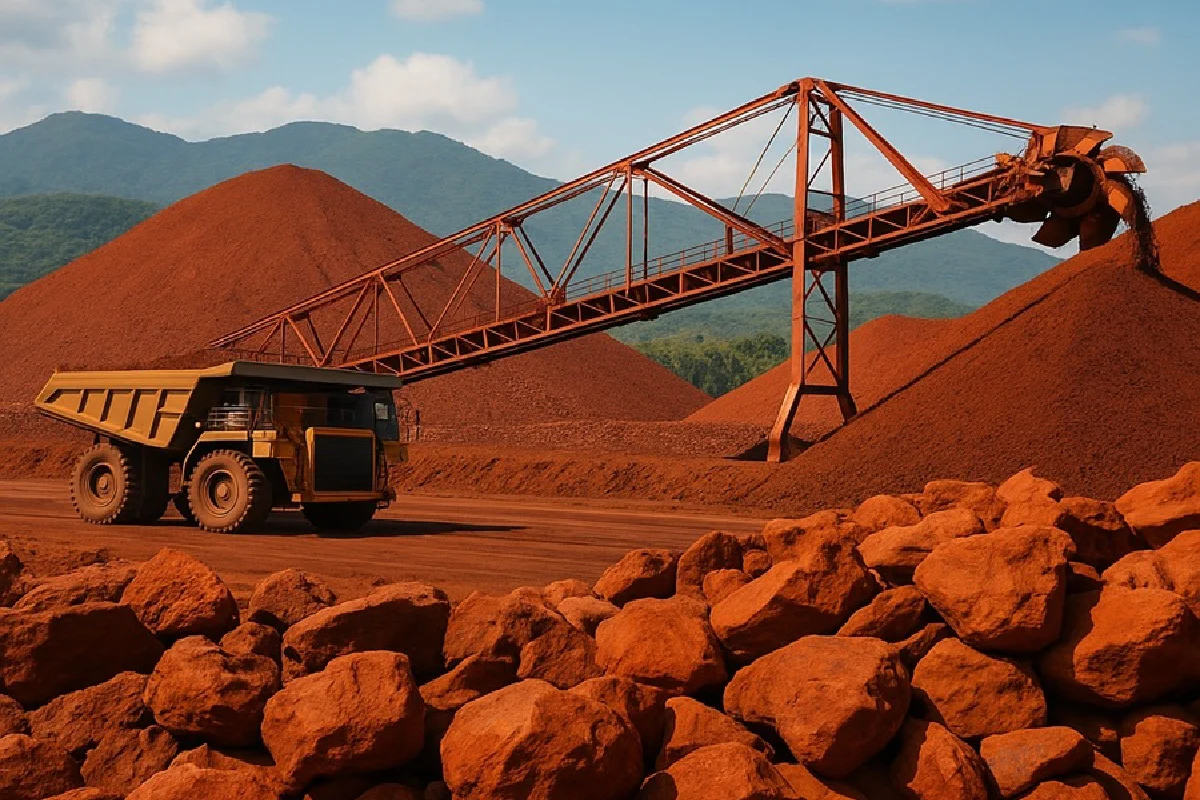
The image used in this article is generated with an AI tool and does not depict any real-time moment
What happens when the world’s biggest bauxite supplier produces too much of the one commodity it dominates? Guinea’s bauxite market is offering a striking answer. Record exports have strengthened its position in global trade, but the surge in supply has also pushed prices lower. Australia, meanwhile, continues to command a premium, even as prices across the market weaken.
Guinea’s FOB bauxite price is forecast at around USD 34–46 per dry metric tonne in 2026, while Australia’s FOB price is forecast at around USD 39.15 per wet metric tonne in FY26.
So why does Australian bauxite continue to hold a different price position when Guinea is supplying the market at such enormous volumes?
The answer begins with quality, but it does not end there. Ore characteristics, freight costs, mining economics, contract structures and, most importantly, the sheer scale of Guinea’s supply are all shaping the price gap between the two major origins.
Guinea and Australia: where are prices heading?
The price outlook shows that both origins are under pressure, although their longer-term trajectories differ.
Guinea’s FOB bauxite price is forecast to decline from USD 40-65 per dry metric tonne in 2025 to USD 34-46 per dry metric tonne in 2026, pointing to continued weakness in the near term. From 2027, prices are expected to gradually recover to around USD 40-42 per dry metric tonne, with the recovery continuing through 2030. Prices are projected to record a CAGR of approximately 4.0-4.6 per cent between 2027 and 2030, before growth moderates to around 1.1-3.7 per cent between 2030 and 2036.
Australia is also expected to see a sharp decline before recovering. Its FOB bauxite price is forecast to fall from USD 51.48 per wet metric tonne in FY25 to USD 39.15 per wet metric tonne in FY26. From FY27, prices are expected to gradually recover, reaching around USD 38.43 per wet metric tonne. Growth is projected at approximately 1.8 per cent CAGR between FY27 and FY30, followed by around 2.3 per cent between FY30 and FY36. For more market details, read Global Bauxite & Alumina Market Forecast to 2036: Supply–Demand, Trade Flows & Price Outlook report.
The outlook shows that both origins are exposed to the same weaker market. What sets them apart is how the market values their ore and responds to their different supply dynamics.
Quality gives Australia its first advantage
Australian bauxite generally contains around 48-52 per cent alumina, while Guinean material typically contains about 45 per cent Al₂O₃, 3 per cent SiO₂, 2 per cent Fe₂O₃ and 27 per cent moisture.
For alumina refiners, those differences matter. Bauxite value depends heavily on the amount of usable alumina that can be recovered and the processing required. Higher alumina generally improves the economics of a cargo, while higher moisture and certain impurities can reduce its effective value.
This helps explain why Australian material is estimated to command an USD 8-15 per tonne premium over Guinean bauxite.
Long-term contracts also reflect these differences. They generally begin with a base price and are then adjusted according to alumina or aluminium price indices and quality parameters.
But quality alone cannot explain the current price gap. If it were the only factor, Guinea’s rapidly increasing supply would not have such a strong effect on its own pricing. The bigger issue is the sheer amount of material entering the market. Read Global Bauxite & Alumina Market Forecast to 2036: Supply–Demand, Trade Flows & Price Outlook report for an indepth analysis.
Guinea produced too much bauxite
Guinea’s expansion has been extraordinary. The country exported around 183 million tonnes of bauxite in 2025, up approximately 25 per cent year on year. The momentum continued into 2026, with production increasing by more than 25 per cent year on year to roughly 61 million tonnes in Q1.
Guinea now accounts for close to 70 per cent of global seaborne bauxite trade, giving it enormous influence over the global supply balance. But that dominance becomes a challenge when supply grows faster than demand.
Bauxite prices fell nearly 50 per cent from their early-2025 peaks, dropping from around USD 120 per tonne in early 2025 to below USD 60 per tonne by early 2026. The issue was not simply that Guinea was producing more; the additional tonnes were reaching the market faster than refineries could absorb them.
Chinese port inventories reached around 90 million tonnes by mid-2026. With buyers already holding substantial stocks, the need to secure fresh cargoes weakened, leaving sellers with less room to push prices higher.
By April 2026, Guinean FOB prices had fallen to around USD 32–38 per tonne, their lowest level since March 2022.
Guinea's success has therefore created an unusual contradiction: the country has strengthened its position as the world's leading bauxite supplier, but the same supply growth is putting pressure on the value of its own ore.
That makes the delivered cost of bauxite even more important.
Explore buying & selling leads of bauxite and trade opportunities on AL Biz
Is cheaper bauxite actually cheaper for buyers?
Not necessarily. The FOB price is only one part of the economics. Guinea benefits from relatively low mining costs, but shipping bauxite from Kamsar to major Asian markets can add an estimated USD 32–35 per tonne.
Australia operates under a different cost structure. Large open-pit operations, including those run by Rio Tinto and Hydro, provide access to relatively high-grade ore, but Australian producers also face higher labour and energy costs.
As a result, a lower FOB price does not automatically mean a lower delivered cost once freight, quality and processing economics are taken into account.
Freight has become even more significant as shipping costs rise amid disruptions linked to the Middle East conflict. For producers already facing weaker bauxite prices, higher logistics costs can put additional pressure on margins.
For Guinea, this combination of falling prices and rapidly rising supply is also prompting a policy response.
Guinea plans to restrict exports, targeting a bauxite price surge
Guinea holds an estimated 7.4 billion tonnes of bauxite reserves, the largest in the world. But its enormous resource base also creates a difficult balancing act: continuing to maximise exports while avoiding an oversupplied market.
The government is considering export quotas to address the imbalance and support prices. Its objective is to push bauxite prices above USD 100 per dry metric tonne while encouraging greater investment in domestic refining.
If implemented, export restrictions could alter the global supply balance. Fewer Guinean tonnes reaching the seaborne market could encourage buyers to seek alternative sources, potentially creating stronger demand for Australian material. Also read: Guinea's 150Mt bauxite export cap may create a market deficit of 33Mt - Can the world make up the difference?
A reduction in Guinean exports could also remove some of the excess supply currently weighing on global prices.
The impact, however, will depend on how the quotas are implemented and how much supply is ultimately removed from the market.
Until then, Guinea’s production growth remains one of the biggest forces shaping global bauxite prices.
Could Australia’s stability become an advantage?
Australia may not match Guinea’s production scale, but its position is relatively stable.
The country produced an estimated 102.4 million tonnes in 2025 and exported 44.23 million tonnes, compared with 42.6 million tonnes in 2024.
Its economically demonstrated bauxite resources stood at roughly 3.97 billion tonnes in 2024, with Geoscience Australia ranking the country second globally for both resources and production.
Australian production is expected to remain above 100 million tonnes annually, while exports are projected at around 45 million tonnes in FY2025–26, supported by continued Chinese demand.
That consistency could matter in an uncertain market. Buyers are not only comparing headline prices; they also have to consider grade, reliability, freight and the certainty of supply.
This is where Australia’s premium becomes easier to understand. Higher-quality ore gives Australian producers a fundamental advantage, while stable production and established supply relationships can add further value.
For now, the market presents a striking contradiction: Guinea has built its dominance through extraordinary production growth, yet that same abundance is putting pressure on the price of its own ore. Australia, with significantly lower output, continues to command a premium.
The question is whether that premium represents a lasting structural advantage for Australian bauxite - or simply the temporary result of a market struggling to absorb Guinea’s next wave of supply.
Note: This is exclusive coverage by AL Circle and may not be reproduced, republished or shared without prior permission.
Rio Tinto's evolving commodity mix reshapes its investment story
Next articleMetro Mining builds bauxite momentum with record output, lower costs and broader sales
Grow with
AL Circle