AL Circle Analysis: How the race for aluminium scrap is reshaping recycling, trade and industrial competitiveness
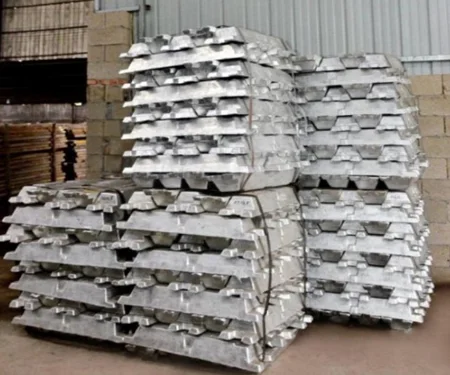
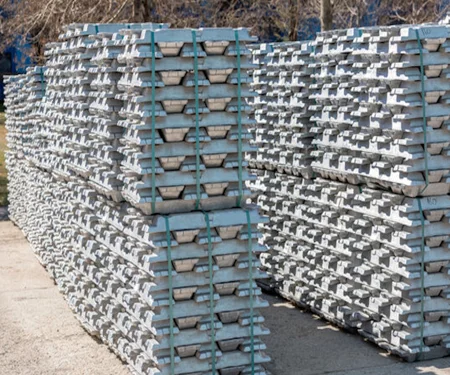
The image used in this article is generated with an AI tool and does not depict any real-time moment
The aluminium industry has entered a new race. It is no longer just about producing lower-carbon metal but about securing the scrap, infrastructure and policy support needed to keep circular supply chains competitive.
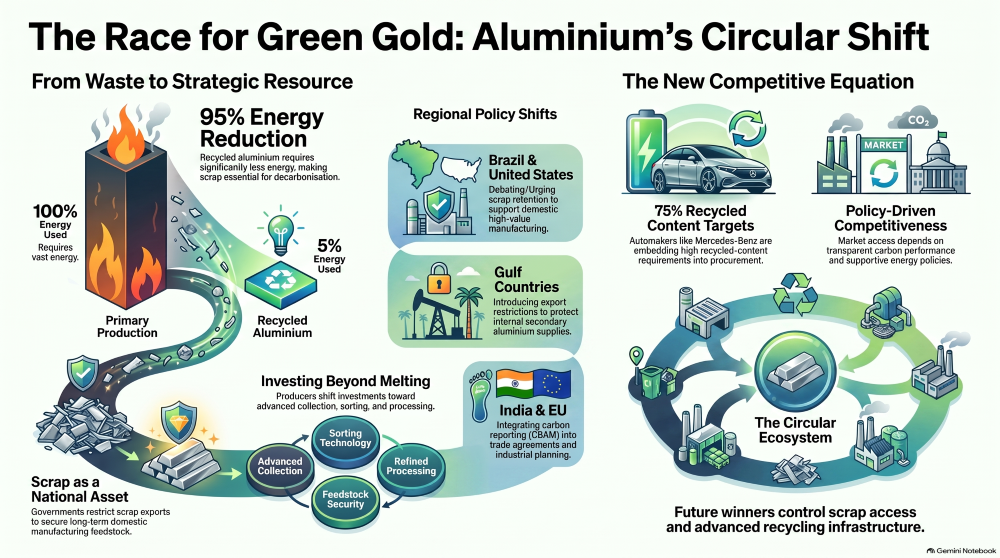
For years, recycling has been one of aluminium's strongest sustainability advantages. Recycled aluminium requires up to 95 per cent less energy than primary production, making it central to global decarbonisation efforts. Yet the industry's priorities are evolving. The key question is no longer how much aluminium can be recycled, but who will control the scrap that makes recycling possible.
Recent developments across Brazil, the United States, Europe, the Middle East, India and Australia point to the same conclusion. Governments are reassessing scrap exports, recyclers are investing in domestic processing, automakers are increasing recycled-content requirements, and policymakers are strengthening industrial strategies. Together, these developments signal a shift from simply recycling aluminium to competing for circular aluminium resources.
This matters because the next wave of demand will come from electric vehicles, renewable energy, electricity networks and sustainable packaging—all sectors seeking lower-carbon materials. As demand for recycled aluminium grows, access to quality scrap is becoming as important as smelting capacity or renewable power.
Scrap is becoming a strategic industrial resource
The changing flow of aluminium scrap offers the clearest evidence of this transformation.
Brazil's rising aluminium scrap exports to China have renewed debate over whether valuable secondary material should remain within the country. Industry representatives argue that retaining more scrap could strengthen domestic recycling, support higher-value manufacturing and improve long-term competitiveness as demand for low-carbon aluminium increases.
A similar conversation is unfolding in the United States. The Aluminum Association has urged policymakers to recognise aluminium scrap as a strategic manufacturing resource rather than simply recyclable waste, warning that rising exports could weaken domestic recycling capacity just as demand for secondary aluminium accelerates.
Meanwhile, export restrictions introduced by several Gulf countries have disrupted scrap supplies to India, exposing the risks of relying on a limited number of sourcing markets. Indian recyclers are being forced to diversify suppliers, while higher freight costs and longer shipping routes threaten competitiveness.
To know the aluminium casting demand forecast in the construction sector, explore our report "Global Aluminium Casting Market 2026-2032: Plant Economics, Alloy Segmentation, Pricing Intelligence, Supply Chain Analysis & Strategic Recommendations"
Although these developments differ by region, they reflect the same trend. Governments are increasingly treating aluminium scrap as a strategic industrial asset rather than a freely traded commodity. The focus is shifting from maximising export revenue to securing long-term feedstock for domestic manufacturing.
This represents a fundamental change in thinking. Scrap is no longer viewed simply as end-of-life material; it is becoming the foundation of future low-carbon manufacturing.
Recycling is becoming a feedstock strategy
As governments rethink scrap security, aluminium producers are reshaping their investment priorities.
Instead of focusing only on melting capacity, companies are investing across the recycling value chain—from collection and sorting to storage and remelting—to secure reliable supplies of secondary aluminium.
Germany-based Speira's transformation of its Rheinwerk site reflects this strategy. Rather than replacing primary production with another smelter, the company is creating a dedicated recycling hub with expanded furnace capacity, enhanced scrap handling and greater use of post-consumer aluminium. The objective is not simply to increase recycled output but to secure long-term access to quality feedstock.
Demand from downstream manufacturers is reinforcing this trend.
Mercedes-Benz's decision to use Hydro CIRCAL containing at least 75 per cent post-consumer recycled aluminium in its next-generation electric vehicles demonstrates how recycled metal is becoming part of core procurement strategies rather than just sustainability initiatives. The partnership also expands the use of Hydro REDUXA, illustrating how future supply chains will combine recycled and lower-carbon primary aluminium instead of relying on either alone.
These developments show that recycling investments are evolving into long-term strategies for material security, resilient regional supply chains and customer-driven decarbonisation.
Carbon policy is becoming a competitive advantage
Alongside the race for scrap, carbon policy is beginning to shape where aluminium is produced and how projects are designed.
India illustrates this transition clearly.
The recently concluded India-EU Free Trade Agreement negotiations have placed the European Union's Carbon Border Adjustment Mechanism (CBAM) at the centre of industry planning. Rather than treating CBAM solely as a trade barrier, both sides have agreed on a roadmap to help exporters adapt to future carbon reporting requirements while exploring recognition of carbon costs paid in India.
For aluminium producers, emissions reporting is becoming a requirement for market access. Future competitiveness will depend not only on price and quality but also on transparent carbon performance across the value chain.
The Adani Group's proposed integrated aluminium complex in Odisha reflects this shift. The project combines mining, alumina refining, smelting and downstream manufacturing with a 4,000 MW captive power plant and a 400 MW renewable energy facility. By integrating cleaner energy into the project's design, it demonstrates how future investments are increasingly combining production efficiency with carbon preparedness.
Together, the India-EU FTA and Adani's investment suggest that competitiveness will increasingly depend on integrating renewable energy, carbon compliance and downstream manufacturing into a single industrial strategy.
Governments are taking a larger role
Another defining trend is the growing involvement of governments in aluminium competitiveness.
Australia provides a clear example. The Federal and New South Wales governments are working on a long-term support package for Rio Tinto-controlled Tomago aluminium smelter to secure affordable electricity beyond its current power contract. The discussions reflect recognition that aluminium production remains strategically important despite rising energy costs.
At the same time, Rio Tinto-operated Bell Bay Aluminium has been excluded from Australia's Green Aluminium Production Credit scheme despite already operating largely on renewable electricity. The decision has created uncertainty over the smelter's future and highlighted that clean energy alone may not guarantee competitiveness without supportive policy.
Together, these developments show that the energy transition is becoming as much a policy challenge as a technological one. Stable industrial policy, affordable energy and long-term government support are increasingly essential for maintaining competitive aluminium industries.
A new competitive equation
Taken together, these developments reveal a fundamental transformation across the global aluminium industry.
Scrap is becoming a strategic resource rather than a low-value by-product. Recycling investments are shifting towards feedstock security instead of simply expanding processing capacity. Automakers are embedding higher recycled content into future products, strengthening long-term demand for secondary aluminium. Carbon policy is influencing investment decisions, while governments are playing a more active role in supporting domestic production.
The industry's competitive advantage is therefore changing.
Success will increasingly depend not only on producing lower-carbon aluminium but also on securing the circular ecosystem that supports it—reliable access to scrap, advanced recycling infrastructure, cleaner energy, resilient regional supply chains and supportive policy frameworks.
The race to build a circular aluminium economy has already begun. Increasingly, the winners may not be the producers with the largest smelting capacity, but those best positioned to keep aluminium circulating within their own industrial ecosystems.
Explore downstream aluminium suppliers, product listings and trade opportunities on AL Biz
Industry takeaways
For recyclers: Prepare for tighter scrap availability
- Growing competition from China, coupled with export restrictions in the Middle East, suggests aluminium scrap availability could become increasingly volatile. Recyclers that rely heavily on imported feedstock may need to diversify sourcing regions and strengthen domestic collection networks to reduce procurement risks.
- Investments should increasingly focus on post-consumer scrap collection, sorting and processing infrastructure, similar to the approach adopted by Speira, as feedstock security becomes as important as recycling capacity.
For primary aluminium producers: Low-carbon production alone may not be enough
- Projects integrating renewable energy, recycling and downstream manufacturing are likely to be better positioned to meet future customer and regulatory expectations. Adani's hybrid-powered aluminium complex reflects how future investments are beginning to combine production growth with lower-carbon energy solutions.
- Australia's Bell Bay case also highlights that access to renewable electricity alone does not guarantee competitiveness. Government policy, electricity pricing and long-term support mechanisms are becoming equally important for maintaining viable aluminium production.
For scrap traders: Expect greater policy intervention in global trade
- Aluminium scrap trade is becoming increasingly influenced by export restrictions, critical material strategies and industrial policy rather than price alone. Market participants should prepare for more frequent changes in trade flows as countries seek to retain secondary aluminium within domestic value chains.
- Heavy dependence on a single sourcing region may expose traders to sudden supply disruptions. Building relationships across multiple markets could improve resilience as geopolitical and policy risks increase.
For downstream manufacturers and OEMs: Secure recycled aluminium supply early
- Mercedes-Benz's decision to increase recycled aluminium content to at least 75 per cent in its next-generation EVs reflects a broader shift towards higher recycled-content requirements. Manufacturers may need to secure long-term partnerships with recyclers and low-carbon aluminium suppliers to ensure material availability.
- As recycled aluminium becomes a strategic procurement input, supply-chain transparency and regional sourcing are likely to become more important alongside product quality and cost.
For policymakers: Align trade, recycling and industrial strategies
- The developments in Brazil, the United States and India suggest that recycling targets alone may not be sufficient if domestic industries continue losing valuable scrap to export markets. Policies supporting circular manufacturing may need to be aligned with trade measures to retain higher-value aluminium processing within national borders.
- Carbon compliance frameworks, industrial incentives and energy policies are increasingly shaping aluminium investment decisions. Governments that coordinate these areas effectively could strengthen domestic manufacturing while improving long-term competitiveness in low-carbon aluminium markets.
Cost support combined with demand constraints keeps ADC12 prices moving sideways at high levels
Next articleBaheti Recycling starts FY27 strong: Revenue jumps 89% on aluminium demand
Grow with
AL Circle