US Fed keeps interest rates 1.75% higher than its target: What it means for the aluminium industry
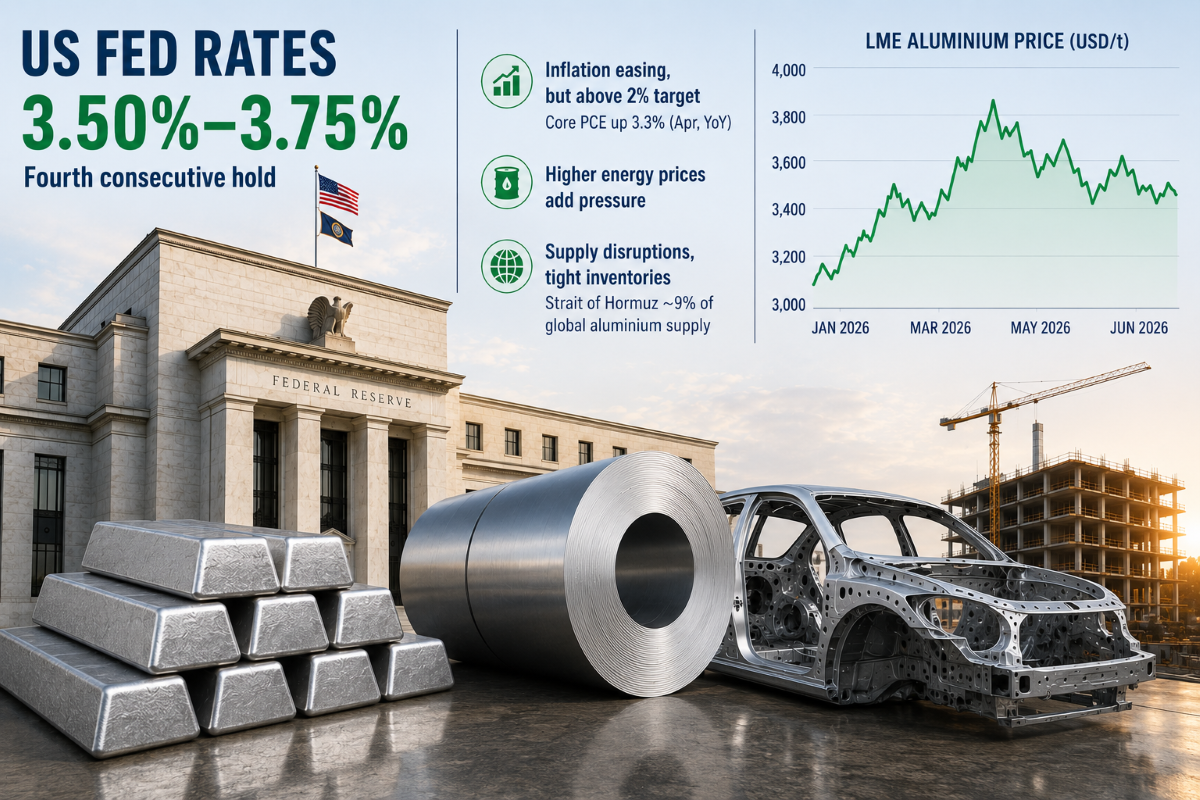
The image used in this article is generated with an AI tool and does not depict any real-time moment
The US Federal Reserve has kept the interest rates unchanged, keeping the benchmark federal funds rate at 3.50-3.75 per cent for the fourth consecutive meeting. The decision, approved unanimously in a 12-0 vote by the Federal Open Market Committee (FOMC), was widely expected by financial markets and keeps the benchmark rate at its lowest level since November 2022.
At first glance, the decision appears to be a routine policy hold. But for the aluminium industry, it offers a clearer picture of the economic environment shaping demand, production costs and metal prices. The Fed's decision signals that inflation remains a concern, particularly as rising energy prices have altered expectations for monetary policy. Earlier this year, markets anticipated one or two rate cuts in 2026, but those expectations have faded. According to the median forecasts in a Reuters poll, economists now expect the Federal Reserve to keep its key interest rate unchanged for the remainder of the year.
Inflation is easing, but the Fed is not ready to declare victory
Although the US Federal Reserve cut the federal funds rate three times in 2025, lowering the benchmark target range from 4.25-4.50 per cent at the start of the year to 3.50-3.75 per cent by December, inflation has slowed from its 2022 peak but remains above the Fed's 2 per cent target.
The Fed's preferred inflation gauge, the core Personal Consumption Expenditures (PCE) Price Index, rose 3.3 per cent over the 12 months through April. Although the measure excludes food and energy prices to better reflect underlying inflation trends, rising energy costs have become increasingly difficult to ignore.
Higher energy prices following the closure of the Strait of Hormuz have added fresh uncertainty to the inflation outlook by pushing up costs across the economy. Commenting on the June policy decision, Rob Haworth, Senior Investment Strategy Director at U.S. Bank Asset Management Group, said, "The Federal Reserve held rates steady in June because inflation is still above target and higher oil prices complicate the path back to 2 per cent."
There are signs that some inflationary pressures may continue to soften. The Consumer Price Index (CPI) rose 4.2 per cent year on year in May, while core CPI, excluding food and energy, increased 2.9 per cent. Shelter costs climbed 3.4 per cent, although slower growth in home prices and rents could help moderate inflation over time.
Meanwhile, the labour market has stabilised after weakening in 2025. Private employers added an average of 117,000 jobs per month through May this year, compared with 10,000 jobs per month in 2025. The unemployment rate stood at 4.3 per cent in May, while weekly initial jobless claims remained low at 228,000 for the week ending June 5.
What does the Fed's policy outlook mean for the aluminium industry?
For the aluminium industry, the Federal Reserve's latest decision is about far more than interest rates. It reflects an economic environment where inflation remains above target, energy costs remain elevated and geopolitical tensions continue to influence commodity markets. While policymakers remain focused on bringing inflation back to 2 per cent, aluminium is responding much more sharply. Inflation is currently running at around 3.3 per cent, or roughly 1.5 times the Fed's target, whereas aluminium prices have risen at roughly four times that pace on a year-on-year basis, highlighting the metal's heightened sensitivity to supply disruptions and rising production costs.
Recent market movements illustrate that volatility. Aluminium prices climbed to nearly USD 3,416 per tonne in mid-June, supported by tight billet supply, rising production input costs and higher carbon credit prices. It was short lived as easing geopolitical concerns and improving market sentiment triggered a sharp correction, with prices falling to around USD 3,080 per tonne by July 3, about 17 per cent below the early-June peak.
The reason lies in aluminium's energy-intensive production process. Unlike broad inflation measures such as the Consumer Price Index (CPI) or the core Personal Consumption Expenditures (PCE) Price Index, which track a wide basket of goods and services, aluminium production is heavily exposed to electricity prices. Producing one tonne of primary aluminium through the Hall-Héroult process requires approximately 14,000 kWh of electricity, with energy accounting for nearly 30-40 per cent of total production costs. Even modest increases in energy prices can therefore have a disproportionately large impact on aluminium production costs and market prices.
Energy is only part of the story. The intensifying US-Iran conflict has disrupted shipping through the Strait of Hormuz, a strategic trade route associated with around 9 per cent of global aluminium supply. Unlike broad consumer inflation, which reflects movements across thousands of goods and services, the aluminium market responds directly to supply disruptions of this nature, making prices significantly more sensitive to geopolitical developments.
Market fundamentals have further amplified those price swings. Inventories in London Metal Exchange (LME) warehouses remain at their lowest level since 2022, while stocks held by the Shanghai Futures Exchange (SHFE) have continued to decline. With physical inventories already tight, any disruption to raw material flows, freight routes or energy markets can trigger an outsized reaction in aluminium prices.
Taken together, persistent inflation, elevated energy prices, geopolitical tensions and tightening inventories continue to create a supportive backdrop for aluminium prices, even as the broader economy gradually moves towards lower inflation.

How the end products will be affected
Automotive
The Federal Reserve's higher interest rate environment is also affecting the automotive sector, one of the largest consumers of aluminium. Auto loan rates, which are influenced by the Fed's benchmark rate along with other market factors, have remained elevated, making vehicle financing more expensive for consumers.
The global aluminium casting usage is expected to reach 24.2 million tonnes in 2026. To learn about the future market trends, explore our upcoming report “Global Aluminium Casting Market 2026-2032”
According to the latest data from Edmunds, many new car buyers are opting for longer loan terms to keep monthly repayments affordable. Despite that, financing costs remain high, with the interest rate on a five-year new car loan hovering around 7 per cent, pushing the average monthly payment for a new vehicle to a record USD 773 in the first quarter of 2026.
"Car buyers are in a tough spot right now because they're getting squeezed from both ends: high sticker prices and high interest rates, with neither showing any signs of letting up," said Joseph Yoon, Consumer Insights Analyst at Edmunds.
He added, "Until the rate picture shifts, buyers will keep stretching loan terms to make payments work, which only adds to the total cost of ownership down the road."
This higher interest rates mean manufacturers should prepare for elevated borrowing costs rather than expect cheaper financing anytime soon. For companies planning plant expansions, equipment purchases or acquisitions, the Fed's June decision signals that financing conditions are unlikely to ease in the near term.
Building and construction
With the benchmark rate 3.50-3.75 per cent, the bigger impact is on mortgage and construction loans. The average 30-year fixed mortgage rate remains around 6.2 per cent, despite a 13-basis-point decline following a USD 200 billion mortgage-backed securities buyback by Fannie Mae and Freddie Mac. Reflecting this pressure, 84 per cent of homebuilders cited elevated mortgage rates as their biggest challenge in 2025, while 65 per cent expect interest rates to remain a concern in 2026.
Builders are also grappling with higher material costs. Tariffs on steel, aluminium and some copper products have reached up to 50 per cent, while overall construction input costs remain about 44 per cent higher than in 2020. The combination of expensive financing and rising material costs has led many contractors to delay, scale back or cancel projects, creating a double squeeze for the sector.
Unlock key insights from leading companies and experts across the aluminium ecosystem with our e-Magazine - Mine to Market: ALuminium Producers & Manufacturers 2026
Aluminium casting prices in 2026: Why tariffs, premiums and energy are squeezing foundry margins
Next articleRobust aluminium semis exports underscore China demand resilience amid supply pressures
Grow with
AL Circle