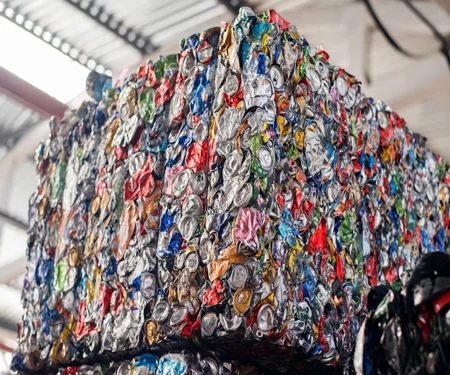
A recent survey by the Aluminum Association and the Can Manufacturers Institute (CMI) has shown a surprising downtrend in consumer aluminium cans recycling in the United States. Once averaging at around 52 per cent in the 1990s, the rate has decreased to 43 per cent in 2023. However, a silver lining is that aluminium cans still have a higher recycling rate than glass, with a recycling rate of 39.6 per cent and plastic bottles with 20 per cent.
Image Source: The Aluminum Association
Outdated recycling infrastructure and less passive approach to recycling policy could be the reasons behind the drop in the United States’ aluminium cans recycling rate. Charles Johnson, president & CEO of the Aluminum Association, said: “Our current approach to recycling in America is simply not working at the level we need. While we recycled more than 46 billion cans in 2023, we threw away more than 61 billion cans – that’s an average of around 15 twelve-packs of cans for each person in the country. That’s nearly $1.2 billion worth of aluminium that ends up in a landfill every year. This is bad for the economy, the environment and national security. It also puts the United States toward the bottom of aluminium can recycling compared to peer countries.”
CMI President Robert Budway believes more methodical action plans and strategic investments in the United States will lead to an improved rate of recycling. According to the roadmap set by CMI, well-designed deposit systems for aluminium cans at the state and federal levels, more household and away-from-home recycling practices, improved sorting technology at recycling centres, and increased post-consumption beverage cans collection will enable to achieve targeted recycling rate – 70 per cent by 2030, 80 per cent by 2040, and 90 per cent by 2050.
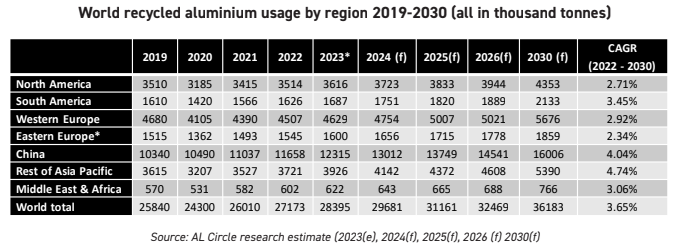
Overall, North America is much ahead in aluminium recycling and usage. According to AL Circle’s report “World Recycled ALuminium Market Analysis Industry Forecast to 2030,” the United States usage of recycled aluminium is expected to reach 3.833 million tonnes by 2025 and to surge above 4 million tonnes by 2030, registering a CAGR of 2.71 per cent since 2019.
The recent survey by the Aluminum Association and CMI also finds – 1) the recycling rate of all aluminium-used beverage containers (UBCs) in the United States is 57 per cent, near the 30-year average of 60 per cent, 2) the closed loop circularity rate of aluminium cans stands 4 points higher than 96.7 per cent, compared to 34 per cent for PET bottles and between 30-60 per cent for glass bottles, 3) the average recycled content of aluminium can made in the US stands at 71 per cent versus 73 per cent in 2019, yet much higher than 23 per cent for glass bottles and 3-10 per cent for plastic bottles, and 4) aluminium cans remain the most valuable beverage package in the recycling bin, with a value of $1,338 per tonne, compared to $215 per tonne for PET and 23 per tonne for glass.
- The Aluminum Association and CMI are working closely with aluminium can makers, beverage brands, environmental organisations, and policy think tanks to collaborate and drive aluminium can recycling in the US.
- Expansion of recycling refund programmes to more states is underway. According to surveys, states with structured refund policies have an aluminium cans recycling rate of 68 per cent compared to an average of 22 per cent in other states.
Charles Johnson said, “If we are truly serious about meeting clean energy goals – and building more secure and resilient domestic supply chains – better recycling policy is essential. Simply recycling all of the aluminium cans we currently throw away would generate enough energy to power 2 million homes for a year. Americans don’t agree on everything, but we can all agree that this is a pointless waste, and we must do better.”












_md.webp)
_md.webp)
_md.webp)