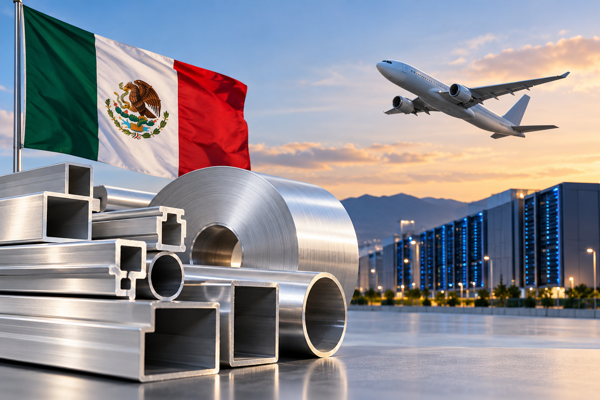
Mexico’s aluminum industry is looking to capitalize on rising demand from artificial intelligence (AI) infrastructure, electric mobility, automotive manufacturing, and aerospace. Expanding technology investments and international market opportunities are expected to support sales growth, while the country’s reliance on imported aluminum highlights the importance of strengthening domestic processing capabilities. Ramón Beltrán, president of Mexico’s National Chamber of the Aluminum Industry (Canalum), expects the country’s domestic and international aluminum sales to gain momentum in 2026, supported by demand from advanced technology applications and established manufacturing sectors. “We expect to close out this year with growth of between 7.5% and 7.8% in domestic and international...
The Confederation of British Metalforming (CBM) has called for closer UK-EU relations, warning that proposed European industrial policies could affect British manufacturers supplying the aluminium, steel and automotive industries. Stephen Morley, CBM President and Chair of the Euroforge Automotive Sector, made the call at the organisation's autumn meeting in Munich. He said stronger cooperation between the UK and EU was important for protecting manufacturing jobs, investment and cross-border supply chains. He stated, “ We need to protect British industry, but we also need to recognise that the UK and European automotive sectors are deeply connected. What damages one part of the supply chain will inevitably affect the other. ” Join the fourth edition of webinar " Hedging for recyclers -...
Grow with
AL Circle

The global aluminium industry is increasingly tying growth to decarbonisation, supply security and circularity. North America is prioritising stronger scrap recovery and domestic supply chains, Europe is balancing scrap retention with climate goals under CBAM, while Asia is driving demand through rising scrap imports, recycling expansion and carbon-focused policy reforms. Across all three regions, aluminium scrap, clean energy and carbon competitiveness are emerging as key pillars of long-term industrial strategy. North America: The US The Aluminum Association has urged US policymakers to adopt a comprehensive strategy combining domestic primary production, recycling, affordable energy, trade enforcement and scrap export controls to build a stronger, more resilient aluminium supply chain....

Australia’s aluminium industry is entering a defining phase of its transition. As demand for low-carbon aluminium accelerates worldwide, the country is seeking to leverage its abundant renewable energy resources, supportive policy framework and growing industrial investment to emerge as a major producer of green aluminium. According to the Australian Energy Market Operator (AEMO), Q1 2026 saw renewable generation and battery storage play an increasingly prominent role in the National Electricity Market (NEM), reinforcing the country’s broader decarbonisation strategy. Here’s a chronological look at the major developments between early 2025 and Q1 2026 that have collectively strengthened Australia’s roadmap towards cleaner aluminium production. January 2025: AUD 2 billion Green aluminium...

Brazilian aluminium and steel exporters are stepping up efforts to measure, verify and certify product emissions as the European Union's Carbon Border Adjustment Mechanism (CBAM) begins to influence trade with Europe. What was initially viewed as a future compliance requirement is now affecting pricing, contracts and sourcing decisions, particularly for companies supplying the European market. According to Rafael Della Barba, climate risk and decarbonisation coordinator at WayCarbon, Brazilian exporters have responded differently to the new framework. Some steel producers started preparing in 2023, well before mandatory compliance, while others postponed investments and are now working to understand their emissions exposure. Under CBAM, exporters must calculate emissions at the individual...

Norwegian aluminium producer Hydro delivered stronger financial results in the second quarter of 2026 as firmer aluminium prices, higher product premiums and improving recycling performance offset weaker energy production and currency headwinds. The company reported adjusted EBITDA of NOK 8.923 billion (USD 927.39 million), up from NOK 7.790 billion (USD 809.6 million) in the corresponding period last year. Adjusted earnings per share increased to NOK 2.2 (USD 0.23) from NOK 1.7 (USD 0.18), while free cash flow reached NOK 4 billion (USD 415.5 million). Hydro's 12-month adjusted return on average capital employed (RoaCE) stood at 10.9 per cent. Slovalco restart strengthens European capacity A key development during the quarter was the announcement on July 1 that Hydro will restart 75,000...

On April 7, 2026, the industry got what it had waited three years for: the European Commission priced carbon at the border for the first time. A CBAM certificate for the first quarter costs EUR 75.36 per tonne of CO2 equivalent, for the second EUR 75.28. Every tonne of aluminium entering the European Union now has two prices: one for the metal and one for its origin. The logic seems obvious from here: the dirtier the metal, the more the border charges, clean producers win, coal-based producers lose. That is how the mechanism was conceived and how the market reads it. Walk through the first-year rules with a calculator, however, and the picture turns upside down. A border built to see carbon does not yet see most of it - and so it rewards not the cleanest producers but the best-organised...

Alvance British Aluminium is carrying out a maintenance and investment programme at its Lochaber Power Station. The hydroelectric power station provides the renewable electricity required for the production of low-carbon primary aluminium at the Lochaber Smelter in Scotland. As part of the 2026 programme, all five generators at the power station are undergoing inspection and refurbishment. The work is being planned using a Failure Mode and Effects Analysis (FMEA) process developed in partnership with engineering company Trillium to identify potential equipment risks and prioritise maintenance activities. The company said the maintenance programme is aimed at ensuring a safe, efficient and reliable power supply while supporting future aluminium production at the site. Explore why...

Aluminium Bahrain B.S.C. (Alba) has recorded 48 million safe working hours without a Lost Time Injury (LTI), reaching the milestone on 16 July 2026 as the company intensifies workplace safety measures for the summer season. The achievement reflects Alba's continued efforts to maintain a safe and healthy workplace for both employees and contractors. Coinciding with the milestone, the company has rolled out its annual plant-wide Summer Safety and Health (S&H) Campaign under the theme "Safety by Choice, Excellence by Habit." The programme will run until July 29, 2026 and focuses on keeping the workforce safe during the hottest months of the year through awareness activities and practical guidance. Employees, contractors and workers will receive information from internal and external safety...

Australian aluminium extruder Capral Aluminium has reinforced its commitment to sustainable manufacturing by introducing independently verified Environmental Product Declarations (EPDs) for its LocAl® lower-carbon aluminium range. An Environmental Product Declaration (EPD) is an independently verified document that quantifies a product's environmental impact throughout its lifecycle, based on internationally recognised assessment standards. The new declarations provide architects, manufacturers, builders and specifiers with internationally recognised environmental data to reinforce embodied carbon assessments, responsible material selection and sustainability reporting. Unlock in-depth insights into the extrusion segment of the global aluminium industry with The World of Aluminium...

The European Commission has proposed raising the European Union's electrification rate to 46 per cent by 2040, alongside a major overhaul of the European Union Emissions Trading System (EU ETS) backed by more than USD 114.37 billion (EUR 100 billion) in industrial decarbonisation funding. Announced on July 18, 2026, the Electrification Action Plan and the proposed review of the EU ETS are aimed at reducing dependence on imported fossil fuels, lowering electricity costs, strengthening industrial competitiveness and keeping the bloc on track to meet its climate goals. According to the Commission, achieving the proposed electrification target could cut the European Union's annual fossil fuel import bill by around USD 297.29 billion (EUR 260 billion). The proposal will now be considered as...

Aluminium has long been the material of choice for flexible packaging because of its barrier performance, strength and recyclability. Today, however, another characteristic is attracting equal attention-its carbon footprint. For decades, discussions around aluminium packaging largely revolved around functionality. Could it keep moisture out? Would it extend shelf life? Could it be recycled at the end of its use? Those questions still matter, but a new one is steadily moving to the forefront: How much carbon is embedded in the aluminium before it even becomes packaging? That question is becoming increasingly relevant as businesses face growing pressure to account for emissions throughout their supply chains. For packaging manufacturers, reducing emissions is no longer only about designing...

Sterling and Wilson Renewable Energy Ltd (SWREL) has reported its highest-ever Unexecuted Order Value (UOV) since the pandemic, closing the first quarter (Q1) of FY27 with an order pipeline of nearly INR 130 billion (USD 1.35 billion) . The milestone was supported by strong domestic EPC activity and a landmark international solar project in Egypt, highlighting continued growth in renewable infrastructure and the increasing use of aluminium-inclusive products like solar module frames, mounting structures, cable systems, battery enclosures and other EPC applications. The company also posted a 36 per cent year-on-year increase in profit after tax (PAT) during the quarter, while revenue from its operation and maintenance (O&M) business rose 40 per cent, indicating the expansion of its managed...

Norsk Hydro operates an integrated aluminium business that spans the full value chain, from bauxite mining and alumina refining to primary aluminium production, extrusion, rolled products and recycling. The company also has a significant presence in renewable power generation, supporting the energy requirements of its aluminium operations. Its business model combines upstream and downstream operations, with mining and refining supplying raw materials for smelters, while finished aluminium products serve industries including construction, automotive, packaging and industrial engineering. This integrated structure enables the company to participate across multiple stages of the aluminium value chain. Norsk Hydro operates in the global aluminium and mining industry, where market conditions...

For decades, India's aluminium industry has measured competitiveness through production costs, operational efficiency and access to raw materials. Today, another metric is steadily moving onto boardroom agendas: carbon intensity. The shift is not being driven solely by climate commitments. Export regulations such as the European Union's Carbon Border Adjustment Mechanism (CBAM), investor expectations around ESG performance and customers seeking lower-carbon materials are collectively changing how aluminium is produced, traded and valued. Against this backdrop, India's Carbon Credit Trading Scheme (CCTS), introduced in 2023, represents far more than another environmental regulation. It is the country's first attempt to place an economic value on industrial emissions and gradually integrate...

Bharat Aluminium Company Limited (BALCO), a subsidiary of Vedanta Aluminium Metal Limited, has issued a public advisory urging citizens, employees, business partners and other stakeholders to remain alert to cyber fraud involving the unauthorised use of the company's identity. The company warned that cybercriminals might register similar-sounding websites, domains and email addresses to BALCO’s name, brand, products and services in an effort to trick users into giving away sensitive information. BALCO says these fraudulent communication channels are usually used to steal confidential, personal, financial or commercial information, spread malware and commit other types of online fraud. The company clarified that it has no association with any unauthorised websites, domains or email...

The US Environmental Protection Agency (EPA) has announced that Columbia Falls Aluminum Co. (CFAC) has agreed to carry out a cleanup of its former aluminium plant north of the Flathead River under a consent decree valued at about USD 57.6 million. The agreement, reached with Glencore and Atlantic Richfield Co. (ARCO), a subsidiary of BP America, requires CFAC to reimburse the EPA for past response costs and undertake the cleanup work at the site. The EPA has also opened a public comment period on the proposed consent decree, which will run until August 6. EPA Region 8 Administrator Cyrus Western said the agreement is an important step towards completing the cleanup and supporting future redevelopment of the site. He added, “In coordination with our federal, state, local, and industry...

Hydro Energy has signed a 10-year power purchase agreement (PPA) with Eviny Fornybar to secure a long-term supply of renewable electricity for its Norwegian operations, supporting the company's low-carbon aluminium production strategy. Under the agreement, Eviny will supply 0.5 TWh of renewable electricity annually between 2031 and 2040, amounting to a total of 5 TWh over the contract period. The electricity will be delivered in Norway's NO5 electricity price area. According to Kari Ekelund Thørud, Executive Vice President of Hydro Energy, predictable long-term access to renewable power is essential for Hydro's operations and will help the company continue supplying low-carbon aluminium and aluminium solutions from its Norwegian plants to European customers. Explore: The most...

Aluminium and renewable energy company Norsk Hydro has signed a five-year supply agreement with Nexans, a global cable and optical fibre company, to deliver around 85,000 tonnes of low-carbon aluminium wire rod spanning from 2026 to 2030. The partnership reinforces Europe's efforts to transform and modernise its electricity grid and expand renewable energy infrastructure. The aluminium would be produced in Norway using renewable energy and supplied through Hydro's low-carbon aluminium brand, Hydro REDUXA, which has a verified carbon footprint of less than 4.0 kg CO₂ per kg of aluminium, i.e., under one-third of the global industry average. Delve deeper into the recycled aluminium and secondary aluminium market with our World Recycled ALuminium Market Analysis Industry forecast to 2032 The...

Türkiye’s plan to scale combined solar and wind capacity to 120 GW by 2035 is putting pressure on a less visible part of the energy transition: the networks required to carry growing volumes of electricity. With around USD 80 billion of investment expected in the renewable energy sector, the expansion is also bringing materials such as aluminium into sharper focus because of their role in cables, transmission lines, distribution networks and solar energy systems. That need is likely to become more pronounced as power demand rises. The International Energy Agency (IEA) expects electricity consumption in Türkiye to continue growing in the coming years, driven by industrial development, the digitalisation of the economy and increasing energy demand. As new generating assets come online, grid...