Three years in: Has India's Carbon Credit Trading Scheme delivered for the aluminium industry?
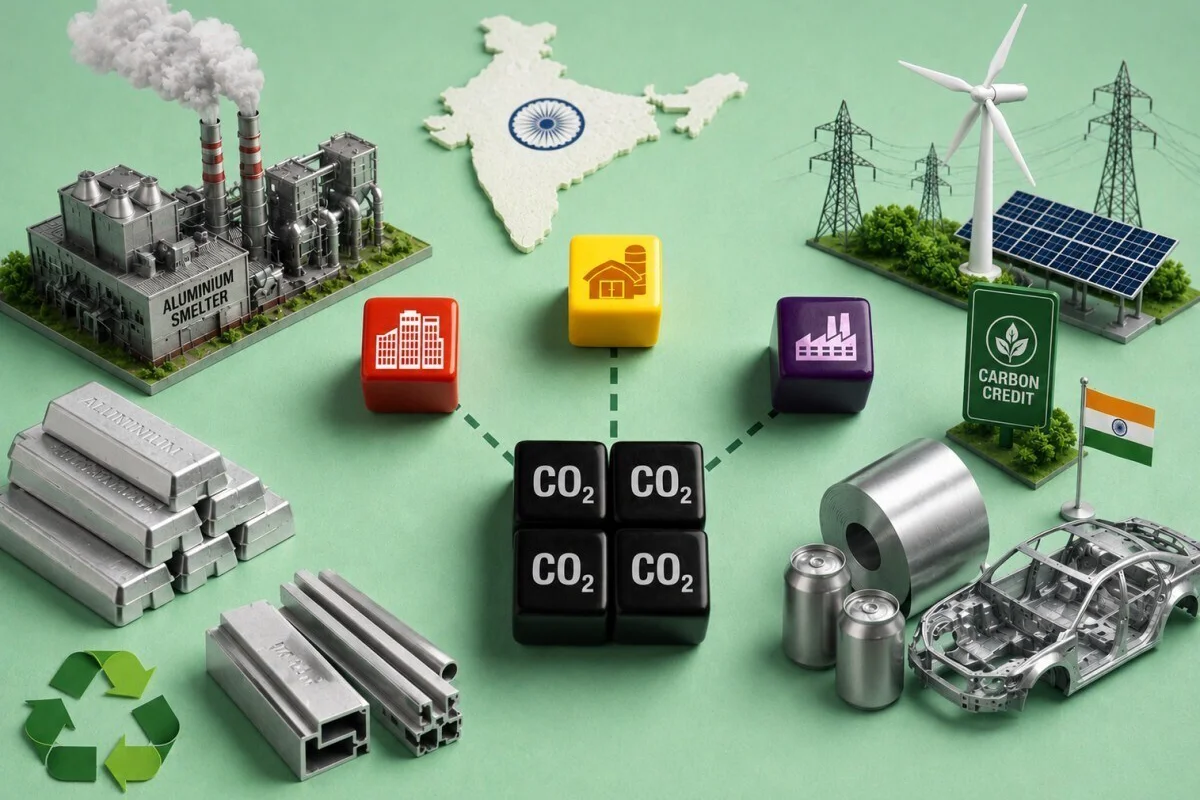
The image used in this article is generated with an AI tool and does not depict any real-time moment
For decades, India's aluminium industry has measured competitiveness through production costs, operational efficiency and access to raw materials. Today, another metric is steadily moving onto boardroom agendas: carbon intensity.
The shift is not being driven solely by climate commitments. Export regulations such as the European Union's Carbon Border Adjustment Mechanism (CBAM), investor expectations around ESG performance and customers seeking lower-carbon materials are collectively changing how aluminium is produced, traded and valued. Against this backdrop, India's Carbon Credit Trading Scheme (CCTS), introduced in 2023, represents far more than another environmental regulation. It is the country's first attempt to place an economic value on industrial emissions and gradually integrate carbon into business decision-making.
Three years on, the scheme has moved beyond legislative intent. The institutional architecture has largely been established, greenhouse gas (GHG) emission-intensity targets have begun to be notified, and exchange-based trading is expected to commence in 2026. Yet, the real measure of success lies not in notifications issued or committees formed, but in whether the scheme has begun influencing industrial investment, operational strategy and long-term competitiveness.
Delve deeper into the recycled aluminium and secondary aluminium market with our World Recycled ALuminium Market Analysis Industry forecast to 2032
Why aluminium sits at the centre of India's carbon story
Primary aluminium is among the most electricity-intensive industrial products in the world. Producing one tonne of aluminium typically requires around 13-15 MWh of electricity, making power availability and power cost as important as alumina quality or smelting technology.
In India, electricity is also the industry's biggest carbon challenge.
Unlike many countries that rely significantly on hydroelectricity, Indian aluminium producers have historically depended on captive coal-fired power plants to ensure uninterrupted electricity for smelters. Aluminium potlines operate continuously. Even short power interruptions can damage equipment and disrupt production. For producers, reliability has therefore taken precedence over carbon intensity.
The result is that electricity accounts for the majority of emissions associated with primary aluminium production. Recognising this, the recently released Roadmap for Aluminium Sector Decarbonisation by NITI Aayog and WRI India identifies power decarbonisation, not process emissions, as the single largest opportunity for reducing the sector's carbon footprint. The report projects that India's aluminium demand could increase from around 4 million tonnes in 2023 to over 37 million tonnes by 2070. Without significant intervention, sectoral greenhouse gas emissions could rise from 83 million tonnes of CO₂ equivalent to 376 million tonnes annually under a business-as-usual scenario.
Against this backdrop, the Carbon Credit Trading Scheme becomes much more than a climate initiative. It is increasingly a policy capable of influencing how India's aluminium industry sources electricity, allocates capital and competes internationally.
From energy efficiency to carbon competitiveness
For more than a decade, the Perform, Achieve and Trade (PAT) scheme encouraged designated industries to improve energy efficiency by reducing Specific Energy Consumption (SEC). The programme delivered measurable savings, avoiding millions of tonnes of carbon emissions while improving industrial efficiency. However, PAT rewarded energy performance rather than direct greenhouse gas reductions, meaning carbon itself remained outside the economic equation.
Instead of measuring energy consumed, the scheme measures Greenhouse Gas Emission Intensity (GEI), the amount of carbon emitted per unit of production. Facilities performing better than their notified targets receive Carbon Credit Certificates (CCCs), while those exceeding their limits must purchase credits once trading begins.
Institutionally, India has built an extensive governance framework. The Ministry of Power acts as the nodal ministry, the Bureau of Energy Efficiency administers the compliance mechanism, the Grid Controller of India Limited manages the registry, the Central Electricity Regulatory Commission oversees trading, while the Central Pollution Control Board enforces compliance. Aluminium is among the first nine sectors brought under the compliance mechanism, reflecting both its energy intensity and its strategic importance to India's industrial economy.
Three years later: what has the scheme achieved?
Judged purely by implementation milestones, the scheme has made meaningful progress.
India now possesses the legal foundation for a domestic carbon market, detailed monitoring, reporting and verification (MRV) procedures, accredited verification agencies, a national carbon registry and clearly defined institutional responsibilities. These are essential prerequisites for any credible emissions trading system and demonstrate that the government has prioritised building governance before launching trading.
Carbon accounting, once largely confined to sustainability reports, is increasingly becoming an operational consideration. Companies are investing in emissions inventories, digital monitoring systems and internal carbon reporting—not simply to satisfy ESG disclosures but to prepare for compliance obligations.
However, the scheme is yet to deliver its most important function: a functioning carbon market.
Trading has not commenced, meaning there is still no transparent carbon price capable of influencing investment decisions. Without price discovery, companies cannot accurately evaluate the commercial returns of investing in renewable electricity, storage technologies or process improvements relative to future compliance costs. Similarly, several sector-specific notifications are still being phased in, leaving parts of industry awaiting greater regulatory clarity.
In other words, India has successfully designed the architecture of a carbon market. Whether that architecture can deliver meaningful decarbonisation remains the question that the next few years must answer.
Participate in our upcoming e-Magazine - Mine to Market: ALuminium Producers & Manufacturers 2026 for the latest industry insights and trends
Why energy, not carbon, will determine the scheme's success
If the first three years of the Carbon Credit Trading Scheme have been about building institutions, the next three will be about transforming India's energy landscape. For the aluminium industry, that transformation is likely to determine whether CCTS becomes a catalyst for decarbonisation or merely another compliance requirement.
Unlike many manufacturing sectors that can relatively easily switch fuels or improve process efficiencies, aluminium production presents unique operational constraints. Smelters operate continuously, with potlines running 24 hours a day. Even brief power interruptions can lead to frozen electrolytic cells, costly repairs and production losses. This explains why India's major aluminium producers have historically invested in captive thermal power plants, prioritising reliability over lower-carbon electricity.
However, that model is becoming increasingly difficult to sustain. Electricity is estimated to account for 30-40 per cent of aluminium production costs, while coal-based captive generation remains the largest contributor to the industry's carbon footprint. Every tonne of aluminium produced using coal-fired electricity carries a higher emissions intensity than metal produced using hydroelectricity or renewable energy-backed systems. As carbon performance begins influencing trade, investment and procurement decisions, power sourcing is no longer simply an operational issue — it is becoming a strategic business decision.
Recognising this challenge, the Roadmap for Aluminium Sector Decarbonisation identifies Renewable Energy-Round-the-Clock (RE-RTC) as the most immediate pathway for reducing emissions. Unlike conventional renewable power, RE-RTC combines solar, wind and energy storage to provide continuous electricity suitable for industrial operations. Over the medium term, the report also identifies direct nuclear power supply as a potential solution, while carbon capture, utilisation and storage (CCUS) is recommended for captive coal-based power plants where complete fuel substitution is not immediately feasible.
These recommendations reinforce an important point: for India's aluminium industry, the future of carbon competitiveness is inseparable from the future of energy security.

Industry is already moving, but unevenly
Several Indian producers have already increased renewable power procurement, signed long-term green power purchase agreements, invested in captive solar and wind projects, and incorporated decarbonisation targets into broader ESG strategies. These investments were initially driven by rising electricity costs, investor expectations and customer demand for greener products.
CCTS has the potential to strengthen this trend by attaching an economic value to emissions reductions. Facilities that outperform their notified emission-intensity targets could generate Carbon Credit Certificates, creating an additional financial incentive for investments in cleaner electricity, energy efficiency and process optimisation.
Large integrated producers typically possess greater financial capacity to invest in renewable infrastructure, storage technologies and sophisticated emissions monitoring systems. Smaller downstream manufacturers, by contrast, may find compliance more challenging because of limited technical resources, capital constraints and dependence on grid electricity. Ensuring that the carbon market remains both credible and commercially practical will therefore require continued regulatory support, capacity building and transparent monitoring systems.
A domestic policy with global consequences
Although CCTS is a domestic mechanism, its significance extends well beyond India's borders.
The implementation of the European Union's Carbon Border Adjustment Mechanism (CBAM) has fundamentally altered the commercial landscape for carbon-intensive exports. Aluminium, alongside steel, cement and fertilisers, is among the sectors directly affected. European buyers are increasingly interested not only in product quality and price but also in the embedded emissions associated with imported materials.
Companies able to demonstrate lower emissions intensity, credible monitoring systems and transparent carbon accounting may find themselves better positioned in export markets where sustainability is becoming an increasingly important procurement criterion. Conversely, producers with relatively carbon-intensive operations could face growing commercial pressure as overseas markets incorporate carbon costs into purchasing decisions.
In this context, CCTS should not be viewed simply as a compliance obligation. It also serves as an institutional framework capable of improving emissions transparency, supporting ESG reporting and strengthening India's credibility in emerging low-carbon supply chains.
The overlooked opportunity: Secondary aluminium
Recycling aluminium requires only a fraction of the energy needed to produce primary metal and consequently results in substantially lower greenhouse gas emissions. As industries place greater financial value on carbon performance, recycled aluminium could become increasingly attractive across automotive, construction and packaging applications.
For India, which is simultaneously pursuing resource efficiency and circular economy objectives, stronger carbon pricing may improve the commercial case for expanding organised aluminium recycling. While the compliance mechanism primarily targets large industrial facilities, its broader influence on investment decisions could encourage greater utilisation of secondary aluminium, complementing efforts to reduce emissions across the value chain.
Note: This is exclusive coverage by AL Circle and may not be reproduced, republished or shared without prior permission.
BALCO warns stakeholders against cyber fraud and impersonation attempts
Next articleASI certifies Saint Jean Industries S.A.S against Performance Standard V3.1
Grow with
AL Circle