AL Circle Analysis: How the US, Europe and Asia are reshaping 2026 aluminium map
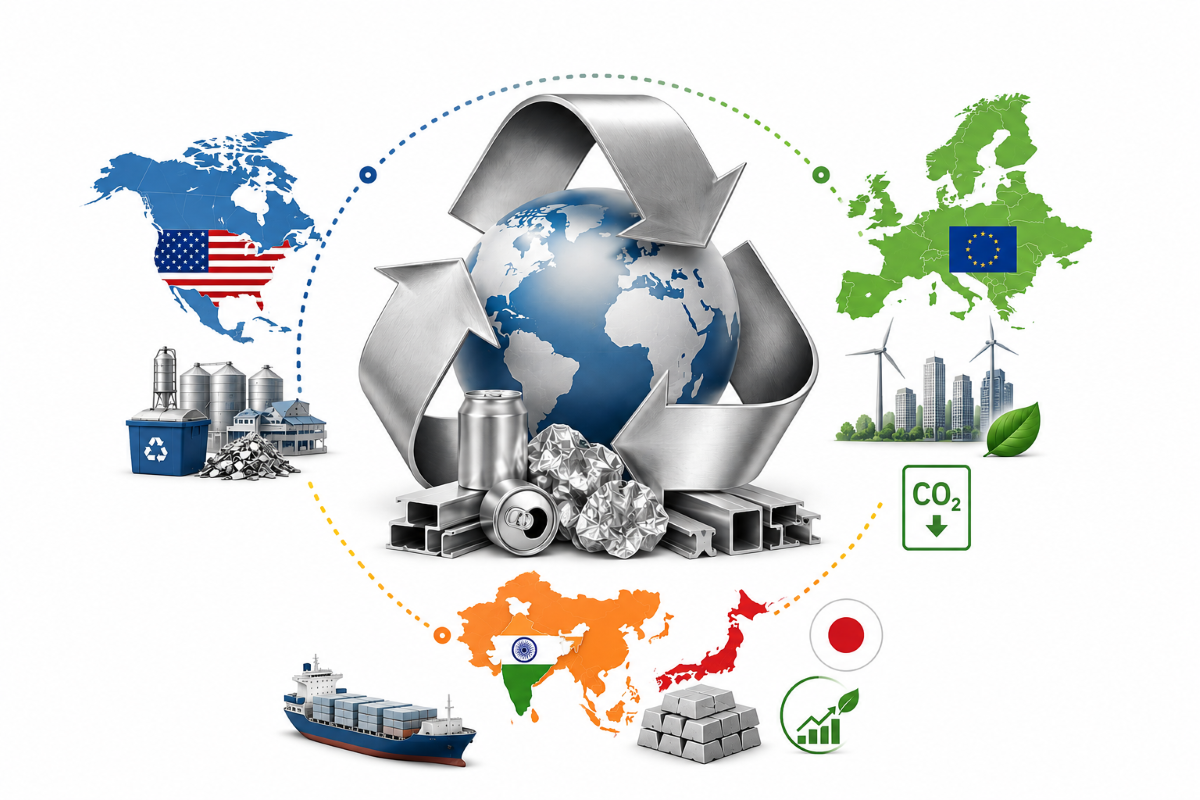
The image used in this article is generated with an AI tool and does not depict any real-time moment
The global aluminium industry is increasingly tying growth to decarbonisation, supply security and circularity. North America is prioritising stronger scrap recovery and domestic supply chains, Europe is balancing scrap retention with climate goals under CBAM, while Asia is driving demand through rising scrap imports, recycling expansion and carbon-focused policy reforms. Across all three regions, aluminium scrap, clean energy and carbon competitiveness are emerging as key pillars of long-term industrial strategy.
North America: The US
The Aluminum Association has urged US policymakers to adopt a comprehensive strategy combining domestic primary production, recycling, affordable energy, trade enforcement and scrap export controls to build a stronger, more resilient aluminium supply chain.
US aluminium scrap recovery continued to strengthen at the start of 2026, with recycled metal production rising by double digits year on year, while primary aluminium output remained largely unchanged, according to the latest US Geological Survey (USGS) Mineral Industry Survey. A total of 318,000 tonnes of aluminium was recovered from scrap in January 2026, up 14 per cent from the same month last year compared to 297,000 tonnes and 3 per cent higher than the revised December 2025 figure.
Key takeaways:
- US aluminium scrap recovery surged 14 per cent Y-o-Y in 2026, signalling stronger domestic scrap availability.
- The Aluminum Association has urged a comprehensive strategy to strengthen the full aluminium value chain, i.e., from mining and refining to recycling and manufacturing.
- Circularity is strengthening US competitiveness. Combining of higher scrap recovery and stronger recycling infrastructure positions the US to produce more low-carbon aluminium while supporting domestic manufacturing.
Why? – With only four operational primary smelters, higher scrap recovery has become critical for strengthening raw material security, though it cannot replace the need for domestic primary production. Thus, higher scrap recovery helps improve raw material security but not eliminating the need for additional domestic primary production.
Delve deeper into the recycled aluminium and secondary aluminium market with our World Recycled ALuminium Market Analysis Industry forecast to 2032
Europe: The UK, Germany
The EU remained a net exporter of aluminium scrap in Q1 2026, with exports reaching 345,908 tonnes against imports of 168,346 tonnes. While Europe continues debating tighter scrap retention to support domestic recycling and CBAM objectives, strong overseas demand and limited processing capacity for certain scrap grades kept export volumes elevated, with proposed restrictions now delayed until September 2026.
The UK's aluminium recycling industry is facing mounting pressure as scrap exports continue to rise despite growing domestic requirements. During January–April 2026, the UK’s scrap exports reached 217,611 tonnes, rising 9 per cent Y-o-Y from 200,374 tonnes a year earlier. By 2035, the country could need up to 6 million tonnes of aluminium scrap, making stronger scrap retention, improved collection systems, advanced recycling infrastructure and targeted policy measures to reduce dependence on exports and strengthen the domestic circular economy.
Germany exported 311,491 tonnes of aluminium scrap to the global market in Q1 2026, up marginally by 0.5 per cent from 310,057 tonnes in Q1 2025. The increase was more pronounced on a quarterly basis, with exports rising 8.8 per cent from 286,285 tonnes in Q4 2025. In Germany’s domestic aluminium market, Q1 recycled aluminium production fell by around 3 per cent year-on-year to 684,564 tonnes.
The EU's CBAM has entered its first compliance year with carbon certificates priced at EUR 75.36 per tonne of CO₂e for Q1 2026 and EUR 75.28 per tonne of CO₂e for Q2. Current aluminium import costs remain limited at EUR 6-8 per tonne because CBAM presently covers only direct emissions, although the chargeable share will rise from 2.5 per cent in 2026 to 100 per cent by 2034.
The European Commission has proposed raising the EU’s electrification rate to 46 per cent by 2040, alongside a major overhaul of the European Union Emissions Trading System (EU ETS) backed by more than USD 114.37 billion (EUR 100 billion) in industrial decarbonisation funding.
Key takeaways:
- Germany's aluminium scrap exports rose 8.8 per cent Y-o-Y in Q1 2026, reflecting stronger overseas demand despite weak domestic consumption.
- The UK may require 6 million tonnes of aluminium scrap by 2035, up from about 800,000 tonnes in 2026, to meet its recycling ambitions.
- EU-27 exported 345,908 tonnes of aluminium scrap in Q1 2026, more than double its 168,346 tonnes of imports, remaining a strong exporter.
- CBAM carbon certificates were priced at EUR 75.36 per tonne of CO₂e (Q1 2026) and EUR 75.28 per tonne of CO₂e (Q2 2026), but only 2.5 per cent of embedded emissions are chargeable in 2026, rising to 100 per cent by 2034.
- The EU aims to raise electrification to 46 per cent by 2040 and has proposed mobilising EUR 114.37 billion through ETS reforms to accelerate industrial decarbonisation.
Why? – Europe has been struggling with energy crisis since 2020. The need for safeguarding scrap metal is twofold as it helps the bloc to mitigate its energy crisis while meeting decarbonisation goals.
Unlock key insights from leading companies and experts across the aluminium ecosystem with our e-Magazine - Mine to Market: ALuminium Producers & Manufacturers 2026
Asia: Japan, India
Japan imported a total of 35,794 tonnes of aluminium scrap in Q1 2026, of which 3,613 tonnes or 10.09 per cent, was imported from the EU. Comparing the Q1 volume over the years, it has risen 89 per cent Y-o-Y from the 1,902 tonnes in Q1 2025. The Q1 import value of Japan’s aluminium scrap from the EU is worth USD 3.26 million, marking a Y-o-Y gain of 45.54 per cent from USD 2.24 million recorded in Q1 2025, indicating a rise in scrap sourcing despite an almost 50 per cent hike in the pricing segment.
The Aluminium Association of India has urged the government to notify BIS standards for aluminium scrap, retain the 2.5 per cent import duty and introduce grade-wise HSN codes to prevent low-quality imports. The industry body said stricter quality controls are essential to protect domestic recycling, support future investments and strengthen India's aluminium value chain.
On the contrary, the Material Recycling Association of India (MRAI) has urged the Indian government to abolish the 2.5 per cent Basic Customs Duty (BCD) on aluminium scrap, arguing that the measure would support the country's recycling industry and strengthen the circular economy. According to the association, India's secondary aluminium production has increased from 0.85 million tonnes in FY16 to nearly 2.2 million tonnes in FY26, accounting for around 35 per cent of the country's total aluminium consumption.
Secondary aluminium producers are facing mounting pressure as tighter CBAM rules, rising scrap prices, geopolitical supply disruptions and India's 2.5 per cent scrap import duty erode traditional recycling margins. To stay competitive, the industry is increasingly turning to AI-enabled scrap sorting, advanced hydrometallurgy and stronger carbon traceability to improve efficiency and meet evolving regulatory demands.
Three years after its launch, India's Carbon Credit Trading Scheme (CCTS) is laying the foundation for a domestic carbon market that could reshape the aluminium industry. With carbon intensity emerging as a key measure of competitiveness, the scheme is expected to encourage cleaner power sourcing, improve emissions transparency and strengthen the sector's position in low-carbon global supply chains, although exchange-based trading is yet to begin.
Trading aluminium across borders? Find out the exact cost you need to bear for the embedded carbon in the product by using this CBAM calculator.
Key takeaways:
- Japan's aluminium scrap imports from the EU surged 90 per cent Y-o-Y in Q1 2026 despite higher scrap prices, highlighting strong demand for secondary raw materials.
- India's secondary aluminium output has nearly tripled from 0.85 million tonnes in FY2015-16 to around 2.2 million tonnes in FY2025-26, now accounting for 35 per cent of domestic aluminium consumption.
- India still imports 80-85 per cent of its aluminium scrap requirement, with imports reaching 2 million tonnes and a foreign exchange outgo of INR 402.03 billion.
- AAI has proposed retaining the 2.5 per cent Basic Customs Duty on aluminium scrap until BIS standards are notified, followed by a 7.5 per cent duty on low-grade (Grade 3-7) scrap.
- NITI Aayog projects recycled aluminium will meet about 45 per cent of India's aluminium demand by 2028, while consuming up to 95 per cent less energy and emitting up to 90 per cent less CO₂ than primary aluminium.
- India's 2.5 per cent Basic Customs Duty on aluminium scrap adds an estimated USD 50-70 per tonne to recyclers' costs, while secondary production generates 200-600 kg of black dross per tonne of aluminium.
- India's Carbon Credit Trading Scheme (CCTS), introduced in 2023, is expected to begin exchange-based carbon trading in 2026, with aluminium among the first nine sectors covered under the compliance mechanism.
Why? – Both Japan and India have been major buyers of the EU aluminium scrap.
Japan is facing an 11-year high USD 395 per tonne premium on primary aluminium shipments, further tightening supply windows. Moreover, its growing use of recycled aluminium in automotive manufacturing are driving higher scrap imports.
Similarly, India pays a 7.5 per cent basic Customs duty, taking the effective import levy to 8.25 per cent. Sourcing scrap with only a 2.5 per cent Basic Customs Duty is a better choice, taking the nation closer to its Net Zero goal. Moreover, India’s already strong base for primary aluminium automatically calls for a larger storage bucket for aluminium scrap.

Australia's green aluminium roadmap: 9 key developments driving clean energy transition
Next articleRio Tinto’s Bell Bay aluminium smelter misses green credit despite clean power
Grow with
AL Circle