UK’s aluminium scrap requirement estimated to hit 6Mt by 2035 - here’s how the country plans to retain more scrap and curb leakage
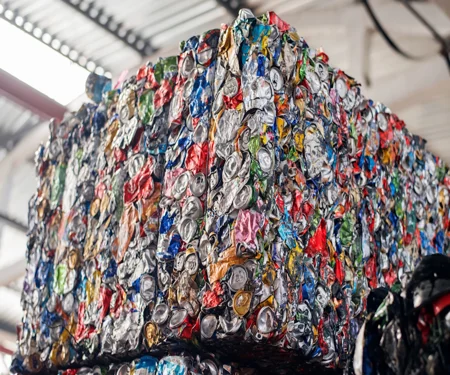
The image used in this article is generated with an AI tool and does not depict any real-time moment
The UK has an ambitious aluminium scrap equation to solve. Domestic industry is forecast to require as much as 6 million tonnes of aluminium scrap for recycling by 2035 to support the government’s projected 8 million tonnes of aluminium demand across sectors. Yet much of the metal needed to support that future is already flowing in the opposite direction.
The UK exports almost half the aluminium scrap it generates, while imports fill only 27 per cent of the resulting gap. The trend has continued into 2026, with scrap exports rising 9 per cent year on year to 217,611 tonnes during January–April, from 200,374 tonnes a year earlier.
This is where the UK’s recycling ambition meets a difficult market reality. Scrap is becoming increasingly important at home, but overseas buyers are competing for the same material.
The stakes extend well beyond recycling. Secondary aluminium is linked to packaging, automotive, defence, aerospace and construction. The UK uses more than 16 billion beverage cans annually and has an 81 per cent can recycling rate, while Novelis is investing another EUR 70 million to double used beverage can recycling capacity. JLR has introduced aluminium skin containing 85 per cent recycled content, UK manufacturers produce specialised components including EV battery casings, and Arconic reuses up to 71 per cent scrap in defence-critical production.
So, how much additional scrap would the UK need to secure for domestic recycling? Against this backdrop, a Make UK paper sets out two different pathways for future scrap availability.
Retention Option 1: 6Mt of scrap to meet 75% of demand through recycling
Retention Option 1 is the higher-recycling pathway. Under this scenario, recycling would meet 75 per cent of the UK’s projected 8 million tonnes of aluminium demand in growth sectors by 2035, requiring 6 million tonnes of scrap to be available for recycling.
Starting from 800,000 tonnes in 2026, scrap requirements would need to grow by around 25.1 per cent annually. The volume rises to 1 million tonnes in 2027, 1.96 million tonnes in 2030 and 3.08 million tonnes in 2032 before reaching 6 million tonnes in 2035.
Assuming imports remain at 18.75 per cent of total procurement, additional scrap retained from exports would need to increase from 163,112 tonnes in 2027 to 320,449 tonnes in 2030 and 504,114 tonnes in 2032.
The real pressure emerges in 2033. Additional retained scrap reaches 632,802 tonnes, equivalent to 101.4 per cent of the UK’s 624,000-tonne 2025 scrap export base. It then rises to 791,780 tonnes in 2034 and 950,198 tonnes in 2035, equivalent to 152.3 per cent of that export base.
This is the critical constraint in Option 1. From 2033, simply redirecting current export volumes into domestic recycling would no longer be enough. The excess requirement would need to be addressed through other domestic levers, including increased post-consumer scrap procurement linked to the anticipated Deposit Return Scheme and stronger UK routes to market capable of attracting more material.

Retention Option 2: 3.55Mt needed to maintain today’s 44% recycling contribution
Retention Option 2 follows a business-as-usual recycling pathway. Under this scenario, recycling continues to meet 44 per cent of aluminium demand in growth sectors in 2035, the same proportion identified by the paper as today’s level.
Even without increasing recycling’s share of demand, the UK would still require 3.55 million tonnes of scrap available for recycling by 2035.
Starting from 800,000 tonnes in 2026, scrap requirements would need to grow by around 18 per cent annually. The volume rises to 944,048 tonnes in 2027, 1.55 million tonnes in 2030 and 2.16 million tonnes in 2032 before reaching 3.55 million tonnes in 2035.
Assuming imports continue to account for 18.75 per cent of procurement, additional scrap retained from exports would need to rise from 117,039 tonnes in 2027 to 192,329 tonnes in 2030 and 267,826 tonnes in 2032.
By 2035, additional retained scrap reaches 440,115 tonnes, equivalent to 70.5 per cent of the 624,000 tonnes exported in 2025.
Unlike Option 1, the additional retention requirement remains below the current annual export base through 2035. However, it would still require the UK to redirect a substantial share of material currently leaving the country while maintaining import growth.
Delve deeper into the recycled aluminium and secondary aluminium market with our World Recycled ALuminium Market Analysis Industry forecast to 2032
Where is UK’s scrap going
The difficulty is that the UK is not starting from a balanced scrap market. Historical estimates in the white paper show that the country exported around 560,000 tonnes of aluminium scrap in 2019, including 400,000 tonnes to non-EU markets, while retaining around 650,000 tonnes and importing 150,000 tonnes.
At least 800,000 tonnes of aluminium scrap was recycled that year, equivalent to around 44 per cent of current UK aluminium demand in growth sectors. Yet before exports and imports were considered, potential recycling based on domestically generated scrap stood at around 1.2 million tonnes.
Recent trade flows show that overseas pull remains strong. During January–April 2026, UK aluminium scrap exports increased 9 per cent year on year to 217,611 tonnes.
India remained the largest destination, importing 60,054 tonnes, although shipments edged down 1 per cent year on year. Hong Kong ranked second with 34,666 tonnes, down 4 per cent, while exports to China fell 15 per cent to 20,261 tonnes. Shipments to Germany also declined 8 per cent to 10,206 tonnes. However, these declines were outweighed by a sharp increase in US buying.
UK aluminium scrap exports to the United States surged 174 per cent to 17,230 tonnes, from 6,285 tonnes a year earlier. The increase followed a shift in the US trade environment, where primary aluminium imports face a 50 per cent tariff while scrap remains exempt, strengthening demand for imported secondary raw material. Thailand also increased purchases by 6 per cent to 11,546 tonnes.
Together, India, Hong Kong, China, the US, Thailand and Germany received about 154,000 tonnes, equivalent to roughly 71 per cent of total UK aluminium scrap exports during the four-month period.
The destination mix shows why retention could become harder. UK scrap is being pulled across Asia, North America and Europe just as both 2035 pathways require substantially greater domestic availability.
What UK can do to retain scrap and curb leakage
The UK’s most concrete route to improving domestic scrap recovery is the Deposit Return Scheme, which could increase collection of high-quality used beverage cans. With more than 16 billion cans used annually, stronger post-consumer recovery could become particularly important under Option 1, where current export volumes alone are insufficient from 2033.
Beyond this, the Make UK white paper proposes “smart scrap retention” measures focused on strategic alloys rather than blanket export restrictions. Recommendations include a UK-market-first mechanism to give domestic processors earlier visibility of priority scrap, clearer HS codes to identify the alloy and quality of exports, and stronger traceability of strategically valuable material.
The paper also calls for investment support for advanced sorting, de-coating, shredding and alloy separation, alongside stronger collection standards and enforcement. The aim is to make domestic processing more competitive where overseas buyers attract UK scrap through higher prices or lower pre-sorting requirements.
At the same time, the paper argues that the UK should seek trusted-partner treatment with the EU to preserve access to specialised European scrap grades. In 2024, the UK exported around 107,000 tonnes of scrap to Europe and imported 73,000 tonnes, while some UK processors rely on EU material for around 31 per cent of input.
The objective is not to stop all exports, but to retain more strategically useful scrap while maintaining access to complementary grades required by UK processors.
Explore the position of aluminium at the intersection of sustainability and strategy in Sustainability & Recycling: Aluminium's Dual Commitment
What could UK learn from EU’s scrap retention strategy?
The European Commission views aluminium scrap retention as important to decarbonisation and strategic autonomy and is preparing measures to curb scrap leakage, with possible action in Q2 2026.
Reported options include export duties, export licensing, mandatory recycled-content targets and tighter surveillance of trade flows.
For the UK, the EU approach could offer a possible direction. A formal monitoring system could track export destinations and vulnerable scrap grades, while targeted retention tools could focus on high-value or strategic alloys when domestic processors face shortages.
Greater investment in collection, sorting and pre-processing infrastructure, backed by stronger enforcement and quality standards, could also help keep more UK-generated scrap available for domestic recycling rather than allowing it to leave as mixed or lower-value material.
Analysis
Retention alone will not be enough to deliver 6 million tonnes of scrap availability by 2035. Under Option 1, the additional retention requirement overtakes the UK’s entire 2025 export base from 2033, while Option 2 stays within that pool but still requires 440,115 tonnes by 2035.
The challenge, therefore, goes beyond keeping more scrap at home: the UK must expand recovery, strengthen domestic processing and build a much larger scrap ecosystem capable of supporting an aluminium market that could reach 8 million tonnes by 2035.
For an in-depth understanding of the UK’s aluminium recycling landscape, download Make UK’s white paper, Strategic Aluminium Scrap, here
Wychavon launches campaign to increase aluminium foil recycling
Next articleAL Circle analysis: Trade policies, carbon costs, supply trends shape aluminium scrap market outlook
Grow with
AL Circle