The blind border: Who actually wins from aluminum’s first CBAM year
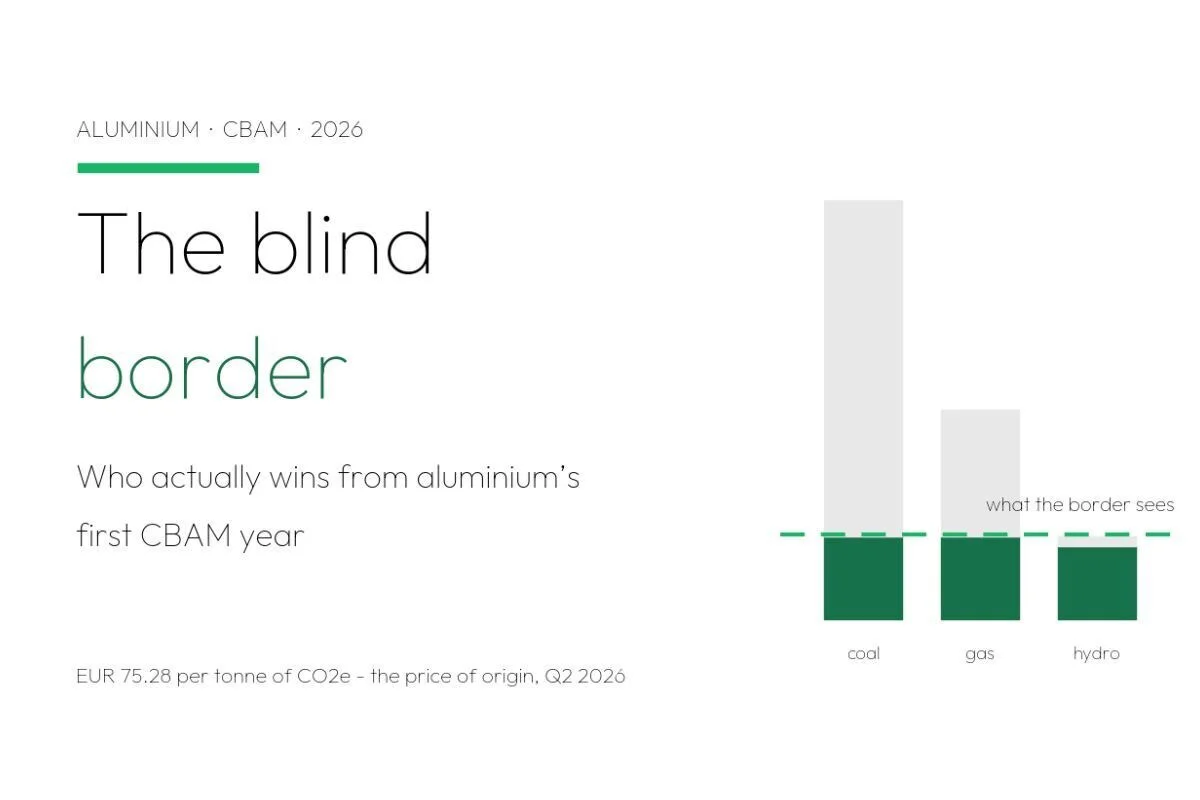
This image has been obtained via official Press Release
On April 7, 2026, the industry got what it had waited three years for: the European Commission priced carbon at the border for the first time. A CBAM certificate for the first quarter costs EUR 75.36 per tonne of CO2 equivalent, for the second EUR 75.28. Every tonne of aluminium entering the European Union now has two prices: one for the metal and one for its origin.
The logic seems obvious from here: the dirtier the metal, the more the border charges, clean producers win, coal-based producers lose. That is how the mechanism was conceived and how the market reads it. Walk through the first-year rules with a calculator, however, and the picture turns upside down.
A border built to see carbon does not yet see most of it - and so it rewards not the cleanest producers but the best-organised paperwork. Below I show how this came about, who gains and by how much, and what follows for producers in Asia and the Middle East.
How the machine is built
Start with the design.
CBAM exists to make an importer pay the same carbon price a European plant pays inside the EU Emissions Trading System. Since January 1, 2026, it runs in earnest: anyone importing more than 50 tonnes of CBAM goods a year needs authorised-declarant status, declares the embedded emissions annually and surrenders certificates against them. The first bill, covering 2026, falls due by September 30, 2027, with certificate sales opening on February 1, 2027.
Four design choices inside this machine decide who wins in year one.
First, for aluminium, only direct emissions count - what the plant itself releases: anode consumption, the perfluorocarbons of electrolysis, the fuel burned in alumina refining. Electricity, the largest single item in the metal’s footprint, is classed as indirect and stays out of the calculation. There is no loophole for captive power: under the regulation’s definition, emissions from generating electricity remain indirect "regardless of the location of the production of the consumed electricity" - a smelter’s own power station is treated like the grid.
Second, what is paid is not the whole accounted emission but a growing share of it, mirroring the withdrawal of free allowances from European plants: just 2.5 per cent in 2026, 48.5 per cent by 2030, the full 100 per cent in 2034.
Explore why verification, traceability and carbon footprint reporting become essential in AL with our upcoming webinar by Alberto Monje Gama, Sustainability Policy Manager, TIC COUNCIL, on “Recycled aluminium, CBAM and trust: Why verification matters for Europe's circular economy”
Third, whoever fails to prove emissions with verified data is assigned default values - deliberately inflated: 10 per cent above the country average this year, 20 next year, 30 from 2028.
Fourth, a carbon price already paid at home is deducted at the border.
Keep these four in mind - the perimeter, the factor, the price of being measured and the deduction. The rest is arithmetic.
What it costs today
Take one tonne of primary aluminium. It carries around 1.5 tonnes of direct CO2 at the pot line and some 3-4 tonnes across all stages. Multiply by the 2.5 per cent factor and the EUR 75.28 price, and the 2026 bill is EUR 6-8 per tonne of metal - roughly 0.3 per cent of its exchange price, less than a daily move on the LME.
Now is the part that matters. The spread in full footprints is enormous: the industry average is 14.8 tonnes of CO2e per tonne (IAI, 2023), coal-fired grids produce around 20 and above, the best hydro brands 4 and below. Yet the border sees the same 3-4 tonnes of direct emissions in all of them. A tonne of coal-based metal from Shandong and a tonne of hydro-based metal from Quebec pay almost the same at the border.
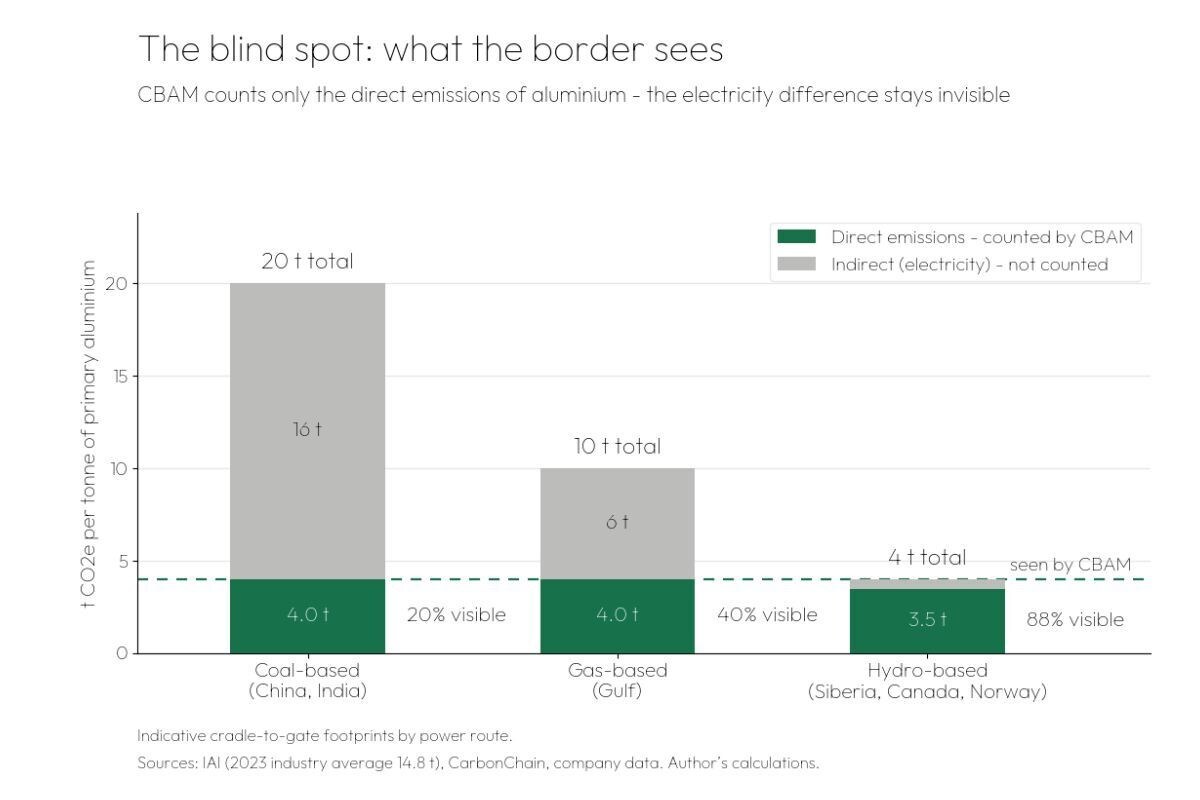
What the border sees - CBAM counts only the direct emissions of aluminium, which are similar across power routes. The electricity-driven difference stays invisible. Sources: IAI, CarbonChain, company disclosures, author’s calculations.
And then the same tonne gets more expensive on schedule: at an unchanged carbon price the bill grows to EUR 140-150 by 2030 and close to EUR 300 by 2034. The conclusion is plain. Today’s bill is small change, but it is the same invoice - and it grows some fortyfold in eight years. What matters is not the level of year one but the slope of the curve.
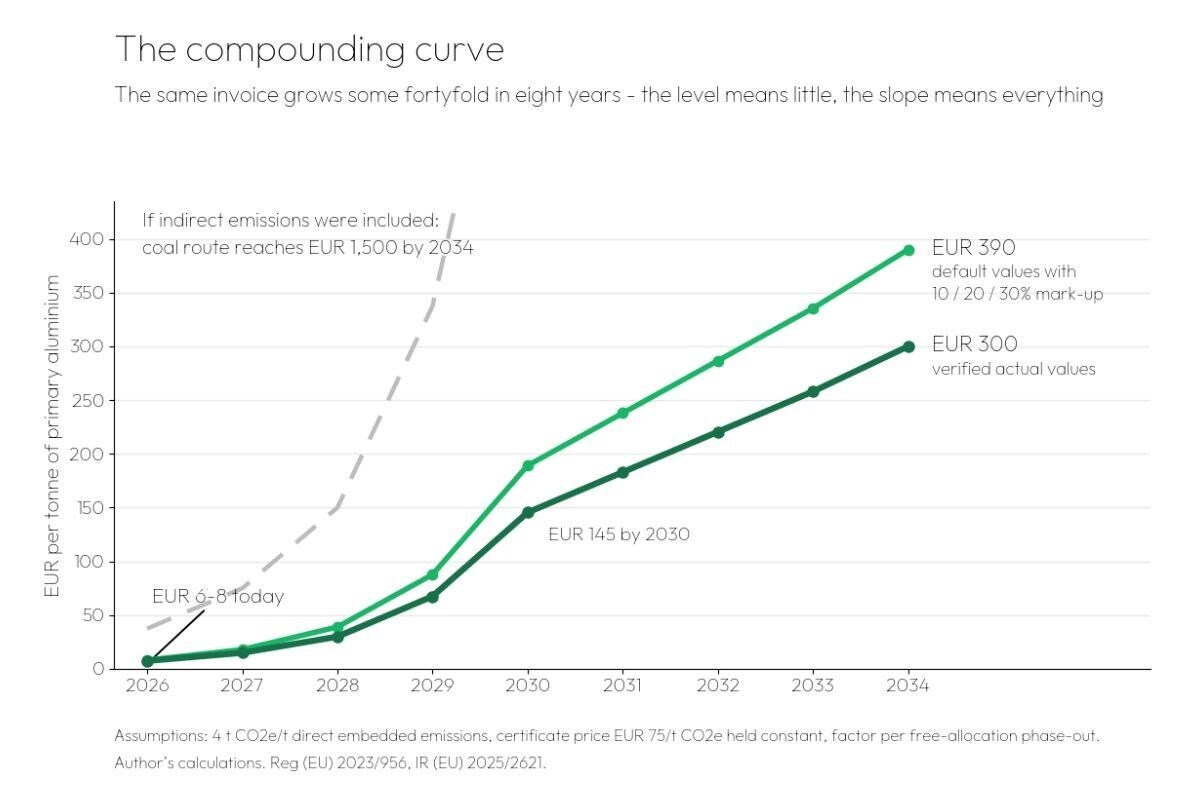
The same invoice grows some fortyfold in eight years - certificate cost per tonne of primary aluminium at EUR 75/t CO2e as the CBAM factor rises from 2.5 to 100 per cent. Author’s calculations based on Regulation (EU) 2023/956 and Implementing Regulation (EU) 2025/2621.
Who wins
Now follow the four choices to their beneficiaries.
The biggest winner is the coal route, and the win comes straight from the perimeter. Since electricity does not count, the invisible part of the footprint is exactly what separates coal-based metal from clean. The border sees nearly the whole footprint of a hydro producer and about a fifth of a coal producer’s. Carbon Chain estimates that including indirect emissions would raise the aluminium bill six-fold on average, up to nine-fold for some countries. Until that happens, the dirtiest route in the industry enjoys its largest regulatory discount.
Trading aluminium across borders? Find out the exact cost you need to bear for the embedded carbon in the product by using this CBAM calculator.
The second win goes to multi-asset groups, and it follows from the right to declare which smelter serves which market. A company with both clean and dirty capacity routes the metal of the "right" plants to Europe on paper, changing nothing in production. The practice is called resource shuffling, and Brussels knows it: the Commission’s own officials call it their main concern, and European Aluminium warns that even with indirect emissions added, producers in China, the Gulf and India could declare low-carbon electricity for their European shipments without changing their cost structure.
The third win goes to the measured, and it follows from the inflated defaults. At identical actual emissions, a producer with verified data beats a neighbour without it by the full mark-up - 10 per cent now, 30 per cent in two years. The unexpected result: audit and accounting earn margin faster than real decarbonisation.
The fourth win goes to countries that collect the carbon rent themselves, straight from the deduction rule. China’s national ETS already covers aluminium smelting, and India is building its CCTS mechanism towards recognition. The deductions start small, around EUR 13 per tonne by 2029 on CCTS estimates, but the money stays in the home budget rather than in Brussels. The Gulf States have no carbon price of their own - every euro of their future bill goes to the EU in full.
The fifth, quiet win follows from the perimeter of goods: post-consumer scrap sits outside the mechanism altogether.
_0_0.jpg)
Who loses
Notice who is missing from the winners’ list: the producer on clean energy. Its advantage lies in the part of the footprint the border cannot see - its regulatory signal is the same EUR 6-8 as its coal-based competitor’s. The market adds nothing on top: Fastmarkets assesses the European low-carbon premium at USD 0-20 per tonne, within the margin of error. Paying, meanwhile, has already begun - not for carbon but for compliance.
The certificate is cheap - the registration, verification and data work around it are not, and that burden lands heaviest on the unmeasured. Indian shipments of unwrought aluminium to the EU were down 41.7 per cent year on year by January 2026. GTRI puts the discount exporters may have to concede to buyers at 15-22 per cent of price. Year one thus inverts the mechanism’s declared purpose: it pays to put your paperwork in order first and your energy second.
The excluded winner
The border’s blindness has a second dimension, best seen in the supplier no longer on the European market. From 2027 a full ban applies to imports of Russian primary aluminium into the EU - for political reasons unrelated to carbon. Yet by carbon measures this was the metal the mechanism suits best: more than 98 per cent of RUSAL’s aluminium is smelted on Siberian hydropower, its ALLOW brand guarantees no more than 4 tonnes of CO2e per tonne on Scope 1 and 2 against an actual average of 2.4, and Krasnoyarsk already operates the first industrial inert-anode cell - ALLOW INERTA, verified by TÜV Austria at 0.01 tonnes of CO2e per tonne, near-zero in exactly what the mechanism counts.
Replacing those volumes carried a carbon price of its own. In 2021 Russian metal held 18 per cent of EU aluminium imports. By 2023 it was 512,000 tonnes and 8-9 per cent, and today, by European Aluminium’s count, some 90 per cent of Russian metal goes outside the EU, above all to Asia. Macro Advisory estimated that replacing those volumes even from the cleanest available sources raised the footprint of EU aluminium imports by 3 per cent, and at the world average by around 14 per cent. A border created for the sake of carbon excluded its lowest-carbon major supplier - and accepted a costlier footprint instead.
If and when the exclusion ends - and that is a political variable, not a carbon one - the player that returns is the one whose profile matches where the mechanism is heading. For anyone planning to 2030, that is not a forecast. It is a scenario cheaper to calculate in advance than to ignore.
Discover expert perspectives and comprehensive coverage of the aluminium value chain in the e-Magazine - Mine to Market: ALuminium Producers & Manufacturers 2026
What to do with the window
Put the picture together: the first year of CBAM is a window - the border exists, but it is cheap and sees little. The window is closing from three sides, each with a date. From 2028 the perimeter widens - the Commission has proposed adding some 180 downstream product lines, from fasteners to machinery components, the Council has agreed its position, and pre-consumer scrap becomes a CBAM good. The mark-up for being unmeasured reaches 30 per cent in the same year. The factor climbs from 2.5 to 48.5 per cent in 2030, the steepest jump on the curve, and to 100 per cent in 2034. And a technical study on including indirect emissions has been published: that question has moved from principle to method.
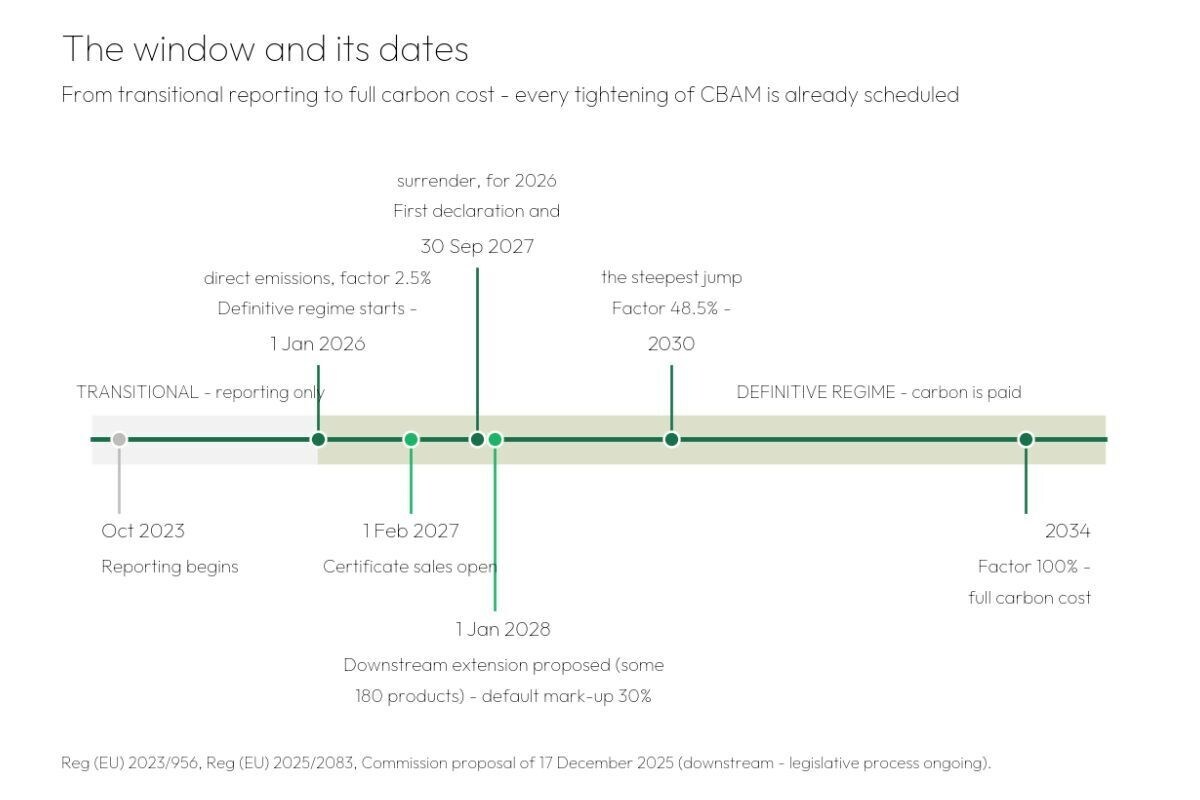
The window and its dates - from transitional reporting to full carbon cost in 2034.
Hence, my practical conclusion for producers in Asia and the Gulf is that the cheapest carbon border there will ever be is operating today, and its years can be spent to double effect. Measurement first: verification, accounting and allocation pay back immediately, against the mark-ups and the defaults.
Energy second: PPAs, gas instead of coal and inert anodes pay back after 2028, when the perimeter and the factor close in. The order is exactly that, but stopping at step one is not an option - measurement without decarbonisation is a one-cycle win, and decarbonisation without measurement is a win the border cannot see. The price of origin after 2028 will be set by those who managed to do both: to count, and to rebuild.
Note: This is exclusive coverage by AL Circle and may not be reproduced, republished or shared without prior permission.
Disclaimer: The opinions, information, claims, references, and images presented here are those of the author alone and AL Circle holds no responsibility.
Alba reinforces Safety Excellence with Annual Summer Safety and Health Campaign
Next articleAlvance British Aluminium begins £400K hydro power upgrade to support aluminium production
Grow with
AL Circle