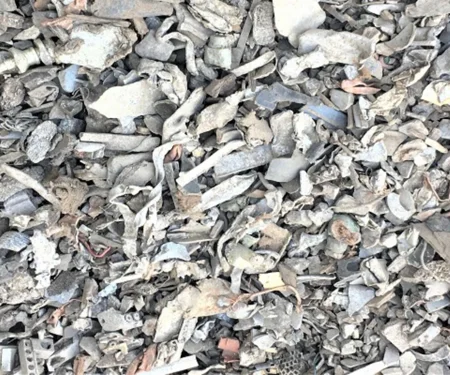
Secondary aluminium margin trap: How toxic dross, CBAM, and 2.5% import duty are destroying the recycling arbitrage
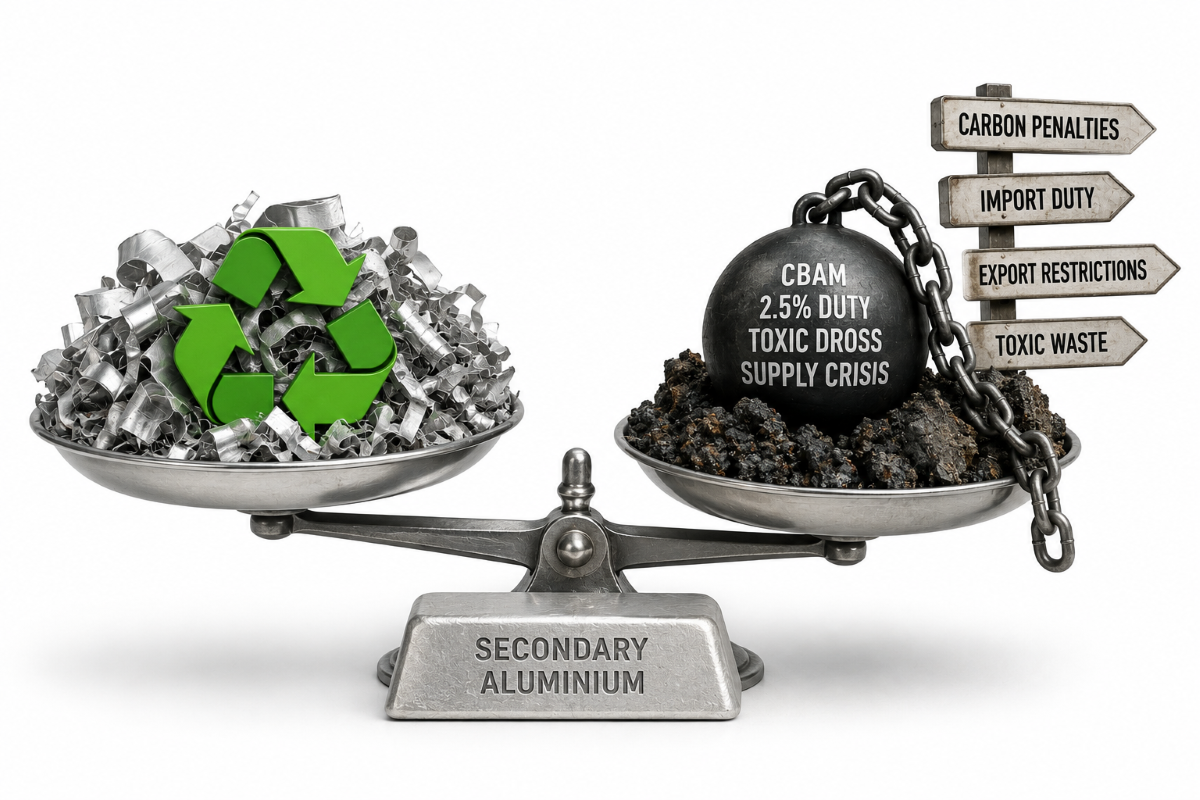
EXECUTIVE SUMMARY:
- The carbon legislation trap: The CBAM Omnibus 2025 update has eliminated the zero-emission loophole for pre-consumer scrap. Secondary aluminium producers using primary factory off-cuts must now declare massive upstream carbon footprints, destroying their European export margins.
- The geopolitical squeeze: As the EU prepares to ban metal scrap exports, import-dependent nations face a catastrophic supply deficit. Indian aluminium recyclers are uniquely crippled by a 2.5 per cent Basic Customs Duty on scrap, creating an inverted duty structure that heavily favours zero-tariff ASEAN competitors.
- The zero-waste imperative: Environmental regulators are aggressively shutting down informal dross processors. To survive, the industry must pivot to AI-driven LIBS precision sorting to bypass the furnace entirely and adopt hydrometallurgy to transform toxic black dross into highly profitable refractory minerals.
The secondary aluminium industry is undergoing a profound structural and economic transformation. Historically championed as the ultimate circular economy success story, secondary aluminium production consumes approximately 5 per cent of the energy required for primary electrolytic smelting. It actively avoids the massive carbon footprint associated with bauxite mining and the Hall-Héroult process.
However, the foundational economics of the secondary aluminium sector are currently being disrupted by an escalating, multifaceted crisis. What was once a straightforward margin play is now a highly complex labyrinth of metallurgical constraints, tightening carbon regulations, geopolitical resource nationalism, and hazardous waste burdens.
Today, high-quality secondary aluminium scrap frequently trades at more than 90 per cent of the primary London Metal Exchange (LME) ingot price. This convergence effectively obliterates the traditional cost arbitrage that subsidised the operational inefficiencies of the recycling sector. As global aluminium consumption scales past 100 million tonnes, the industry must immediately confront the thermodynamic limits of tramp elements, the severe regulatory shifts of the Carbon Border Adjustment Mechanism (CBAM), and the fracturing of global scrap supply chains.
Trading aluminium across borders? Find out the exact cost you need to bear for the embedded carbon in the product by using this CBAM calculator.
The thermodynamic dead end: Dilution and dirty alloys
At the absolute core of the hidden cost crisis in secondary aluminium production is an immutable law of thermodynamics. Standard remelting and fluxing processes are fundamentally incapable of purifying liquid aluminium. Unlike steel or copper recycling, aluminium's extreme reactivity means that once tramp elements enter the molten bath, they remain entirely in solution.
When an end-of-life vehicle or mixed consumer product is mechanically shredded, highly diverse aluminium alloy grades are conflated into a single, heterogeneous scrap stream. Iron is universally recognised by metallurgists as the most damaging contaminant in this matrix. When iron concentrations exceed a highly sensitive threshold of just 0.2 wt%, it reacts during cooling to form exceptionally brittle intermetallic phases (specifically Al₃Fe and the needle-like Al₅FeSi).
For a downstream manufacturer, the commercial consequence of these microscopic stress concentrators is catastrophic. It leads directly to premature part fractures during stamping, devastating defect rates on the factory floor, and massive downstream warranty claims. Because these tramp elements cannot be fluxed out of the melt, secondary producers have historically been forced to rely on two highly inefficient, cost-heavy strategies.
The first strategy is downcycling. Contaminated scrap cascades into lower-value cast alloys, such as the Al-Si-based 300 series, which can tolerate higher impurity loads. However, the rapid electrification of the global automotive sector is driving immense demand for high-strength wrought alloys, while demand for traditional cast engine blocks is stagnating. Downcycling is now a commercial dead end.
The second strategy is dilution, known as sweetening. This involves adding high-purity virgin primary aluminium to the scrap melt to artificially suppress the concentration of tramp elements. Sweetening introduces massive hidden costs by requiring premium-priced primary aluminium. More critically, in the modern era of carbon accounting, introducing primary metal injects a massive carbon penalty into the final product.
Carbon economics and the CBAM omnibus shockwave
As metallurgical limitations drive up raw operational costs, the international regulatory environment is concurrently imposing unprecedented financial penalties. The European Union's Carbon Border Adjustment Mechanism (CBAM) entered definitive financial enforcement on January 1, 2026, fundamentally altering the global cost curve.
Primary aluminium production is intensely electricity-dependent. If this power is sourced from coal-dominated grids, the embedded emissions can soar to between 16.0 and 16.5 tCO₂e per tonne. Secondary aluminium production bypasses the electrolytic reduction process entirely, resulting in a drastically lower carbon footprint of 0.05 to 0.5 tCO₂e per tonne.
However, a highly disruptive regulatory update known as the CBAM Omnibus Regulation (EU 2025/2083) has injected a massive hidden cost into the secondary supply chain.
Under the original 2023 CBAM framework, secondary producers could purchase pre-consumer manufacturing scrap (such as machining chips or dross generated by high-carbon primary smelters) and classify this input as "zero-emission" scrap. The CBAM Omnibus 2025 explicitly dismantled this circumvention route. Under Article 7a, any pre-consumer scrap utilised by a secondary smelter must legally carry forward the exact embedded emission factor of the original primary production process from which it was generated.
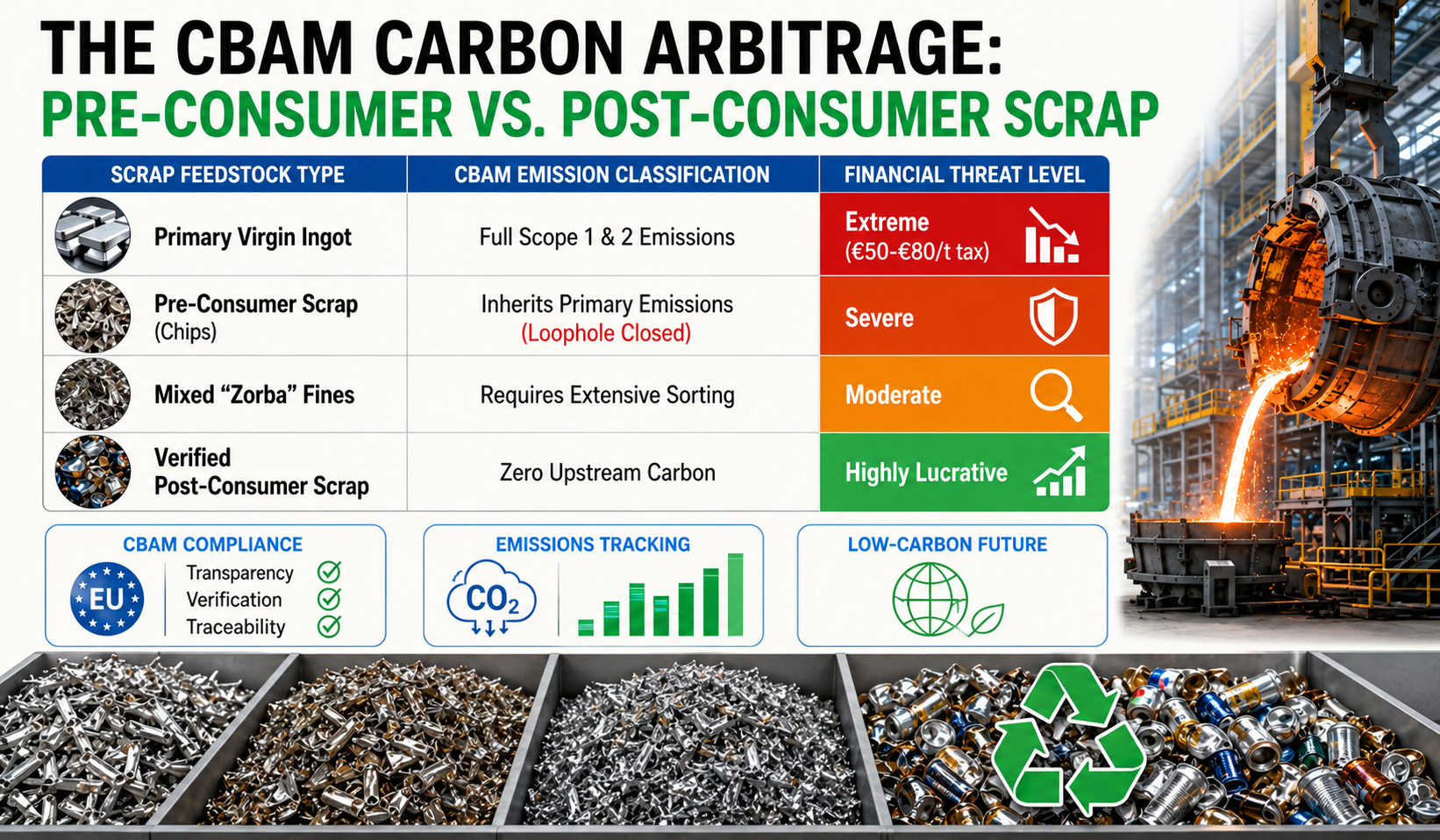
For secondary producers relying on pre-consumer scrap from coal-powered primary giants, this is a devastating recalculation. Their exported product will now carry a weighted average reflecting the coal-heavy primary footprint, subjecting them to severe CBAM penalties. Consequently, verified post-consumer scrap has skyrocketed in strategic value, driving prices further toward primary parity.
Geopolitical chokepoints and the Indian tariff crisis
Because CBAM financially penalises the use of primary metal or pre-consumer scrap for dilution, the only economically viable pathway is to secure vast, uninterrupted quantities of high-purity post-consumer scrap. However, this necessity is colliding with a rapidly fracturing global geopolitical landscape.
Major economies are erecting aggressive legislative barriers to prevent scrap export. The most consequential of these is the European Union’s revised Waste Shipment Regulation (WSR). Slated for strict enforcement, the updated WSR will prohibit the export of non-hazardous recyclable aluminium scrap to non-OECD countries. Removing this massive supply node from the open global market guarantees intense procurement competition and exponential price spikes for developing nations.
The immediate impact of these global supply shocks is most acutely visible in India, the world's largest importer of aluminium scrap. India’s domestic per capita aluminium consumption remains historically low, meaning the country lacks a mature domestic reservoir of end-of-life scrap. Consequently, the Indian secondary industry must import between 80 and 85 per cent of its total scrap requirements.
Despite this near-total reliance on foreign raw materials, the Indian government imposes a crippling self-inflicted cost: a 2.5 per cent Basic Customs Duty (BCD) on imported aluminium waste and scrap, classified under HSN Code 7602.
Delve deeper into the recycled aluminium and secondary aluminium market with our World Recycled ALuminium Market Analysis Industry forecast to 2032
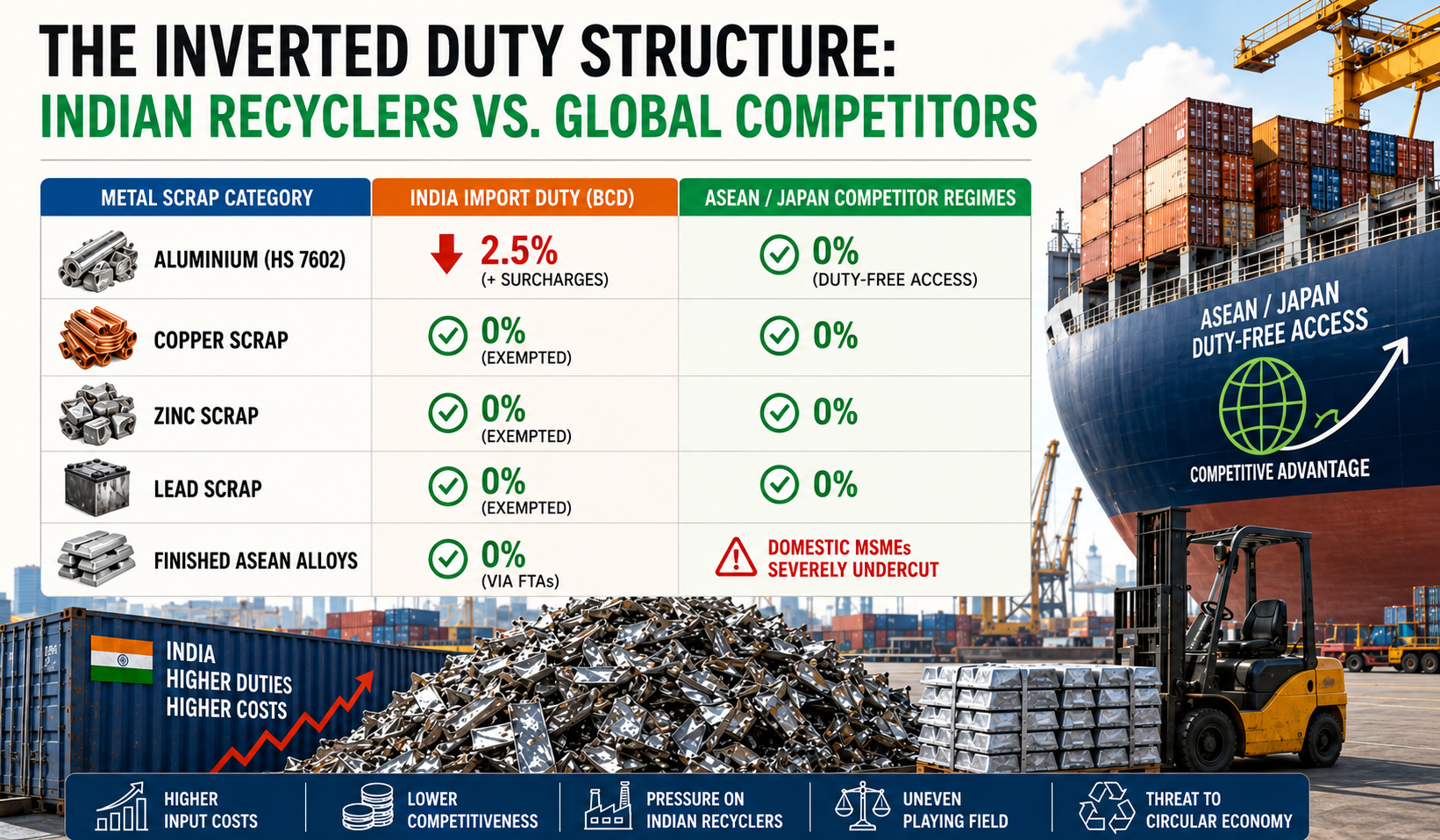
Financial Reality Check: At current premium scrap valuations, this compounded 2.5 per cent BCD and surcharge structure inflicts an estimated, unavoidable penalty of USD 50 to USD 70 per tonne directly onto the Indian recycler's working capital, bleeding cash from the balance sheet before the furnace is even ignited.
When stacked sequentially with an 18 per cent IGST and a 10 per cent Social Welfare Surcharge, the landed cost of scrap is severely inflated. As the Material Recycling Association of India (MRAI) has vehemently highlighted, this creates a crippling inverted duty structure. Competing manufacturing economies operate under a 0 per cent aluminium scrap import duty regime. Furthermore, finished secondary aluminium alloys manufactured in ASEAN nations frequently enter the Indian market completely duty-free under various Free Trade Agreements (FTAs). Indian recyclers are forced to compete in their own domestic market against foreign manufacturers who enjoy zero-duty raw material inputs.
The dross liability: WBPCB crackdowns and zero-waste technologies
Beyond the geopolitical complexities of procurement, the physical processing of secondary aluminium generates a highly problematic byproduct: black dross.
Depending on the raw mix, secondary operations generate between 200 and 600 kg of black dross per single tonne of aluminium metal produced. It contains a vast matrix of aluminium oxide (Al₂O₃) and massive concentrations of soluble chloride salts. Critically, black dross is laced with highly reactive impurities, specifically aluminium nitride (AlN) and aluminium carbide (Al4C3). When exposed to ambient humidity, these compounds undergo rapid hydrolysis, releasing a cocktail of poisonous and explosive gases, including ammonia (NH₃) and methane (CH₄).
The era of cheap, informal dross disposal is abruptly ending. Environmental regulators are aggressively enforcing hazardous waste compliance. A stark illustration of this shift is evident in the recent enforcement actions taken by the West Bengal Pollution Control Board (WBPCB) in India. The Howrah and Hooghly districts have seen a wave of aggressive closure orders executed against units attempting to process dross without adequate Air Pollution Control Devices. Facilities utilising rudimentary coal-fired Tapai Bhatti furnaces with defunct suction hoods face immediate electricity disconnection, effectively eliminating the informal dross processing sector in the region.
To mitigate these massive regulatory liabilities, the industry is rapidly pivoting toward hydrometallurgical processing. This cold-processing wet technique utilises aqueous leaching to dissolve the hazardous chlorides. Advanced bench-scale research has demonstrated the ability to recover over 97 per cent of the flux salts through the evaporation and crystallisation of the leachate. These recovered high-purity salts can be cycled directly back to the smelting furnaces. Simultaneously, the water-insoluble oxide residue is transformed from a hazardous waste into a highly valuable secondary mineral resource boasting an alumina purity exceeding 98 per cent, ideal for synthesising high-performance refractory products like magnesium-aluminium spinel (MgAl₂O₄).
Defeating the ceiling: AI, XRT, and LIBS precision sorting
The compounding pressures of thermodynamic limits, CBAM penalties, geopolitical scarcity, and toxic dross management lead to a singular operational conclusion. The only viable strategy is to defeat the thermodynamic ceiling before the scrap ever reaches the melting crucible.
This imperative has catalysed a technological revolution in AI-driven precision sorting. The foundational layer relies on X-Ray Transmission (XRT) technology, which excels at the binary separation of light metals from heavy tramp contaminants such as copper, brass, and free iron.
However, to achieve true alloy-specific separation, the industry has turned to dynamic Laser-Induced Breakdown Spectroscopy (LIBS). As scrap fragments hurtle down a conveyor belt, a high-energy laser pulse ablates a microscopic layer of the metal, generating a localised microplasma. A high-resolution spectrometer captures this optical signature in milliseconds, allowing AI algorithms to instantly quantify the exact concentrations of specific alloying elements (Si, Mg, Cu, Zn, Mn, Fe).
The economic viability of multi-sensor AI sorting is perfectly illustrated by the operations of Raffineria Metalli Cusiana S.p.A. in Italy. By installing a fully automated, multi-stage sorting architecture capable of processing 100,000 tons per annum, Cusiana fundamentally restructured its profitability. By achieving virgin-like purity from 100 per cent post-consumer scrap, they introduced branded "Recall" ingots, perfectly engineered to bypass impending CBAM taxes.
More innovatively, the LIBS-sorted scrap achieved such pristine elemental precision that Cusiana could bypass their own melting furnaces entirely for specific streams. They now sell premium, furnace-ready, alloy-specific scrap directly to downstream manufacturers, completely eliminating the massive time and energy expenditure associated with traditional ingot casting.
Explore why verification, traceability and carbon footprint reporting become essential in AL with our upcoming webinar by Alberto Monje Gama, Sustainability Policy Manager, TIC COUNCIL, on “Recycled aluminium, CBAM and trust: Why verification matters for Europe's circular economy”
The Strategic Conclusion
The prevailing narrative that secondary aluminium production is a universally low-cost pathway to sustainability is operationally obsolete. The industry is navigating a severe crucible of hidden costs that requires an immediate transition from bulk volume processing to precision metallurgical engineering.
Facilities that cling to rudimentary sorting, carbon-intensive dilution, and informal dross dumping will be swiftly and permanently priced out of the market by CBAM and regional environmental regulators. Conversely, operators who aggressively integrate AI-driven LIBS sorting, zero-waste hydrometallurgy, and rigorous supply-chain carbon traceability will capture the immense, unparalleled margins waiting in the decarbonised circular economy of the next decade.
_0_0.jpg)
Note: This is exclusive coverage by AL Circle and may not be reproduced, republished or shared without prior permission.
Disclaimer: The opinions, information, claims, references, and images presented here are those of the author alone and AL Circle holds no responsibility.
Japan's aluminium scrap imports from EU jump 90% in Q1’26 despite soaring prices
Next articleUS aluminium scrap recovery continues to strengthen into 2026 with a 14% jump Y-o-Y
Grow with
AL Circle