H1’26 LME aluminium stocks dip 31.82%: Russian sanctions & Gulf crisis pack a double blow
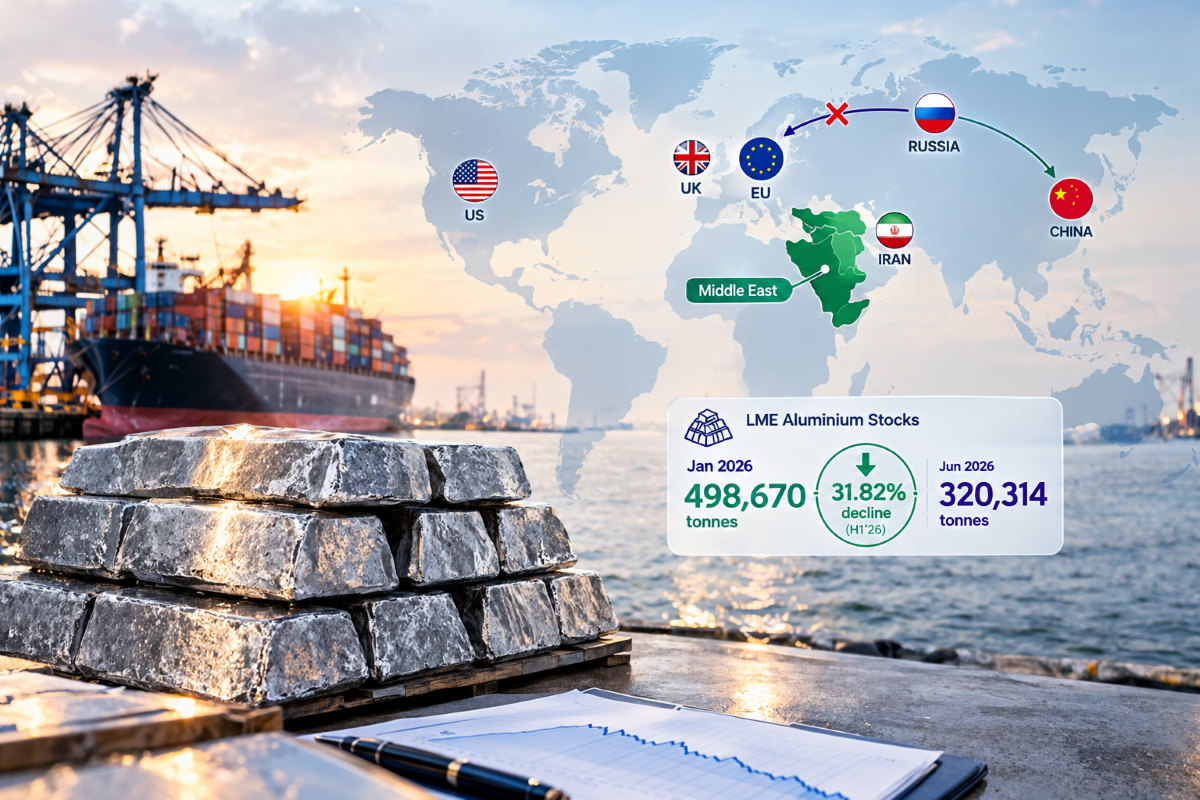
The image used in this article is generated with an AI tool and does not depict any real-time moment
As we reflect on the Middle East crisis that commenced on February 28, 2026, and stretched into the second half of the year, it brings to mind the dramatic rise and fall of the London Metal Exchange (LME) aluminium price that reached four-year highs before cooling down. The skyrocketing prices result from the declining inventory levels of the LME aluminium stocks, thereby reporting a month-on-month decline from 498,670 tonnes in January to 320,314 tonnes in June.
LME H1 inventory trend: 2026 vs 2025 vs 2024
How has the LME aluminium inventory scenario fared across the January-June period? Here is the six-month cumulative year-on-year comparison among 2026, 2025 and 2024:
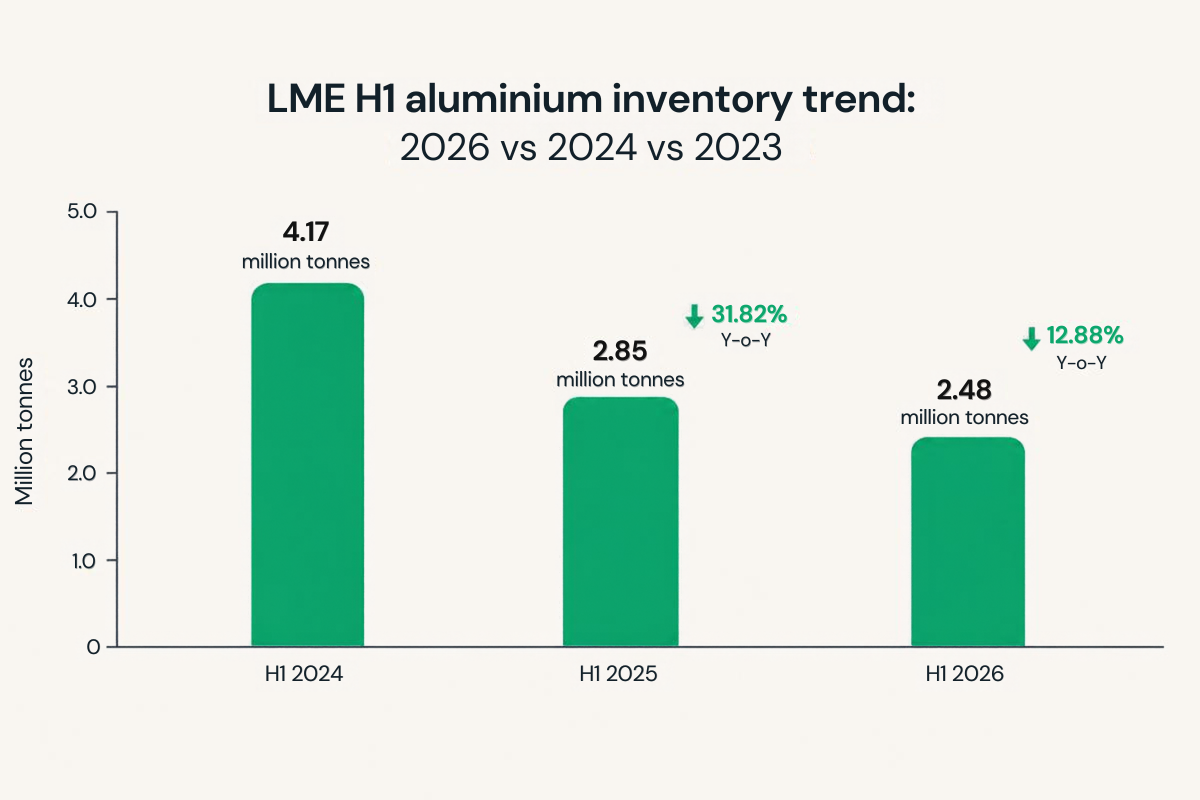
- H1 2026 – 2.48 million tonnes, down 12.88 per cent Y-o-Y
- H1 2025 – 2.85 million tonnes, down 31.82 per cent Y-o-Y
- H1 2024 – 4.17 million tonnes
Explore: The most comprehensive and forward-looking industry-focused report – Global Bauxite & Alumina Market Forecast to 2036: Supply–Demand, Trade Flows & Price Outlook
Month-on-month declining rate
2026 LME inventory chart reported a steady month-on-month decline in warehouse stocks.
- June – 320,314 tonnes, down 7.8 per cent M-o-M
- May – 347,403 tonnes, down 10.83 per cent M-o-M
- April – 389,598 tonnes, down 11.6 per cent M-o-M
- March – 440,710 tonnes, down 8.47 per cent M-o-M
- February – 481,489 tonnes, down 3.45 per cent M-o-M
- January – 498,670 tonnes
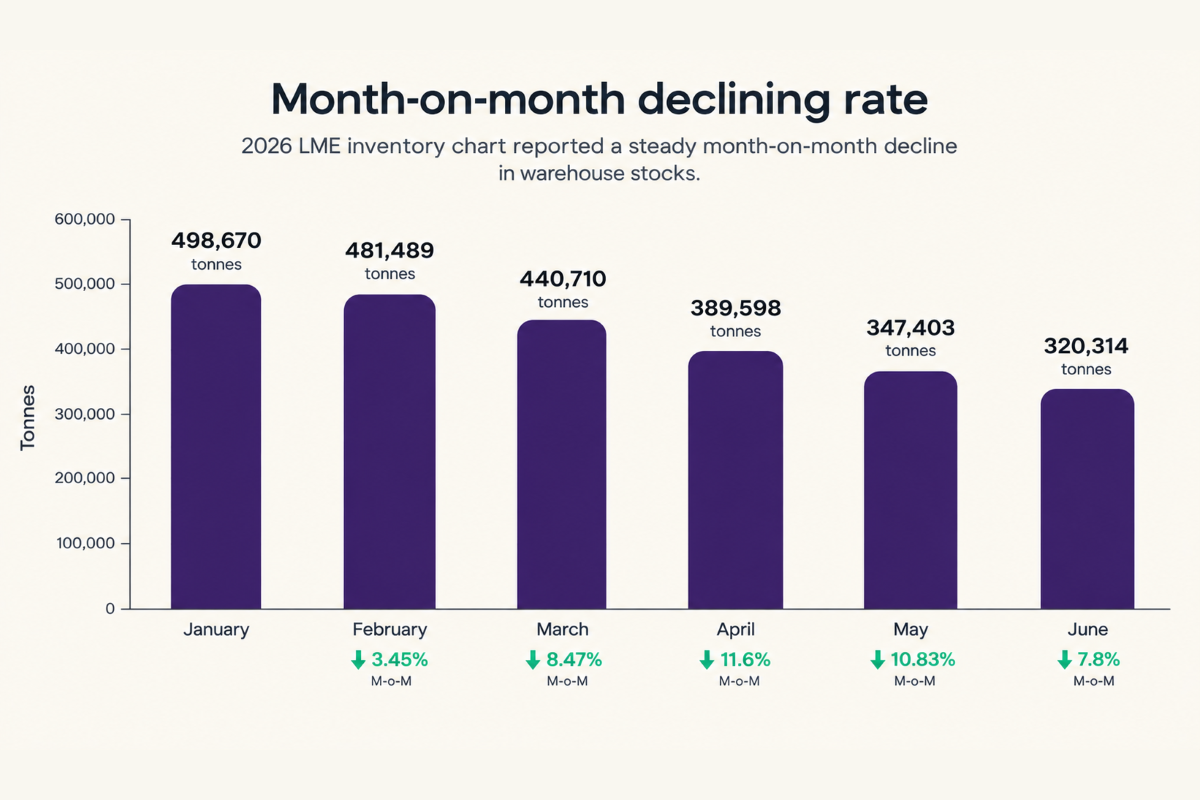
A total volume shed saw 178,356 tonnes leaving exchange warehouses over this timeframe, with an average monthly volume loss of 35,671 tonnes per month.
H1 2026’s sharp decline can be directly attributed to the market volatility caused by the Middle East conflict among the US, Israel and Iran, affecting the Gulf region, which accounts for 9 per cent of the global share of primary aluminium production capacity.
Complicated shipping through the region, affecting both the import of alumina and the export of finished aluminium. Gulf smelters depend on uninterrupted alumina imports to sustain production, with the disruption limiting the movement of finished aluminium to international markets.
Thus, the shipping disruptions due to the closure of the Strait of Hormuz brought the LME aluminium inventory under pressure, compelling Aluminium Bahrain (Alba) to invoke force majeure on certain products from early March. Soon after, a controlled shutdown of Alba’s potlines 1, 2 and 3 cut 19 per cent or 308,369 tonnes of Alba’s 1.62 million-tonne production capacity.
The situation was compounded by the controlled shutdown of Qatar’s Qatalum smelter from March 3, to be reopened 10 days later (QAMCO), which will continue manufacturing at around 60 per cent of its total capacity of about 640,000 tonnes, thereby cutting off approximately 256,000 tonnes.
On March 28, Iran launched drone and missile attacks on the facilities of Emirates Global Aluminium (EGA) and Alba, leading to “significant damage” sustained by the EGA plant, with Alba assessing the intensity of the damage caused.
However, is this the only instance where the LME inventory has witnessed volatility in stock trends?
Explore primary aluminium suppliers, product listings and trade opportunities on the AL Biz platform.
Throwback: LME stock dip in 2025
Looking at the three-year trend from 2024 to 2026, a much sharper decline has occurred in the stock movement from 2024 to 2025.
The 2025 decline traces back to an April 13, 2024 US-UK ban on new Russian-origin aluminium entering LME warehouses, aimed at curbing Russia’s war-funding export revenue. At the time, Russian metal already made up 91 per cent of the 342,225 tonnes held in LME warehouses that March, freezing a massive Russian inventory when most Western buyers were avoiding it.
Pre-ban aluminium remained technically tradeable, though wanted by few. Cancelled warrants collapsed 97 per cent since 2021, while live warrants fell a milder 64 per cent by June 2025, with the metal sitting idle rather than moving. Russian inventory on the LME actually rose 35 per cent between January and May 2025, with nowhere else within the exchange to go. By June, total stocks dropped to 340,975 tonnes, less than half their July 2021 level.
Much of the surplus was rerouted to China, whose Russian aluminium imports jumped 48 per cent Y-o-Y to 741,000 tonnes between January and April 2025, with Russia supplying about 40 per cent of China’s total imports. A brief diversification followed in July, as Russian share eased to 66 per cent (from 69 per cent) while Indian-origin metal rose to 34 per cent, though this reversed sharply in 2026. The 2025 EU Sanctions package barred Russian aluminium from EU-listed warehouses, further tightening availability.
Consequently, H1 2025 stocks fell 31.82 per cent Y-o-Y to 2.85 million tonnes, a steeper drop than H1 2026’s 12.88 per cent, indicating that sanctions, not the Middle East crisis, first hollowed out the LME’s usable aluminium inventory.
For more in-depth insights and exclusive analysis on the global aluminium industry, explore the e-Magazine - Mine to Market: ALuminium Producers & Manufacturers 2026
H2 2026 Outlook: A recovery of sentiment, not of supply
H2 monthly averages show the LME stock volume still struggling, but softening in rate.
- September (est.) – 245,053 tonnes (down 2.45 per cent M-o-M) for USD 3,301.78 per tonne (up 1.61 per cent M-o-M)
- August – 251,215 tonnes (down 11.03 per cent M-o-M) for USD 3,249.63 per tonne (up 2.97 per cent M-o-M)
- July – 282,350 tonnes for USD 3,155.98 per tonne
The pattern is telling, for prices are no longer being pushed higher by acute shortage alone. They are reflecting a market that raised price margins in scarcity and is now testing whether supply confidence can catch up. Inventory, notably, has not followed the price up. In fact, aluminium stocks hit the lowest level in this century, at 271,275 tonnes on July 24.
A key stabilising factor is EGA’s ongoing restoration of its Al Taweelah smelter, which had reached a 25 per cent milestone with full output targeted for Q1 2027. The progress has eased prices to some extent, though not bringing physical replenishment. Al Taweelah won’t be back to full output until early 2027.
Moreover, several aluminium value chain-building projects are underway. Indonesia’s USD 7 billion downstream commitment, Vietnam’s newly completed bauxite-to-aluminium value chain and its cross-border partnership with China and China’s production pushing toward its 45-million-tonne domestic cap prompting the country to take projects overseas, point to a structurally expanding aluminium value chain overseas.

But none of this translates into H2 2026 relief. Building a primary aluminium smelter typically takes 5–6 years. With capacity building underway, however significant, and the majority of the current projects not having a commissioning date set in 2026, it cannot physically or realistically offset a stock deficit within a six-month window.
Hence, the H2 2026 outlook is one of partial sentiment recovery without inventory recovery. EGA’s repair progress and long-term capacity investments are easing the Middle East crisis-caused market panic. But with no smelter capable of coming fully online before 2027 at the earliest, LME aluminium inventory is unlikely to rebuild by the end of 2026 or into early 2027 and replenish the deficits.
Note: This is exclusive coverage by AL Circle and may not be reproduced, republished or shared without prior permission.
Alcoa says Canada tariff cut alone won't bring US aluminium premium down
Next articleLME aluminium price rises above 1%; stocks slip to 244,100t on September 14
Grow with
AL Circle