The ripple effect of Hormuz block: A worry for the Middle East or global trade?
The escalating Iran-Israel conflict and growing uncertainty around the Strait of Hormuz are casting a shadow over the global supply chain. Aluminium markets were jolted after Aluminium Bahrain (Alba) declared force majeure on certain supply contracts, citing shipping disruptions through the Strait of Hormuz, with geopolitical tensions in the Middle East on the brink, sending shockwaves across global trade flows – aluminium as well as other sectors like fuel and liquified natural gas (LNG).
Explore- Most accurate data to drive business decisions with Global ALuminium Industry Outlook 2026 across the value chain
As one of the world’s most critical maritime corridors, Hormuz, connecting the Persian Gulf and the Gulf of Oman, links the GCC producers with the world. It handles over 5 million tonnes of Middle Eastern aluminium and related raw materials exports annually, making the market highly sensitive to disruption.
With global trade flows closely tied to this waterway, the situation is increasingly being watched with caution as a slowdown or blockage along this narrow corridor could ripple across global trade.
The Bahrain-based producer Alba, one of the world’s largest aluminium smelters outside China, informed customers of potential shipment delays after maritime transport through the critical Gulf shipping corridor slowed sharply. However, the company clarified that the disruption is due to logistics rather than operational damage, stating, “It’s because [of] what’s happening in the Strait of Hormuz, we are not able to ship. So, we’re producing, but the metal is here in Alba.”
The company spokesperson elaborated, “The force majeure… is not due to any disruption or damage to the smelter facility. The team is working intensively on identifying alternative shipping solutions to minimise the impact.”
Market reaction was swift. Aluminium prices on the London Metal Exchange climbed sharply following the announcement, briefly reaching around USD 3,418 per tonne, the highest level since the COVID-19 phase in April 2022. Analysts warned that prolonged disruptions could push prices even higher and expose vulnerabilities in an already constrained global supply network.
The situation has been compounded by the shutdown of Qatar’s Qatalum smelter due to disruptions in gas supply linked to the regional conflict, further tightening availability. The facility has an annual capacity of around 648,000 tonnes, and a full restart may require around six to twelve months.
Similarly, Metro Mining CEO Simon Wesley expressed concern over supply chain disruption caused by the “hostilities in the Middle East,” leading to “uncertainties in the market.” Rising oil costs and the concurrent price revision of freight costs would significantly increase shipping charges for bauxite.
As per the UN Comtrade data, in 2025, Iran exported aluminium worth USD 438 million across the world, with top buyers Turkey and Iraq, amongst others. With inventories already tight and regional output playing a key role in global supply balances, industry observers warn that prolonged disruptions in Gulf shipments could increase price volatility and intensify supply pressures across the aluminium market.
However, the critical situation of aluminium trade and supply is not where the Hormuz story ends. Coupled with force majeure developments and climbing crude oil prices, the situation is injecting a new layer of risk into an already sensitive supply chain, heightening concerns over tighter availability, higher production costs and increased price volatility in the months ahead.
Don't miss out- Buyers are looking for your products on our B2B platform
Disruptions in other sectors of Iranian export: Fuel, natural gas, bentonite
Crude oil plays an essential role in the energy mix of the aluminium industry, particularly through its influence on global energy costs. It plays a key role in mining, alumina refining, logistics and power generation in oil-dependent regions. Increases in crude oil prices, therefore, tend to raise overall production and transportation costs across the aluminium value chain, tightening margins and influencing global aluminium prices.
Beyond the immediate export disruptions, the Strait of Hormuz crisis is beginning to trigger broader systemic risks across global supply chains. The waterway carries around 21 million barrels of crude oil and petroleum products per day. About 90 per cent of the Persian Gulf exports are carried out through the narrow maritime corridor.
Several European nations, such as Belgium, Greece, Italy, Spain and Poland, rely on the Hormuz route for oil and LNG importing and refining requirements, accounting for approximately 15 per cent of the European trade flow. They import supplies from Saudi Arabia, Qatar, Kuwait and Iraq.
The nation exported crude and petroleum oils worth USD 7.7 billion, primarily to a handful of countries such as the United Arab Emirates (UAE), China, Oman, Afghanistan, Pakistan, India etc. In the sector of natural gas, Iran shipped an amount valued at approximately USD 1.02 billion. Iraq and Turkey are two of the top buyers from the country.
Bentonite, although with a modest export volume, was shipped worth USD 761 thousand, mainly to countries like Kuwait, South Korea and Turkey.
Roughly 20 per cent of the global oil (crude and refined) and LNG generally pass through the Hormuz corridor. Iran, having effectively closed this route due to the latest geopolitical tensions, has exposed the trade to a highly delicate situation, making it one of the most critical chokepoints in international energy logistics and potentially cascading global energy crisis.
Recent maritime monitoring reports indicate that tanker traffic through the strait plunged by almost 94 per cent between February 28 and March 1, as shipping companies paused operations amid security concerns and rising insurance risks.
Thus, the gap of 20 per cent of oil and LNG supply must be filled with substitute sources, thereby raising the cost of products due to a sudden increase in demand, accompanied by a surge in transhipping prices, adding pressure on the other supply channels.
Rerouting and alternatives?
Substituting and rerouting options to mitigate the crisis seem limited. Aluminium passage has no dedicated bypass, with air and land routes being uneconomic. Rerouting aluminium or bentonite via land to Red Sea ports like Jeddah or King Abdullah Port might be an option, provided the USD 45-50 per tonne surcharge is paid to cover these expenses.
Similarly, while the Cape of Good Hope can be considered an alternative, the logistical delays take up 10-15 days more, as well as the freight premiums issued to buyers, making it an expensive choice.
Goldman Sachs analysis warns aluminium prices will escalate to USD 3,600 per tonne within a month if production losses persist till then. Citi analysts, on the other hand, predict the prices to climb further up to USD 4,000 under a bull-case scenario.
In case of oil supply, an alternative can be the East-West (Petroline) Pipeline of Saudi Arabia, with about 5 million barrels per day (bpd) transported from Abqaiq to the Red Sea port of Yanbu. In the UAE, the Abu Dhabi Crude Oil Pipeline (ADCOP) carries roughly 1.5 million bpd from Abu Dhabi’s inland fields of Habshan to Fujairah on the Gulf of Oman.
The Iranian Goreh-Jask Pipeline has around 300,000-350,000 bpd capacity to export crude via the Gulf of Oman instead of Hormuz. However, the cumulative capacity of the three alternatives would still fall short of the total capacity of the Strait of Hormuz, which is over 20 million bpd.
With energy flows threatened and shipping routes under strain, the unfolding situation around the Strait of Hormuz may prove to be more than a geopolitical flashpoint. If disruptions persist, what began as a regional geopolitical crisis could quickly evolve into a broader supply chain shock, testing the resilience of global trade and supply.
Must read: Key industry individuals share their thoughts on the trending topics

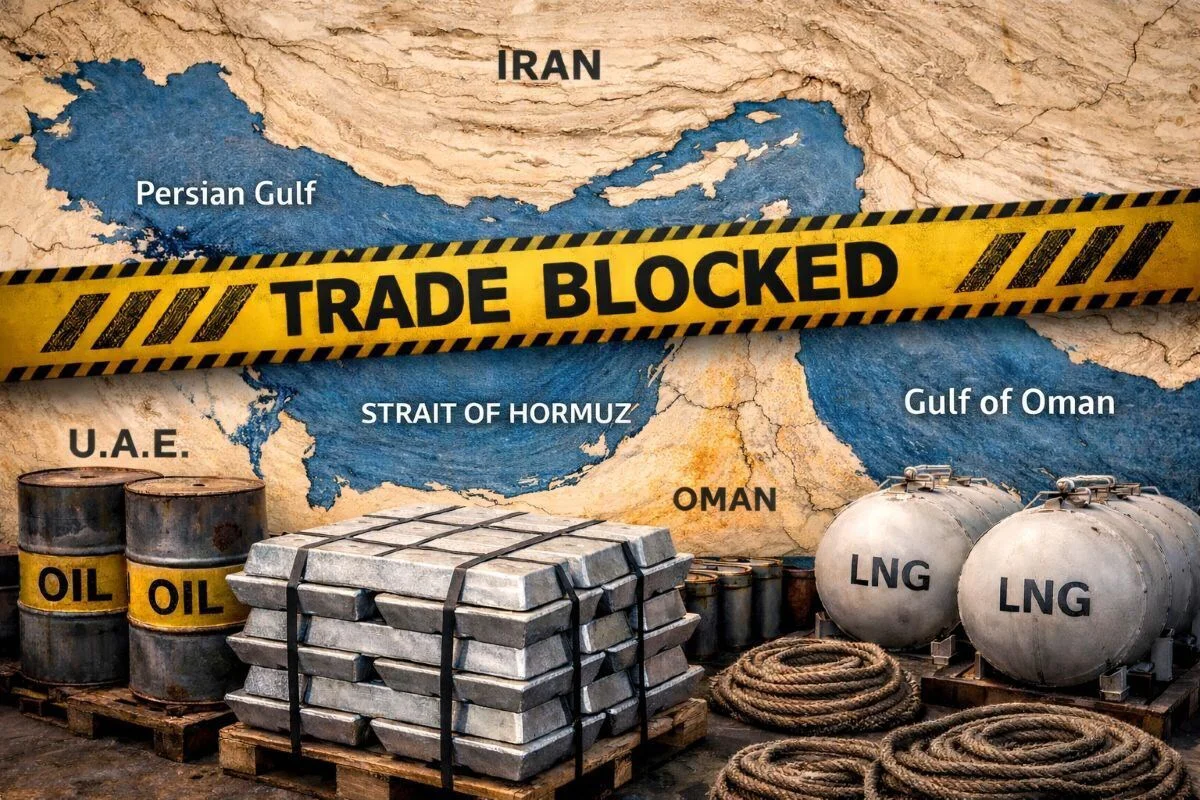
Note: The image has been generated by AI for referential purposes only.
LME aluminium prices ease over 2% after reaching 4yr high from Strait of Hormuz tensions
Next articleEconomic and policy challenges in Australia’s aluminium recycling industry
Grow with
AL Circle