The US primary aluminium market is navigating a challenging phase as domestic production declines and imports tighten under higher tariffs. With smelter output under pressure and external supply becoming less predictable, concerns around supply stability have intensified. Uncertainty surrounding the Strait of Hormuz, through which a large share of Middle Eastern aluminium exports pass, adds another dimension to an already strained supply environment.
Production data from 2025 provides a clear snapshot of how US primary aluminium output has moved over the year. During the first nine months of 2025, domestic production reached 497,000 tonnes, compared with 506,000 tonnes during the same period in 2024, reflecting a 1.8 per cent year-on-year decline.
Quarterly figures further illustrate the trend. In Q1, production stood at 166,000 tonnes in 2025, compared with 172,000 tonnes in 2024, marking a 3.5 per cent decline. Output then remained broadly stable in Q2, reaching 168,000 tonnes in 2025 against 167,000 tonnes in 2024. By Q3, production slipped again to 163,000 tonnes, compared with 167,600 tonnes in the previous year, representing a 2.7 per cent decrease as per USGS data.
Month-on-month figures show how production progressed during the first nine months of the year. Output remained within a 52,000–58,000 tonne range over the period. Production stood at 57,000 tonnes in January, declined in February, recovered in March, and then stayed within a relatively narrow band in the following months before reaching 53,000 tonnes in September.
These figures highlight a domestic smelting sector operating under pressure even as demand for primary aluminium remains strong in the US market.
Demand continues to grow while imports tighten
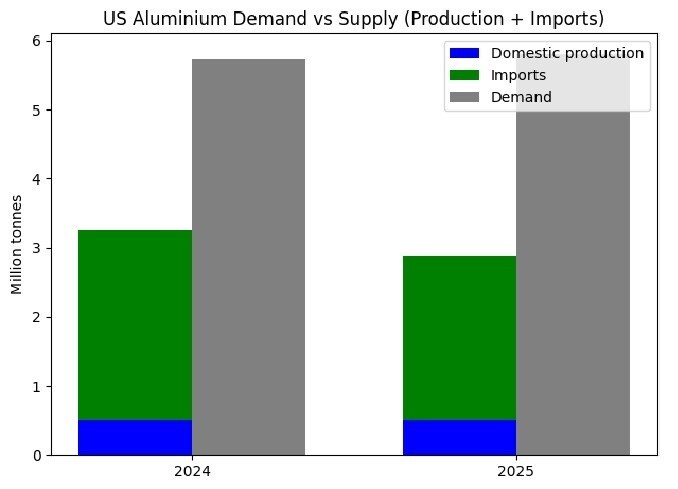
While domestic production shows signs of strain, aluminium demand in the United States continues to move higher. Demand for primary aluminium increased from 5.73 million tonnes in 2024 to 5.81 million tonnes in 2025 according to Industry Publications.
To meet this growing demand, the United States continues to rely heavily on imported primary aluminium. However, this source of supply has also come under pressure as shipments into the country have declined. During the first nine months of 2025, imports totalled 2.38 million tonnes, compared with 2.74 million tonnes during the same period in 2024.
When production and imports are viewed together, the scale of the supply gap becomes visible. Domestic production for the first nine months, combined with imports, totals around 2.87 million tonnes against 5.81 million tonnes of demand, leaving a gap of roughly 2.9 million tonnes.
The constraints on domestic supply become clearer when looking at the longer-term evolution of the US smelting industry.
Fewer smelters and rising energy pressure
The US aluminium industry now operates with a much smaller smelting base. As of early 2026, only four primary aluminium smelters remain operational in the country.
The long-term contraction has been significant. Since 1998, the number of operating smelters has fallen by about 75 per cent, declining from more than 20 facilities to five by late 2025. During the same period, total capacity dropped from roughly 4.5 million tonnes to about 2.4 million tonnes.
Today, the remaining smelters produce approximately 700,000–900,000 tonnes annually while competing for electricity with rapidly expanding data centres and other energy-intensive industries. Tariffs on aluminium imports increased to 50 per cent in 2025, providing some protection to domestic producers but offering limited relief from structural challenges.
Several plants illustrate the current landscape. Century Aluminium’s Mount Holly smelter in South Carolina operates at about 75 per cent capacity and is investing USD 50 million to restart more than 50,000 tonnes of idled lines, targeting full production by June 2026 under a power extension agreement with Santee Cooper through 2031.
Elsewhere, Hawesville in Kentucky remains curtailed due to high energy costs, while Sebree continues steady operations. Alcoa’s Warrick facility in Indiana sustains partial production, and Massena West in New York relies on hydro power but faces growing pressure on the grid. Magnitude 7 Metals exited the primary aluminium market in January 2024.
Amid this environment, new investments have emerged. Emirates Global Aluminium (EGA) and Century Aluminum plan to build a USD 4 billion smelter in Inola, Oklahoma. Century Aluminum will hold 40 per cent, while EGA will retain 60 per cent ownership. The project’s capacity has been increased from 600,000 tonnes to 750,000 tonnes per year, which could more than double US primary aluminium output. But with the new developments also, the gap in the demand and the production and import will remain and its yet to see how US will fulfil the gap.
For 2026 aluminium market outlook, download our report TOC: Global Aluminium Industry Outlook 2026
Tariffs and geopolitics reshape supply flows
Trade policy has also reshaped the aluminium supply picture. Canada, the largest supplier of primary aluminium to the United States, faced a major policy change when tariffs returned at 25 per cent in March and later increased to 50 per cent by June, without USMCA exemptions.
Washington raised concerns that Canadian metal was flooding domestic markets and weakening supply security. As costs rose, US buyers reduced purchases and Canadian producers such as Rio Tinto redirected shipments toward Europe and Asia, creating tensions with Ottawa.
Imports from Canada reflected the shift. The US imported 144,000 tonnes during the first nine months of 2025, compared with 168,000 tonnes in the same period of 2024.
The UAE experienced a similar impact. Its aluminium exports to the United States declined sharply after Section 232 tariffs rose from 25 per cent in March to 50 per cent by June 2025. Before the increase took effect, Emirates Global Aluminium accelerated shipments, sending 68,560 tonnes in early March, nearly three times higher than March 2024.
The tariff escalation effectively ended quota arrangements that had allowed the UAE to hold 8–15 per cent of the US aluminium market, while tighter scrutiny over possible Chinese-origin metal further restricted shipments.
Geopolitical factors also add another layer of uncertainty. The Middle East accounts for nearly 10 per cent of global primary aluminium production, with output concentrated in the UAE, Bahrain, Saudi Arabia, Oman, Qatar and Iran. Excluding Iran, GCC countries produce more than 6 million tonnes annually, while Iran contributes over 550,000 tonnes, bringing the region’s total output to more than 6.5 million tonnes.
A significant portion of this metal passes through the Strait of Hormuz, which handles about 5.14 million tonnes of primary aluminium exports each year, representing roughly three-quarters of the region’s production. With the strait already under heightened tension due to ongoing conflict in the region, any disruption or closure could significantly affect aluminium shipments and place additional pressure on global supply.
Scrap emerges as a stabilising force
Alongside these supply developments, secondary aluminium has emerged as a significant part of the US aluminium landscape. Scrap recovery has continued to grow, adding another stream of material to the domestic supply chain. Between January and September 2025, the United States recovered 2.76 million tonnes of aluminium scrap, compared with 2.63 million tonnes during the same period in 2024, representing a 4.9 per cent increase.
Quarterly figures provide a clearer view of how scrap recovery progressed during the year. Recovery reached 945,000 tonnes in the first quarter, declined to 898,000 tonnes in the second quarter, and then rose again to 923,000 tonnes in the third quarter.
Demand for secondary aluminium also moved slightly higher. Consumption increased from 3.17 million tonnes in 2024 to 3.18 million tonnes in 2025, while scrap imports reached 444 thousand tonnes, suggesting that secondary aluminium supply broadly aligns with demand in the secondary market.
According to The Aluminum Association and United States Geological Survey data, secondary aluminium accounts for about 83 per cent of domestic production and more than 78 per cent of total aluminium consumption in the United States. Producing aluminium from scrap requires only 5–10 per cent of the energy needed for primary production, and scrap also remains free from tariffs, strengthening its position within the supply chain.
With domestic production under pressure, imports tightening and geopolitical risks looming, the question remains: how will the United States bridge its widening aluminium supply gap?
Don’t miss out- Buyers are looking for your products on our B2B platform
Image generated by AI for referential purpose














_md.webp)
_md.webp)
_md.webp)







