From CBAM to recycling growth, here’s how supply shocks and sustainability race redraw the global aluminium map
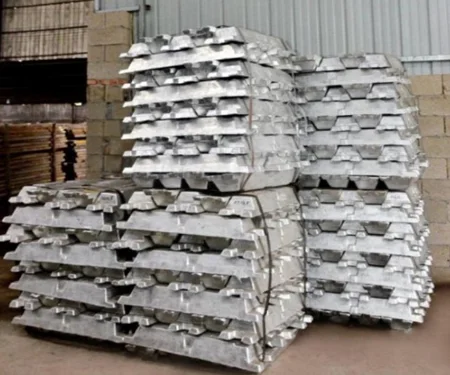
Stock image for referential purposes
The aluminium industry witnessed a defining phase shaped by tightening supply chains, rising sustainability pressures, accompanied by an acceleration in recycling investments. From shifting global scrap trade patterns and low-carbon aluminium initiatives to CBAM-driven policy responses and ESG-led industrial strategies, producers and governments alike continued repositioning themselves for a market increasingly influenced by resilience, decarbonisation and circular economy ambitions.
Delve deeper into the recycled aluminium and secondary aluminium market with our World Recycled ALuminium Market Analysis Industry forecast to 2032
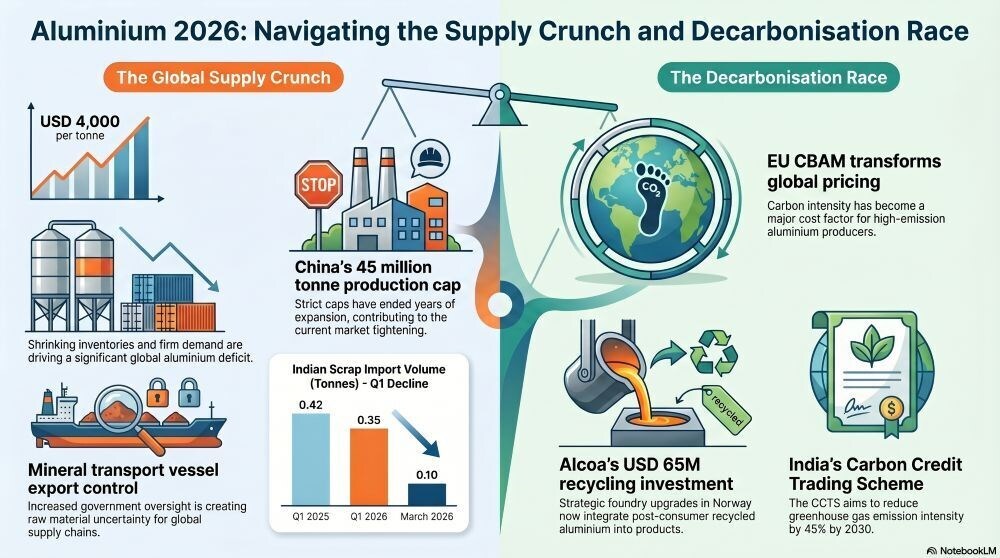
The global aluminium market has entered 2026 under intense pressure as supply shortages, geopolitical tensions and carbon-linked trade barriers reshape the industry. China’s strict 45 million tonne production cap has ended years of surplus-driven expansion, while Indonesia’s rapid downstream push is colliding with power and resource constraints. Guinea is tightening control over bauxite exports, adding uncertainty to raw material supply chains heavily relied upon by China.
At the same time, the EU’s CBAM has turned carbon intensity into a major pricing factor, raising costs sharply for high-emission producers. Supply disruptions in Mozambique, Iceland and the downstream sector, including Novelis’ fire-hit US operations, have further tightened availability. With inventories shrinking, premiums climbing and demand from EVs, solar and grid infrastructure remaining firm, analysts now expect a sizeable global aluminium deficit and prices potentially touching USD 4,000 per tonne. Read more about the supply crunch, geopolitical fragmentation and carbon-driven barriers.
The “2026 Carbon Reduction R&D for Core Export Items of SMEs” project is being organised by Ministry of SMEs and Startups in collaboration with the Korea Technology and Information Promotion Agency for SMEs (TIPA). The project’s aim is to respond to the EU's Carbon Border Adjustment Mechanism (CBAM). The project also aims to address the other global carbon regulations, focusing on the development and demonstration of carbon-reduction technologies, especially for carbon-heavy exports like aluminium and steel.
The Indian Carbon Credit Trading Scheme (CCTS) signifies India’s aim to realise sustainability goals by reducing 45 per cent of greenhouse gas (GHG) emission intensity by 2030 and achieving net-zero by 2070. This groundwork was laid and implemented by the Energy Conservation (Amendment) Act, 2022, and the Detailed Procedure for Compliance Mechanism (BEE, 2023). TIC Council India has recommended CCTS implementation to foster a reliable and globally aligned market framework that lowers compliance pressures, maintains transparency, and strengthens India’s momentum toward achieving its climate commitments.
European aluminium producers are facing mounting pressure as the European Union pushes reforms to its Emissions Trading System (EU ETS), which would likely inflate operating costs across the region’s recycling and refining industries. While these are intended to support long-term decarbonisation goals and cleaner industrial production, analysts and industry groups fear they could weaken the competitiveness of Europe’s aluminium sector at a time when producers are already dealing with high energy prices and sluggish industrial demand. Learn more.
EGA is rebuilding its aluminium supply chain resilience through renewed bauxite sourcing from Guinea and the near-completion of its Al Taweelah recycling plant, even as repairs continue at the damaged Al Taweelah smelter following the March attack. The company is accelerating recycling capacity, diversifying raw material sources, and expanding globally to strengthen long-term supply stability and low-carbon aluminium production.
Alcoa Corporation is set to invest USD 65 million to enhance its foundry production capabilities. This will be possible by incorporating recycled materials into the casting process at its Mosjøen smelter in Norway. The company aims to utilise this investment to strengthen its position by enabling the delivery of low-carbon aluminium products, which will benefit consumer demand in the key market. This will be done by the firm, for the first time, by integrating post-consumer recycled aluminium into its offerings.
Hydro is showcasing a curated selection of recycled aluminium design works at ELEMENT: METAL, the latest exhibition organised by Schloss Hollenegg for Design, running from May 9 to 31, 2026, in Styria, Austria. Hydro CIRCAL 100R, an aluminium material made exclusively from post-consumer trash, is the focus of Hydro's larger collaboration programme with worldwide designers, including this presentation. Over the past two years, the company has been considering new ways of incorporating recycled aluminium into interior designs and collectables.
To look for buying or selling leads of aluminium twitch scrap, visit our B2B marketplace.
Midal Cables, guided by its ESG strategy, GROW, launched the third edition of its Sustainability Report, marking a milestone in the Group’s approach to responsible growth and long-term value creation. Mr Khalid A. Latif, Group Chief Executive Officer of Midal Cables, commented, “During the year, we expanded our renewable energy capacity to 4.491 MWp and achieved a 13 per cent reduction in GHG emission intensity.”
Vedanta Aluminium solidified its commitment to manufacturing excellence by conducting a Business Partner Workshop on Safety and TQM at its Jharsuguda plants. More than 115 representatives from more than 20 significant business partner organisations connected to the company's operations attended the session. The initiative was designed as a collaborative industry platform to deepen engagement on workplace safety, operational discipline and quality management practices across the aluminium value chain.
India's aluminium scrap imports declined by 16 per cent Y-o-Y to 0.35 tonnes in Q1CY'26, down from 0.42 tonnes in the corresponding period last year. The country remains heavily dependent on imports, with nearly 85 per cent of its aluminium scrap requirement sourced from overseas. Consequently, the import decline directly impacts domestic secondary producers. Though India's aluminium scrap imports peaked at 0.2 tonnes in October 2025, arrivals declined soon after, before dropping sharply to 0.1 tonnes by March 2026.
Trade between Libya and Brazil hit a slump in Q1 2026, total bilateral commerce falling 56.5 per cent year-on-year to USD 95.9 million. Led by higher aluminium scrap shipments, Libya’s exports to Brazil saw a sharp spike. However, Brazilian exports declined significantly despite continued demand for commodities such as iron ore, poultry, beef, tobacco and coffee. Brazil nevertheless maintained a strong trade surplus of USD 92.4 million.
Explore the position of aluminium at the intersection of sustainability and strategy in Sustainability & Recycling: Aluminium's Dual Commitment

Vietnam enters the global scrap race with tax incentives and recycling ambitions in focus
Next articleRecAL targets Europe’s aluminium recycling bottleneck as industry pushes for higher-value recovery
Grow with
AL Circle