Aluminium Scrap Exporters

EU aluminium scrap export measure delayed as Commission shifts from duty to non-OECD restrictions
The European Commission has delayed its planned measures on aluminium scrap exports, replacing the earlier proposal for export duties with restrictions on waste shipments to non-OECD countries. European Aluminium said the change has added to discomfort across the aluminium industry, which has been waiting for measures to address the rising flow of scrap out of Europe. The association is now calling for a trade measure with wider territorial coverage and product scope. The Commission had initially planned to introduce restrictions in the second quarter of 2026, later moving the timeline to September. The proposed export duty has now been withdrawn, with the Commission instead preparing a delegated act under the Waste Shipment Regulation. Under the new approach, exports of waste, including...
Buying Indian secondary aluminium? Start with these seven verifications
Secondary aluminium is increasingly central to Europe’s decarbonisation plans. It is used in automotive castings, construction profiles, packaging and consumer goods and is valued because it can deliver similar mechanical properties to primary metal while requiring a fraction of the energy and emitting far less carbon dioxide. The European Union’s Emissions Trading System (ETS) and the Carbon Border Adjustment Mechanism (CBAM) have made low-carbon aluminium a strategic priority. As India’s scrap aluminium imports have continued to rise, from 0.88 million tonnes in CY15 to nearly 2 million tonnes in CY25, with a long-term CAGR of about 8.6 per cent, stronger traceability and licensing requirements are becoming increasingly important across the secondary aluminium supply chain. For this...
Grow with
AL Circle
Price
→Events

15th International Bauxite, Alumina & Aluminium Conference & Exhibition - IBAAS–VFMSTA 2026
ALUMINIUM Arabia 2026
ICSOBA 2026 - 44th International Conference and Exhibition
15th International Bauxite, Alumina & Aluminium Conference & Exhibition - IBAAS–VFMSTA 2026
ALUMINIUM Arabia 2026
ICSOBA 2026 - 44th International Conference and Exhibition
Business Cards
A report that reveals where the aluminium casting industry is heading and how businesses can act.
LEARN MORE
A report that reveals where the aluminium casting industry is heading and how businesses can act.
LEARN MOREGermany’s construction aluminium demand falls 12%, but 2027 recovery and recycling offer fresh growth prospects
AL Circle analysis: Germany’s aluminium trade surplus, Novelis’ US expansion, Asia’s EV demand & India’s underutilised downstream capacity
AL Circle Analysis: From Guinea to Gulf, how bauxite, tariffs and logistics redraw aluminium map
India’s bauxite imports jump 129.5% in H1 2026: Quality gap, refinery expansion outpace 25Mt domestic output
Who’s holding up Germany’s aluminium game? Meet EGA, Hydro and Constellium
News

India’s aluminium recyclers face a scrap-supply bottleneck
India’s rapidly expanding secondary aluminium industry is facing a shortage of domestic scrap, leaving recyclers dependent on overseas suppliers and vulnerable to changing trade policies in major exporting regions. Secondary aluminium production has increased from approximately 0.85 million tonnes in 2015–16 to nearly 2.2 million tonnes in 2025–26, according to industry estimates cited by the Material Recycling Association of India. The sector now supplies around 35 per cent of India’s aluminium consumption, but imports account for roughly 80 per cent-85 per cent of its scrap requirements. The imbalance is prompting recyclers and primary aluminium producers to push competing policy proposals on the 2.5 per cent basic customs duty applied to imported aluminium scrap. Domestic scrap cannot...

More US aluminium scrap heads to Asia amid domestic supply concerns
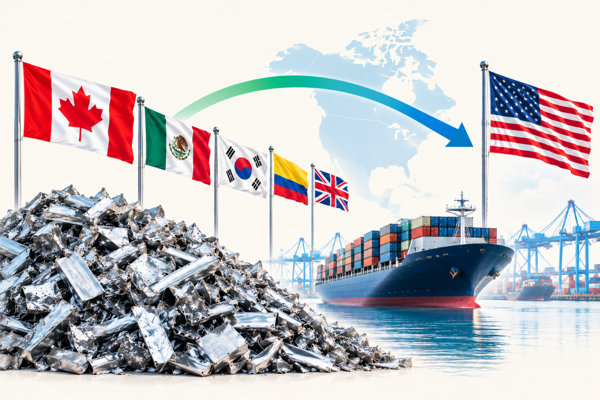
The United States exported about 1.25 million tonnes of aluminium-bearing scrap in the first half of 2026, up 21 per cent from 1.03 million tonnes during the same period last year. The figures, based on US Census Bureau data cited by Davis Index, show that more recycled aluminium is leaving the country even as domestic producers and policymakers debate whether the material should be retained to support US supply chains. Thailand and India lead purchases Thailand was the largest destination for US aluminium scrap in the first six months of 2026, receiving 268,000 tonnes. India followed with 233,350 tonnes, while Malaysia, South Korea and Hong Kong rounded out the top five destinations with 160,700 tonnes, 139,500 tonnes and 136,200 tonnes respectively. All five markets increased their...

A measure intended to increase the availability of recycled aluminium in Europe could ultimately reduce it, says Julia Ettinger
Europe’s aluminium scrap market is at the centre of a growing debate over whether rising exports are tightening domestic supply or are a result of weak demand from European smelters. In this interview, Julia Ettinger, Secretary General of Recycling Europe, explains the market factors driving scrap exports and the challenges affecting smelter capacity utilisation. She also discusses the possible impact of a proposed export levy on scrap collection, processing and recycling investment, alongside changing aluminium trade flows towards Asian markets and the outlook for Europe’s recycled aluminium sector through 2030. Julia joined Recycling Europe in 2018 and has served as Secretary General since April 2024, leading the association’s work on key regulatory, policy and legal issues affecting...

AL Circle analysis: Trade policies, carbon costs, supply trends shape aluminium scrap market outlook
As aluminium increasingly becomes a strategic raw material for decarbonisation and advanced manufacturing, the focus is no longer limited to primary metal production. From export restrictions and carbon pricing to import duties and circular economy measures, a growing wave of policy interventions is reshaping global aluminium scrap flows. These developments are influencing availability, pricing and competitiveness across aluminium supply chains. Trade scenarios When it comes to scrap leakage, Europe takes the centre stage. While in 2024 the European Union’s aluminium scrap outflow exceeded 1.2 million tonnes, in 2025 it neared 1.3 million tonnes, settling at 1.27 million tonnes. As industrial analysts warn the administration of stricter measures to safeguard quality aluminium scrap and...

Germany’s aluminium scrap exports rise 8.8% in Q1 2026 amid weak domestic demand and overseas pull: What does the trend reveal?
As aluminium producers place greater emphasis on recycled metal, scrap has become an increasingly important part of the wider aluminium value chain. Against this backdrop, Germany entered 2026 with a shift in its export picture, as aluminium scrap shipments moved higher after declining on an annual basis in 2025. Germany exported 311,491 tonnes of aluminium scrap to the global market in Q1 2026, up marginally by 0.5 per cent from 310,057 tonnes in Q1 2025. The increase was more pronounced on a quarterly basis, with exports rising 8.8 per cent from 286,285 tonnes in Q4 2025. The change in direction came at an interesting time for Germany’s aluminium industry. Recycled aluminium production weakened, semi-finished output declined and demand from automotive, construction and mechanical...

Can Europe secure 1Mt+ aluminium scrap for circularity goals while maintaining global competitiveness?
Europe’s aluminium recycling industry is entering a defining phase. Demand for low-carbon aluminium is climbing rapidly across automotive, packaging, construction and clean energy sectors, while policymakers continue to champion circularity as a key pillar of climate action. Yet, despite recycling rates above 80 per cent in several segments and continued investment in recycling infrastructure, a rising share of valuable aluminium scrap is still leaving the continent. That paradox is becoming one of the industry’s biggest focal points. Across the value chain, we notice a growing regard for Europe’s recycling success, which will be measured not only by how much scrap it collects, but by how much of that material it can keep, process and turn back into aluminium products at home. As...











Blog
LATEST POSTS




Turn marketplace visibility into more relevant buyer enquiries.
View Priority Plans
Turn marketplace visibility into more relevant buyer enquiries.
View Priority Plans
