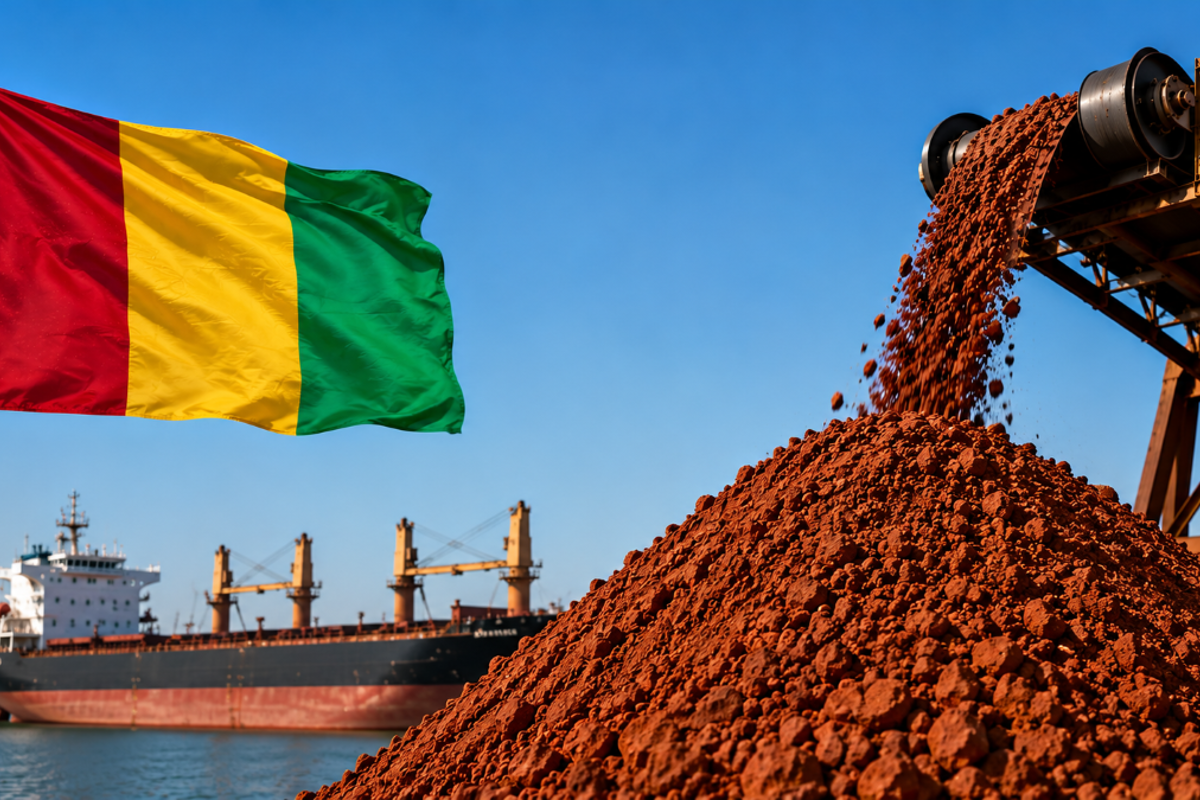
For the past few years, Guinea has been the driving force behind the global bauxite trade. Production expanded rapidly, exports climbed to record highs, finding their way to refineries across the world. But after years of pushing output higher, Guinea is now considering a different approach - a possible export cap of around 150 million tonnes.
Such a move would mark a major shift for a country that exported nearly 183 million tonnes in 2025. If introduced, the cap could remove almost 33 million tonnes from the market, raising questions about where the industry would find replacement supply.
The proposal comes at a time when market conditions have changed significantly. Bauxite prices have fallen, freight costs have risen and concerns over surplus have grown. For Guinea, which holds an estimated 7.4 billion tonnes of bauxite reserves - the largest in the world, the focus appears to be shifting from maximising volumes to preserving value.
Now, the key question for the market is whether other suppliers can make up for the shortfall if Guinea exports less?
How did Guinea become indispensable to the bauxite market?
Few mining stories have been as dramatic as Guinea's rise. The country's bauxite production increased from 100 million tonnes in 2022 to 123 million tonnes in 2023, before climbing to 142 million tonnes in 2024 and reaching 178 million tonnes in 2025. In just three years, production expanded by nearly 78 per cent.
By contrast, global bauxite production increased from around 400 million tonnes in 2022 to an estimated 465-470 million tonnes in 2025, representing growth of about 16–18 per cent over the same period.
Exports followed the same trajectory. Guinea exported 77.7 million tonnes in 2021, increasing to 88.8 million tonnes in 2022. Volumes then accelerated to 119.8 million tonnes in 2023 and 129.8 million tonnes in 2024 before surging to 182.8 million tonnes in 2025. Overall, exports expanded by around 135 per cent between 2021 and 2025. For more market details, read Global Bauxite & Alumina Market Forecast to 2036: Supply–Demand, Trade Flows & Price Outlook report.
Why is Guinea considering an export cap?
Ironically, the answer lies in the consequences of Guinea's rapid growth. As production and exports climbed, bauxite prices came under pressure
Guinea bauxite CIF prices, which reached around USD 92 per tonne in November 2024, steadily declined throughout 2025 as the market moved into oversupply. By June 2025, prices had fallen to around USD 74 per tonne, with most transactions occurring within the USD 73–75 per tonne range.
The pressure continued into 2026. Guinea FOB prices for 45/3 grade bauxite were quoted at around USD 38 per tonne in May 2026, while CIF prices stood at approximately USD 68 per tonne.
According to analysts, Guinean FOB prices had fallen to around USD 32–38 per tonne by April 2026, the lowest level since March 2022.
At the same time, freight rates increased because of disruptions linked to the Middle East conflict, squeezing margins across the mining sector. The combination of lower prices and higher logistics costs raised concerns over profitability, possible bankruptcies, job losses and pressure on government revenues.
Who would feel the impact first?
The clearest answer is China. Around 70 per cent of Guinea's bauxite exports are shipped to China, making the country the cornerstone of China's aluminium raw material supply chain.
China imported approximately 201.19 million tonnes of bauxite in 2025. Of that total, around 149.5 million tonnes came from Guinea, compared with approximately 110.6 million tonnes in 2024. Imports from Guinea therefore increased by about 35 per cent year on year.
Other countries like the United Arab Emirates, Ireland and Canada could also feel the impact. In 2025, they imported 11.15 million tonnes, 4.50 million tonnes and 3.42 million tonnes of bauxite respectively.
The increase in Guinea's exports was driven by production growth from major operators including SMB Guinea, CBG, Chalco and AGB2A, all of which expanded output as Chinese alumina refineries sought reliable long-term supply.
Which exporters could step in?
Several producers could potentially increase shipments, although none currently operate anywhere close to Guinea's scale. Read Global Bauxite & Alumina Market Forecast to 2036: Supply–Demand, Trade Flows & Price Outlook report for an indepth analysis.
Australia: The largest alternative supplier
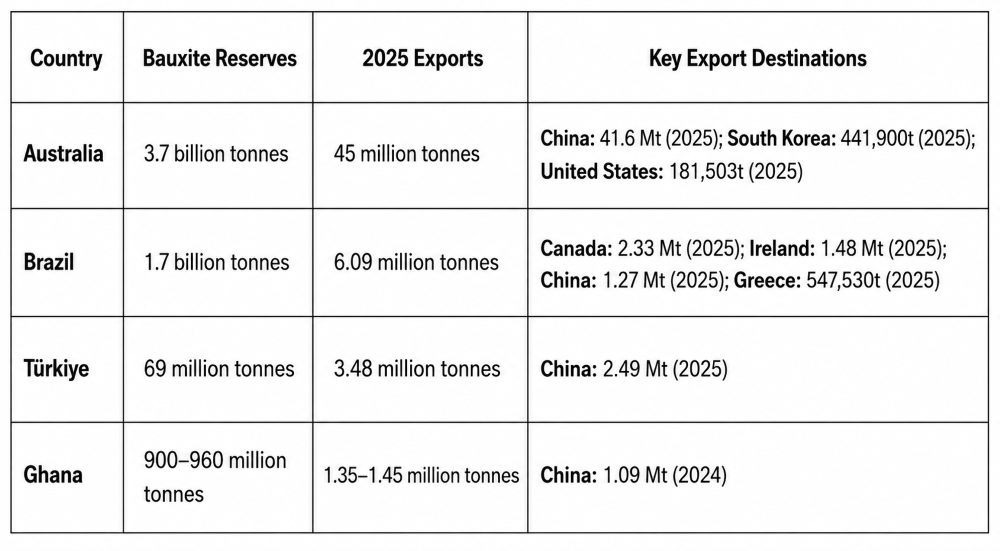
Australia remains the strongest alternative. The country holds around 3.7 billion tonnes of bauxite reserves and exports approximately 45 million tonnes (as of 2025).
China continues to be the dominant buyer, with imports rising from about 35.9 million tonnes in 2021 to nearly 41.6 million tonnes in 2025, after peaking at around 42 million tonnes in 2024.
By comparison, exports to South Korea remained relatively stable at around 445,500 tonnes in 2021–2022, before easing to 396,000 tonnes in 2023 and recovering to about 441,900 tonnes in 2025. Shipments to the United States were more volatile, falling from 133,566 tonnes in 2021 to 87,345 tonnes in 2022, rising to 286,278 tonnes in 2023 and easing to 181,503 tonnes in 2025.
Brazil: Gradual but steady growth
Brazil offers another source of supply, although on a much smaller scale. The country holds around 1.7 billion tonnes of reserves and exported 6.09 million tonnes in 2025, up from approximately 5.29 million tonnes in 2021.
Canada remained the largest destination for Brazilian bauxite last year, taking around 2.33 million tonnes, followed by Ireland at 1.48 million tonnes and China at nearly 1.27 million tonnes. Greece imported a further 547,530 tonnes.
Türkiye: Increasing exposure to China
Türkiye has also expanded its presence in the market. Exports almost doubled from around 1.84 million tonnes in 2021 to roughly 3.48 million tonnes in 2025, supported largely by growing sales to China.
Shipments to the country increased from about 464,356 tonnes in 2021 to nearly 2.49 million tonnes in 2025, although they remained below the 2024 peak of 3.14 million tonnes. Türkiye holds around 69 million tonnes of bauxite reserves.
Ghana: A growing African supplier
Among African producers, Ghana has steadily built its export profile. The country holds an estimated 900–960 million tonnes of reserves and exported around 1.35-1.45 million tonnes in recent years.
China has been the key driver of that growth, with imports rising from negligible volumes in 2021 to approximately 1.73 million tonnes in 2023 before easing to around 1.09 million tonnes in 2024.
New mining projects are emerging across key regions
Several projects are moving forward globally. In Cameroon, Canyon Resources is advancing the Minim Martap project, which contains more than 1.1 billion tonnes of resources grading 51 per cent alumina and 2 per cent silica. First shipments are targeted for late September 2026, with production planned to increase from an initial 1.2 million tonnes annually to 6.5 million tonnes and eventually 10 million tonnes per year.
Guyana is preparing to revive its bauxite sector after the government approved the restart of mining operations in the Berbice River area following almost six years of inactivity. Infrastructure rebuilding and preparations are underway in 2026, while full production is targeted by the end of 2027.
Vietnam, which holds around 3.1 billion tonnes of bauxite reserves, is also expanding its presence in the regional aluminium industry. Vietnam–Phuong Group is developing a USD 1 billion integrated bauxite-alumina-aluminium project in neighbouring Laos. The complex covers nearly 9,000 hectares and includes a 1 million tonne aluminium smelter powered by a 600 MW plant.
Full operations are expected by 2028, although much of the output is likely to support downstream aluminium production rather than significantly boost seaborne bauxite exports.
In Brazil, MRN's Projeto Novas Minas is expanding mining across the Rebolado, Escalante, Jamari, Barone and Cruz Alta Leste plateaus from 2026 onwards. However, the project is designed mainly to sustain production and replace depleting reserves rather than generate substantial export growth.
Australia's Metro Mining is also advancing a production ramp-up at its Bauxite Hills operation in Cape York following its 7 million tonne expansion programme, targeting stronger output growth during the second half of 2026.
India is strengthening domestic bauxite availability as well. Vedanta secured the Sijimali bauxite mine, which contains around 300 million tonnes of resources and has a mining capacity of 12 million tonnes. The mine is expected to meet approximately 67 per cent of Vedanta's future bauxite requirements for its alumina refineries.
The company also secured the Karnapodikonda bauxite mine in Odisha as part of its broader raw material strategy. Separately, NALCO is targeting the commencement of mining at the Pottangi bauxite deposit in Odisha by June 2026. Most Indian projects, however, are intended to support domestic alumina refining and aluminium production rather than export markets.
Can the market really replace Guinea?
The short answer is not anytime soon. If Guinea proceeds with a 150 million tonnes export cap, replacing the resulting 33 million tonnes shortfall immediately would be extremely difficult. Australia, Brazil, Türkiye, Ghana and a number of emerging projects can help diversify supply, but none currently has the scale to match Guinea's position in the market.
Over the next several years, however, new mining developments could gradually help bridge the gap. Read Global Bauxite & Alumina Market Forecast to 2036: Supply–Demand, Trade Flows & Price Outlook report for an indepth analysis.
At the same time, Guinea's strategy extends beyond restricting exports. The country is planning five to six alumina refineries by 2030–2032, adding around 7 million tonnes of refining capacity, with the first refinery under the SPIC agreement targeted for completion in 2027.
Last year, Guinea initiated proceedings to revoke the mining licence of Emirates Global Aluminium's (EGA) Guinea Alumina Corporation (GAC), underscoring the government's increasingly interventionist approach to the mining sector. However, EGA and the Guinean government later reached an agreement on bauxite supply and the resolution of outstanding disputes, helping to stabilise the company's operations in the country.
The export cap is also consistent with Guinea's aim to push bauxite prices towards USD100 per tonne as part of a broader strategy to extract greater value from its vast bauxite resources.
Note: This is exclusive coverage by AL Circle and may not be reproduced, republished or shared without prior permission.













_md.webp)