
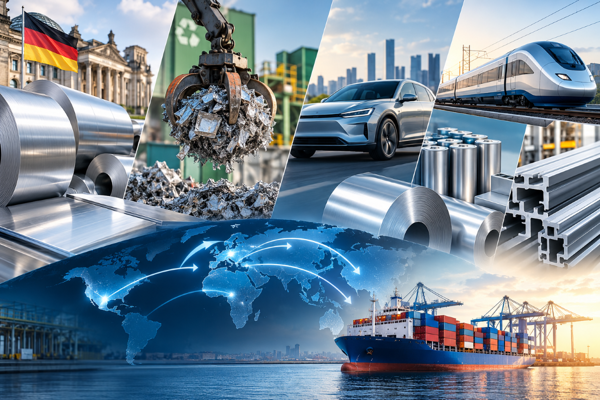
AL Circle analysis: Germany’s aluminium trade surplus, Novelis’ US expansion, Asia’s EV demand & India’s underutilised downstream capacity
Aluminium’s next growth phase is increasingly being shaped by downstream processing, supply-chain resilience and demand from specialised applications. Germany continues to generate a substantial trade surplus in flat-rolled products despite a shrinking primary aluminium base, while North America is investing in recycling and rolling. Across Asia, new manufacturing capabilities and growing demand from electric vehicles, railways and batteries are creating further opportunities. However, declining exports, underutilised capacity and uneven profitability show that investment alone does not guarantee success. For industry leaders, the challenge is to identify where demand is shifting, develop products that meet customer requirements and ensure that new investments translate into sustainable...
AL Circle Analysis: From Guinea to Gulf, how bauxite, tariffs and logistics redraw aluminium map
Aluminium markets in late 2026 are being shaped by more than the headline LME aluminium price. Bauxite security, alumina availability, geopolitical disruptions, tariff negotiations, logistics diversification and regional premiums are increasingly determining where metal moves and what buyers pay. From RUSAL reassessing Caribbean assets and Vedanta securing Odisha bauxite to Brazil extending mine life and EGA rebuilding its Guinea supply chain, producers are strengthening control over critical raw materials. At the same time, the US remains heavily dependent on imported bauxite and alumina, while Europe and Asia are experiencing sharply different premium dynamics. These developments point to a market where physical availability is becoming a regional factor even as aluminium itself remains...
Grow with
AL Circle

Has Alcoa’s 2024 been sustainable enough? A deep dive into the aluminium giant’s environmental and ESG scorecard
In a metal market battered by volatile prices, inflationary stress, and escalating scrutiny over climate credentials, Alcoa’s 2024 Sustainability Report arrives not just as a routine corporate checklist but as a statement of ambition — and, in some areas, quiet disruption. With operations sprawling across 30 global facilities — from bauxite mines to smelters and casthouses — the US-based aluminium major shoulders more than just metal output; it shoulders a reputation. But does Alcoa’s latest ESG report genuinely reflect industry leadership, or is it a slick exercise in eco-branding? Let’s unpack the facts, compare performance, and critically assess how the numbers stack up. Renewable power — a benchmark or a baseline? In 2024, 86 per cent of the electricity powering Alcoa’s smelters came...

After Guinea setback, EGA turns to Ghana: strategic shift or coincidence?
Following the initiation of bauxite mining revocation by Guinea, Emirates Global Aluminium (EGA) now eyes Ghana to explore fresh bauxite-related opportunities. According to a report on June 4, the UAE-based aluminium major has inked an agreement with the Ghana Integrated Aluminium Development Corporation (GIADEC) to assess the feasibility of bauxite exploration in the West African country. What’s in the deal? Under the agreement signed with GIADEC, EGA aims to explore Ghana’s estimated 920 million tonnes of bauxite reserves in Ghana, spread across Nyinahin (700 million tonnes), Kyebi (160 million tonnes), and Awaso (60 million tonnes). Despite this vast potential, Ghana currently produces just 1.5 million tonnes annually. Beyond exploration, EGA will also examine the potential for...

China’s clean energy investment push surpasses the US and EU, driven by USD 1T net-zero vision
We are already well-versed in the fact that China is the top country which invests in and consumes energy. As of 2025, China is expected to indulge in higher spending on energy than the US and EU combined. Moreover, in the past few years, China has securely moved their investment in global clean energy up to 33 per cent from 25 per cent. This spending has been distributed between wind, nuclear, batteries, solar and nuclear. It's only been 6 months into 2025, and the total global energy investment is expected to create a new record of USD 3.3 trillion. However, this is subject to the world facing high economic fluctuations and rising geopolitical risks. From the new global record of investment, the majority of the share, USD 2.2 trillion, would be devoted to developing clean technologies....
_0_0.jpg)
CANPACK’s 2024 sustainability report reinforces a circular economic achievement backed by 96% reduction in its Scope 2 emissions
CANPACK, one of the leading global manufacturers of high-quality packaging solutions, with a legacy that began over 30 years ago has shown remarkable results in their sustainability report for 2024. Headquartered in Wayne County, Pennsylvania, the company is touted as the fourth largest supplier of aluminium beverage cans in the world. In 2024, CANPACK bagged the position as the second largest supplier of aluminium beverage cans in Europe. This is not just it; the company has also managed to reduce its Scope 2 emissions by 96 per cent in 2023 and has unlocked several other milestones followed by bagging prestigious recognitions. Renowned for its advanced technology, deep industry expertise, and strong commitment to sustainability, CANPACK continues to set new standards in packaging...

Indian giant, World Aluminium Ltd, witnesses high buying interest amidst stock price fluctuation and Trump's 50% reciprocal tariff
Worldwide Aluminium Limited, an Indian aluminium giant specialising in both aluminium-based industry and household products, has recently reported seeing a significant increase in buying activity, irrespective of market decline. How does it indicate for the Indian aluminium industry amidst the tariff imposed by Trump? As of June 3, 2025, Worldwide Aluminium Limited saw a rebound in buying activity after witnessing a decline for five consecutive days. On the same day, the performance increased by 4.98 per cent, representing a contrast to the Sensex, which showed a decline of 0.62 per cent. It shows a stock trend reversal, as before the gain, the market was low for five days straight. Despite the gain, the firm's stock indicates mixed performance in various frames. In the past week, the...

America’s last alumina refinery yet again riddled with unlawful waste disposal allegation
Updated on 18/07/2025: State environmental regulators have recorded fresh violations at Atlantic Alumina’s Gramercy refinery in Louisiana, the only operational alumina refinery in the United States. A compliance inspection by the Louisiana Department of Environmental Quality (LDEQ) on May 29 documented nine violations, including discharges from red mud waste lakes, unmaintained levees, and chemical overflows into public drainage systems. This follows an earlier LDEQ report from March, which found that toxic waste from the site had entered a drainage ditch leading to the Blind River Swamp. Water samples from that ditch contained arsenic levels nearly 1,400% above the EPA’s safety threshold. Inspectors noted that “multiple discharges from Red Mud Lake 3 into Outfall 003” had occurred, while...

Manufacturing and export activities slow in Asia’s Big Three - Trump tariffs in the crosshairs
Already strained by the United States’ 25 per cent import tariffs, East Asian economies like China, Japan and South Korea are now bracing for even higher uncertainty as Washington eyes a steep 50 per cent duty. Reports show that all the three economic powerhouses experienced subdued export orders and manufacturing activity in May, just as signs of stabilisation had begun to emerge. Both South Korea and Japan’s PMI recorded contraction, hovering at 47.7 and 49.4, respectively, attributed to weakening global demand, with many citing US tariffs and rising cautious buying sentiment as key drags on production and order volumes. South Korea’s export struggle deepens amid US tariffs Evidently bearing the brunt of intensifying US trade policies, South Korea is seeing cracks in its export-driven...

Why CBAM’s scrap loophole is a data and enforcement crisis waiting to erupt
For all its ambition, the European Union’s Carbon Border Adjustment Mechanism (CBAM) suffers from a problem not uncommon in modern climate regulation: data complexity outpacing policy design. In our previous editorial derived from the same study by European Aluminium , we have explored how aluminium scrap has become a billion-euro backdoor for foreign producers to undercut CBAM fees and outprice European producers. But underneath the circumvention tactics lies an even bigger story, one of missing traceability, legal grey zones, and statistical blind spots that could seriously undermine CBAM’s integrity over the next decade. This time, we delve deeper into why CBAM’s loophole isn’t just about policy, it’s about enforcement infrastructure, legal classification, and the technical debt of...

The US delay on EU duties signals strategy, not softening ‘brinkmanship’
The Trump administration has put a temporary lid on an economic powder keg by delaying the proposed 50 per cent tariffs on European Union exports until July 9, 2025. However, the world will have faced the same tariff rate card, specifically for aluminium and steel, starting June 04. Image for referential purposes only This last-minute pause by the US president, after what is being called a good conversation with EU president Ursula Von Der Leyen, deemed more than just diplomatic prudence. It transmitted the aura of a calculated US strategy to press Brussels into a more favourable trade arrangement without triggering immediate retaliation from a bloc already navigating economic headwinds and geopolitical constraints. Trump’s policy by provocation Earlier in May, former President Donald...

India assesses potential $4.6 billion export hit from US 50% aluminium and steel tariff—how real is the threat?
As soon as the news broke about the US President Donald Trump’s decision to double aluminium and steel tariffs from 25 per cent to 50 per cent, effective from June 4, 2025, major producers and exporters of aluminium and steel worldwide began assessing the implications of the double-whammy, steep tariffs. India, being a country among the top 10 aluminium exporters to the United States , has assessed that its metal exports worth USD 4.56 billion would face headwinds. A report by the Global Trade Research Initiative (GTRI) warned that Indian exports would become more expensive in the US market, potentially reducing their competitiveness and affecting overall trade volumes. GTRI said "For India, the consequences are direct. In FY2025, India exported USD 4.56 billion worth of iron, steel, and...

Here’s the trick! Study reveals how aluminium scrap, with a Billion-Euro backdoor, is potent to loosen EU’s Carbon Border for importers
When the European Union unveiled its Carbon Border Adjustment Mechanism (CBAM), the ambition was clear: to build a fortress against carbon leakage, shield domestic industries from unfair competition, and incentivise global decarbonisation. It was heralded as the world’s most sophisticated climate tariff, with a complex, bold, and precise outline. Image for referential purposes only But as the legislation transitions from theory to implementation, a critical vulnerability has emerged. And it’s not in exotic energy systems or abstract accounting tricks. It’s in something far more mundane, yet deceptively potent — aluminium scrap. As for the current plan, CBAM creates a multi-billion-euro arbitrage opportunity for foreign aluminium producers. And the loophole is alarmingly simple. Both...

Trump doubles aluminium and steel tariffs to 50% - how long will it last amid global pushback and renegotiation calls?
The global aluminium and steel industries are in for another jolt as US tariffs take a sharp new turn. Just a day after a Federal Court ordered a halt to the implementation of tariffs, sending through global optimism, President Donald Trump reversed course dramatically. Not only did he secure a suspension of the court's ruling , but he also announced a doubling of tariffs on aluminium and steel imports, from 25 per cent to 50 per cent, effective Wednesday, June 4, 2025. What seemed like a moment of relief quickly turned into renewed uncertainty as celebrations over the court's block were cut short by the President's swift and unexpected escalation. Trump’s decision to doube tariffs - whimsical or strategic? While addressing a rally in Pittsburgh, Pennsylvania, President Trump reiterated...

Alcoa’s $1B tax win over Australia: A big save for the global business in a volatile time
In a blow to Australia’s aggressive multinational tax crackdown, the Australian Taxation Office (ATO) has abandoned its six-year-long legal fight with Alcoa over alleged transfer pricing abuses, marking a rare high-stakes defeat for Canberra in its broader battle against US corporate giants. With Alcoa now set to receive USD 107 million in tax refunds, the decision has reverberated through both the aluminium sector and the global tax justice landscape. Image for representational purposes only But beneath the surface of a billion-dollar ruling lies a deeper narrative, one that cuts across resource nationalism, transfer pricing frameworks, and a geopolitical tug-of-war over who gets to tax global profits in the age of cross-border supply chains. The dispute and what was at stake At the...

For Q3 2025: High stockpiles and muted demand cut Japan aluminium premium again
For the second consecutive quarter, the premium offered by Japan’s primary aluminium buyers has further depleted, said two sources directly involved in quarterly pricing talks. Mirroring a similar20 per cent decline as seen in the previous quarter, the proposed premium for Q3 2025 has reached USD 145 per tonne versus USD 182 per tonne. This continued downturn marks not only the second straight quarterly decline within the year but also the second such drop in the past five years. After a strong start to the year, when the premium surged to USD 228 per tonne for the March quarter, representing a 30 per cent quarter-on-quarter increase, Japan’s aluminium premium has steadily weakened with each subsequent quarter. When compared to the Q1 2025 premium, Japan’s outbound trade premium for Q3...

‘Stop tariffs’, orders US Federal Court – but reverses it within 24 hours: Why the sudden U-turn?
Yet another dramatic twist has unfolded in the US tariff corridor! Within just 24 hours, the same US Federal Court delivered two starkly opposite rulings. In one moment, the court struck down Donald Trump’s sweeping tariffs, deeming them unjustified and labelling them as mere safeguard measures not rooted in genuine national security concerns. The other moment, it repealed the verdict, effectively reinstating the tariffs. After even commenting that the tariffs “exceed any authority granted to the president”, this unprecedented move by the US Federal Court arrives as a big surprise for the entire global trade communities. What exactly did the court say? The US Court of International Trade delivered the judgement this week that Donald Trump wrongly used the presidential authority under the...

India’s industrial exports, including aluminium, to the UK are at risk from 2027 carbon duties
India and the United Kingdom have recently concluded negotiations on a long-anticipated Free Trade Agreement (FTA) aimed at unlocking bilateral trade potential and reducing tariff barriers. The deal is expected to usher in smoother market access for Indian goods, from textiles and engineering products to aluminium and steel. But even before implementation begins, an invisible tariff threatens to erode these gains: the United Kingdom’s upcoming Carbon Border Adjustment Mechanism (CBAM). Image for representational purposes only (Source: https://x.com/narendramodi/) Set to take effect from January 1, 2027, the UK CBAM is designed to level the playing field between domestic and imported goods by placing a carbon cost on high-emission imports. In doing so, it mirrors the European Union’s CBAM,...

Turkey’s solar strategy at a crossroads: Will anti-dumping move on Chinese aluminium frames hurt more than help?
Sunday’s report on Turkey initiating anti-dumping probe into Chinese aluminium solar frames imports make both the global aluminium and solar industries wonder 'WHY', given the nation’s growing solar energy capacity. In only two and half years, Turkey’s solar energy capacity surged by 102 per cent and reached 19.6 GW by the end of 2024, surpassing the 2025 target ahead of time. Against this backdrop, Turkey’s decision to target China, a key supplier of aluminium solar frames, comes as a surprise. China – dominant supplier under scrutiny China remains Turkey’s largest exporter of aluminium photovoltaic (PV) frames. In 2023, China alone exported 280,000 tonnes of solar frames, accounting for 76 per cent of Turkey’s total imports. This, according to Turkey, is undercutting local...

GAC’s 2Mt bauxite pile-up in Guinea: What built it, what’s blocking it, and what could break the deadlock
In October 2024, Guinean customs authorities suspended bauxite exports from Guinea Alumina Corporation (GAC), a subsidiary of Emirates Global Aluminium (EGA), due to unresolved issues with the Guinean government, chiefly around concerns over GAC’s failure to progress on its commitment to build a domestic alumina refinery. As a result, GAC halted exports, and by early 2025, around 2 million tonnes of bauxite had accumulated at the port in Kamsar, unable to be shipped. Image for referential purposes only Located in northwestern Guinea, GAC operates a vast 690-square-kilometre mining concession that feeds directly into international supply chains, thanks to a dedicated rail link to its port at Kamsar. Since exports began in 2019, GAC has become a key supplier of bauxite, the primary ore for...

