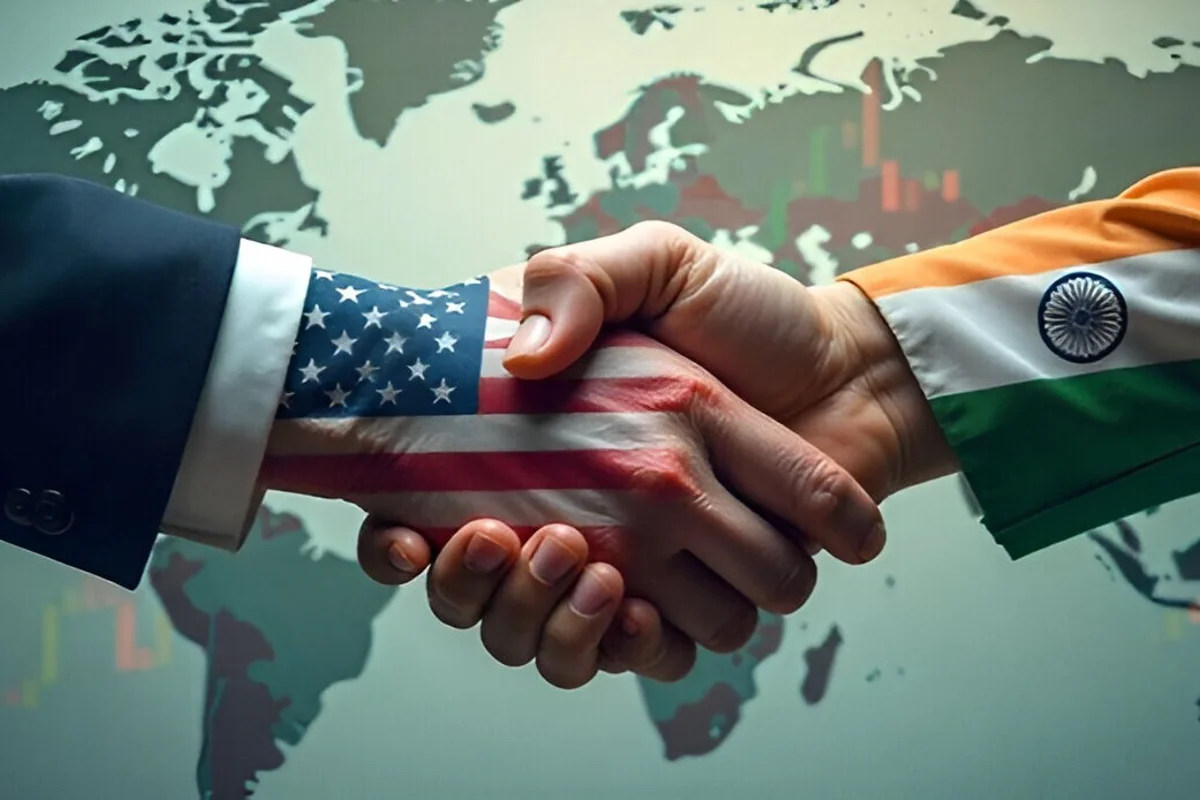
India’s talks with the US for a Bilateral Trade Agreement, which would smoothen gross exports worth USD 86.5 billion (FY 2024–25 data, up 11.6 per cent from FY 23–24), are walking on a double-edged sword.
Image source: Linkedin (Handle: Harnam Prajapati)
With the progression of a second Trump administration, there is a renewed and pressing push for comprehensive trade relations. Current high-level negotiations are underway, with India and the US aiming to finalise an interim three-phase trade agreement by June 25, ahead of a potential July 9 deadline for the USA’s 26 per cent reciprocal tariff on India, which is currently suspended.
While Indian exports still face America’s standard 10 per cent baseline tariff, discussions are focused on securing duty reductions across labour-intensive Indian sectors like textiles, gems and jewellery, leather products, garments, plastics, chemicals, shrimp, oil seeds, chemicals, grapes, and bananas. In return, the US seeks tariff reductions in industrial products, automobiles (especially electric vehicles), wines, petrochemicals, dairy, and agricultural goods such as apples and tree nuts.
“India is prepared to finalise a trade agreement with the US by first addressing low-hanging fruits,” Commerce Minister Piyush Goyal said on Monday on the proposed bilateral trade pact. When asked if it will be low-hanging fruits, he said, “India is always ready for that, and I believe that” the things which are not controversial, the low-hanging fruits, should be captured first as those sectors will start getting profits. Goyal is on an official visit to meet Swiss leaders and businesses here. When asked if something can be concluded before July 9, he said: “I am a born optimist”.
The numbers tell a compelling story. At USD 131.84 billion in bilateral trade, the United States has secured its position as India’s largest trading partner for the fourth consecutive year. China, the former frontrunner from 2013-14 to 2017-18 and briefly in 2020-21, now sits in second place with USD 127.7 billion. But these figures merely scratch the surface of a complex economic relationship that’s currently at a critical juncture.
As India and the US navigate their latest round of trade negotiations, the stakes couldn’t be higher. Sources indicate that an interim trade agreement could materialise as early as June 25, 2025, ahead of the July 9 deadline when the US’s 26 per cent reciprocal tariff on Indian goods is set to kick in. Currently, Indian exports face America’s standard 10 per cent baseline tariff, making this negotiation window crucial for both nations.
The journey to this point has been anything but linear. Post-independence India, under Jawaharlal Nehru’s leadership, embraced protectionist policies and strategic autonomy, limiting economic engagement with the US to programs like PL-480 food aid. The 1974 nuclear test and India’s Soviet alignment further complicated matters. But 1991 marked a watershed moment when India, facing a severe balance-of-payments crisis, dismantled its protectionist framework under PM PV Narasimha Rao and Finance Minister Manmohan Singh.
The current negotiations reveal specific priorities for both nations. India seeks relief from the 26 per cent reciprocal duty and pushes for duty reductions in labour-intensive sectors like textiles, gems and jewellery, leather products, and garments. The US, meanwhile, eyes tariff reductions across industrial products, electric vehicles, wines, petrochemicals, and agricultural goods including GM crops – though India maintains strict standards on GM imports.
Looking at the trade balance, India maintains a significant surplus, reaching USD 41.18 billion in 2024-25, up from USD 35.32 billion in the previous year. This growing imbalance concerns US policymakers, particularly as both nations aim to boost bilateral trade to an ambitious USD 500 billion by 2030 – more than double current levels.
The relationship has weathered various storms. During Trump’s first term (2017-2021), India lost its Generalized System Preferences status when the US criticised India’s 12 per cent tariffs compared to America’s 2.2 per cent. India retaliated with counter-tariffs on US almonds and steel. The Biden administration (2021-2025) adopted a more collaborative approach, focusing on supply chain resilience and clean energy cooperation, though no substantial trade agreement materialised during this period.
Historical perspective offers interesting insights. Economic historian Douglas Irwin’s research challenges the notion that high tariffs were solely responsible for America’s industrial rise. While the US share of global manufacturing grew from 23 per cent in 1870 to 36 per cent in 1913 under high tariffs, these protectionist measures came at a cost of roughly 0.5 per cent of GDP in the mid-1870s. The fundamental drivers of US economic growth were abundant resources and openness to people and ideas.
Drawing lessons from the annals of American economic history, the proposition of increasing tariffs on steel and aluminium imports from 25 to 50 per cent is fraught with potential perils despite its stated aim of bolstering domestic industries.
In history, punitive tariff hikes, such as the infamous Smoot-Hawley Tariff Act of 1930, demonstrably amplified the severity of the Great Depression by triggering widespread retaliatory measures from trading partners, leading to a precipitous collapse in global trade volumes. While tariffs can offer a short-term shield to specific sectors, a doubling of duties to 50 per cent on crucial industrial inputs like steel and aluminium risks significantly raising production costs for a vast array of US manufacturing industries, including automotive, construction, and packaging.
This cost inflation can erode competitiveness, suppress demand for finished goods, and paradoxically lead to broader job losses across these downstream sectors, echoing past instances where job gains in protected industries were far outweighed by losses elsewhere in the economy. Rather than fostering sustained growth, such drastic protectionism often invites a tit-for-tat dynamic, disrupting global supply chains and creating an environment of uncertainty that ultimately harms both producers and consumers.
If an upstream or semi-finished aluminium product (like unwrought aluminium, aluminium extrusion, bars, rods, tubes, sheets, foil, etc.) was previously subject to a 25 per cent tariff, it will now face a 50 per cent tariff. This means the cost of importing that specific product doubles in terms of the tariff applied.
For instance, if a shipment of aluminium sheets valued at USD 100,000 previously incurred a USD 25,000 tariff (25 per cent), it would now incur a USD 50,000 tariff (50 per cent). The cost for the importer, solely due to the tariff, increases by USD 25,000.
However, today, as Special Secretary Rajesh Agrawal and Commerce Minister Piyush Goyal engage with their American counterparts, including US Commerce Secretary Howard Lutnick, the focus remains on securing an interim arrangement before finalising the broader bilateral trade agreement. A finance ministry report suggests that a successful deal could transform existing challenges into opportunities, potentially creating new avenues for market access and enhanced exports.
The clock is ticking, but the foundation for progress exists. With India constituting approximately 18 per cent of America’s total goods exports and the US remaining crucial for India’s IT, pharmaceutical, energy, and defence sectors, both nations have compelling reasons to find common ground. The question isn’t if they’ll reach an agreement but when and on whose terms.












_md.webp)
_md.webp)
_md.webp)







