75% less calcium leaching: Aluminium strengthens cement against sulphate attack
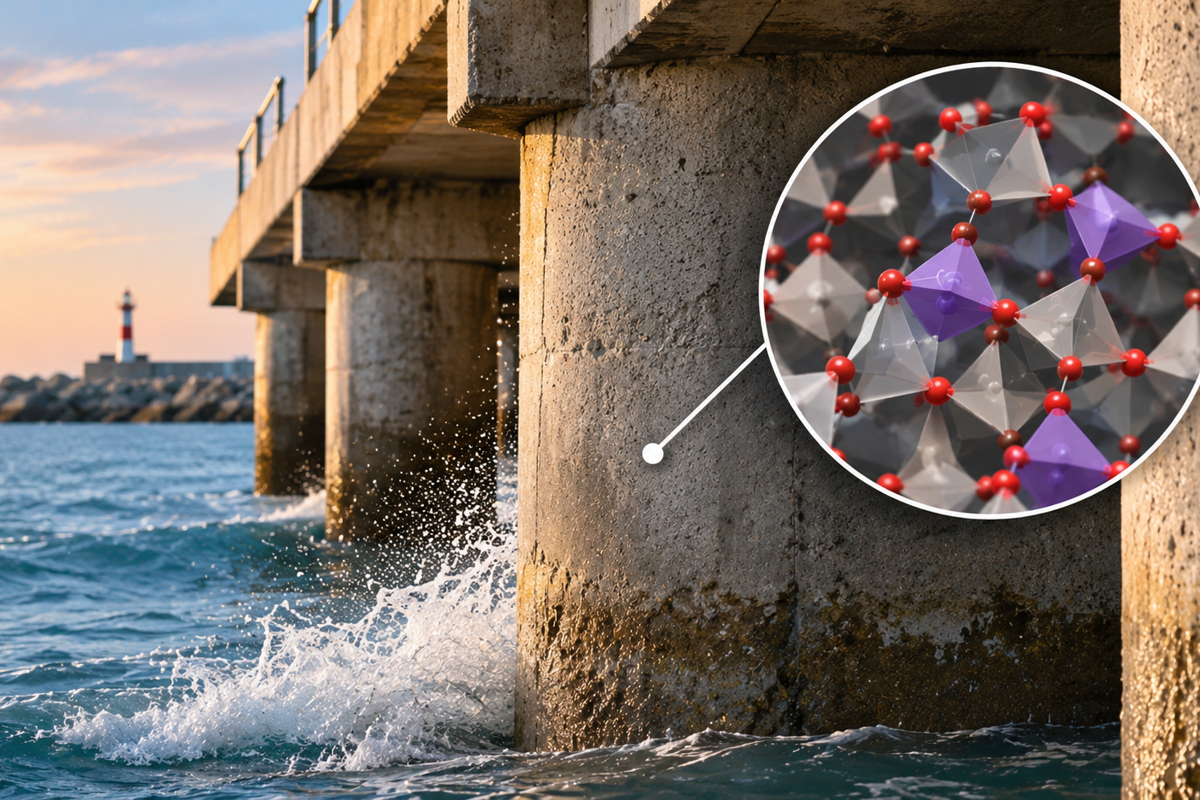
The image used in this article is generated with an AI tool and does not depict any real-time moment
Aluminium could help make cement-based materials more resistant to chemical deterioration, according to a new molecular dynamics study that found a significant reduction in calcium leaching when aluminium was incorporated into cement hydrates. Increasing the aluminium-to-silicon ratio to 0.2 reduced calcium loss by approximately 75 per cent under simulated sodium sulphate exposure, highlighting a potential approach to improving the durability of concrete used in aggressive environments.
The research examined calcium aluminosilicate hydrate (C-A-S-H), a key binding phase in cementitious materials, to understand how changes in its chemical composition influence resistance to sulphate attack. Sulphate ions found in seawater and groundwater can penetrate cement structures and disrupt the internal binding network, allowing calcium to escape. This process weakens the material's structure and contributes to long-term deterioration.
To learn about the market potential of aluminium dross, explore "ALuminium Dross Processing: Generation, Recovery & Strategic Roadmap"
Aluminium helps retain calcium in cement hydrates
To investigate the protective effect of aluminium, researchers simulated three different aluminium-to-silicon ratios: 0, 0.1 and 0.2. Each model was exposed to a 10 per cent sodium sulphate solution over a 50-nanosecond simulation period.
The results showed a clear difference in calcium loss across the three configurations. The aluminium-free system released approximately 32 calcium ions into the surrounding solution. At an aluminium-to-silicon ratio of 0.1, this number fell to 14, representing a 56 per cent reduction. Increasing the ratio further to 0.2 reduced calcium loss to just eight ions, equivalent to a 75 per cent decrease compared with the aluminium-free model.
The researchers attributed this improvement to changes in the internal chemical structure of the cement hydrate. Aluminium atoms introduced additional oxygen-coordination sites that strengthened the interactions holding calcium ions within the framework. This made it more difficult for calcium to detach and enter the surrounding solution.
The simulations also showed that higher aluminium content restricted water penetration into the cement structure. This is important because invading water helps facilitate the chemical processes responsible for calcium removal during sulphate exposure.
Four mechanisms contribute to improved sulphate resistance
The study identified several ways in which aluminium helped protect the cement hydrate. First, its incorporation strengthened the internal structure by improving the connectivity of aluminosilicate chains. Second, additional calcium-oxygen-aluminium interactions helped retain calcium ions within the framework.
Aluminium also altered the electrical properties of the exposed surface, encouraging sodium ions to accumulate near the interface. This adsorption layer helped restrict the movement of aggressive ions towards vulnerable regions. Finally, the more compact structure limited water penetration into internal channels, reducing opportunities for further chemical deterioration.
The researchers also found that the average residence time of interfacial water increased from 1.05 nanoseconds in the aluminium-free system to 1.62 nanoseconds at an aluminium-to-silicon ratio of 0.2, an increase of 54 per cent. This indicated stronger water retention near the surface, while deeper penetration into the material was restricted.
Unlock key insights from leading companies and experts across the aluminium ecosystem with our e-Magazine - Mine to Market: Aluminium Producers & Manufacturers 2026
Implications for durable concrete materials
The findings could help guide the development of more durable cementitious materials for infrastructure exposed to seawater, sulphate-rich groundwater and other aggressive conditions. Such environments include marine facilities, offshore structures, harbours and coastal foundations, where chemical deterioration can affect the long-term integrity of concrete.
The research is particularly relevant to supplementary cementitious materials such as blast furnace slag, fly ash and metakaolin. These materials introduce reactive aluminium and silicon into cement hydration systems, helping form calcium aluminosilicate hydrate.
However, the reported improvements were established through molecular dynamics simulations rather than full-scale concrete exposure tests. Further experimental investigation would be needed to determine how the observed molecular mechanisms translate into long-term performance under practical construction conditions.
Nevertheless, the study provides an atomistic explanation of how aluminium incorporation can limit calcium loss and restrict sulphate-driven deterioration, offering a potential direction for designing more durable cement-based materials.
To keep your aluminium operations running efficiently, explore essential consumables and connect with global suppliers on AL Biz.
Grow with
AL Circle












_md.webp)