India’s renewable power capacity set to reach 530 GW by 2030 as solar leads expansion
The image used in this article is generated with an AI tool and does not depict any real-time moment
India’s renewable energy transition is gathering pace, with installed renewable power capacity surpassing 300 gigawatts (GW) in 2026, almost quadrupling over the past decade. The country has also achieved its target of sourcing 50 per cent of installed electricity capacity from non-fossil fuel sources five years ahead of schedule, strengthening its position as one of the world’s fastest-growing clean energy markets.
The expansion is beginning to deliver measurable energy security benefits by reducing dependence on imported fossil fuels, while competitive renewable power costs and expanding domestic manufacturing are opening new investment opportunities.
However, sustaining this momentum will require substantial improvements in electricity transmission, storage infrastructure and industrial energy integration.
By 2030, India’s aluminium sector plans to add 20 GW of renewable energy capacity by investing INR 42,500 crore (USD 4.51 billion).
Renewable energy expansion saves India over USD 100 billion in fuel imports
India’s renewable energy growth is increasingly becoming an economic and energy security advantage. The addition of solar photovoltaic (PV), wind and bioenergy capacity has helped the country reduce its exposure to international coal and natural gas markets, particularly amid geopolitical uncertainties and volatile fuel prices.
Between 2011 and 2025, renewable electricity helped India save more than USD 100 billion in cumulative expenditure on coal and natural gas imports. These savings are expected to more than double by 2030.
The impact becomes clearer when considering an alternative scenario without the renewable capacity installed since 2010. India's coal imports would have been approximately 110 million tonnes higher in 2025, while the import dependence of electricity generation would have exceeded 30 per cent, almost twice the actual level.
Renewable energy is also contributing to energy security beyond electricity generation. Domestic biofuel production reduced India's crude oil import dependence by around four percentage points in 2025, while the expansion of renewable heating helped limit fossil fuel consumption.
Commenting on the development, Fatih Birol, Executive Director, said, “India’s renewables expansion is delivering major benefits for its energy security at a time of heightened uncertainty in global energy markets,” adding, “As countries look to strengthen domestic energy supplies, India’s experience shows how consistent policies can help drive down renewable energy costs and attract investment, offering valuable lessons for other emerging economies. We look forward to supporting India as it builds on these achievements.”
Explore AL Circle’s report ALuminium Wires & Cables - Insights & Forecast to 2030 for insights into aluminium applications, industry developments and opportunities across the electrical sector.
Solar PV to account for over 80 per cent of India's renewable capacity additions
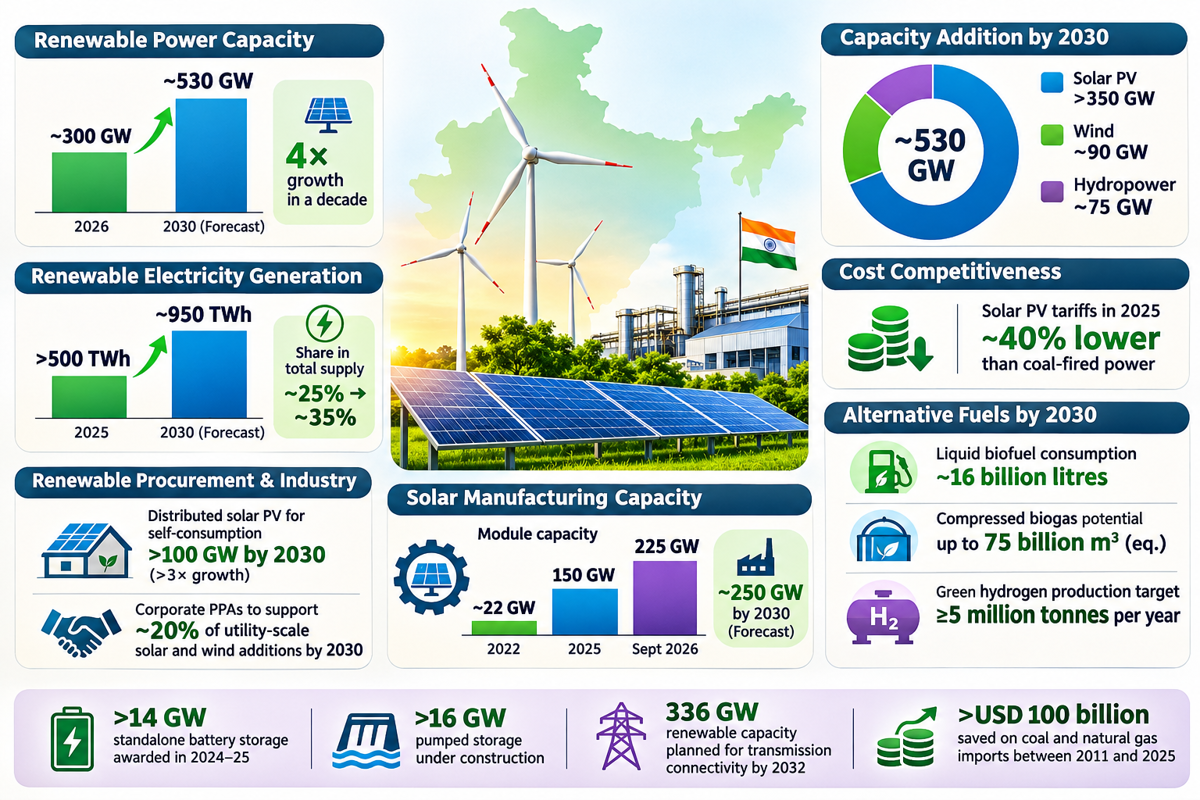
India's renewable power capacity is projected to reach approximately 530 GW by 2030, with solar PV expected to dominate the expansion. Its contribution is forecast to exceed 350 GW, while wind capacity is projected to approach 90 GW. Hydropower is also expected to reach 75 GW as conventional projects are commissioned and investment in pumped storage accelerates.
The generation outlook is equally significant. Renewable electricity generation exceeded 500 terawatt-hours (TWh) in 2025, accounting for approximately one-quarter of the country's total electricity supply. This figure is forecast to approach 950 TWh by 2030, raising renewables' contribution to around 35 per cent of India's electricity mix.
Solar PV has already overtaken hydropower as the country's largest renewable electricity source. By the end of the forecast period, it is expected to contribute more than half of renewable electricity generation.
However, the growing contribution of variable renewable energy (VRE), particularly solar and wind, will require greater operational flexibility. Its share of India's total electricity supply is expected to increase from approximately 14 per cent to 26 per cent by 2030, making grid modernisation, energy storage and improved electricity management increasingly important.
Competitive auctions make renewable electricity increasingly affordable
Since 2010, the country has awarded more than 220 GW of utility-scale renewable energy capacity through competitive auctions.
Transparent price discovery, standardised contracts and centralised procurement mechanisms have helped reduce project risks and improve tariff competitiveness. Utility-scale solar PV in India now has the world's second-lowest levelised cost of electricity (LCOE), estimated at USD 30-35 per megawatt-hour (MWh).
The cost advantage is particularly evident when compared with conventional power generation. Tariffs for solar PV projects commissioned in 2025 were approximately 40 per cent below the average cost of coal-fired electricity.
India has also moved beyond standalone solar and wind procurement towards hybrid renewable energy projects combining multiple generation technologies and storage. These systems offer more consistent electricity supply, better utilisation of transmission infrastructure and improved alignment between generation and consumption.
In 2025, India auctioned 15 GW of hybrid renewable projects, taking cumulative awarded capacity to 64 GW. Both figures represented the largest volumes globally. Average tariffs secured between 2023 and 2025 stood at approximately USD 45 per MWh, around 20 per cent below the average cost of coal-based electricity in 2025.
Explore AL Circle’s B2B Marketplace to discover aluminium electrical and power products, including conductors, busbars, cables and wires, and connect with suppliers across the industry.
Corporate renewable procurement opens opportunities for energy-intensive industries
The expansion of renewable electricity procurement expands beyond large power generators. Households and businesses are increasingly investing in solar PV installations for self-consumption, while commercial and industrial consumers are turning towards corporate renewable energy procurement.
Distributed solar PV capacity for self-consumption is projected to more than triple, exceeding 100 GW by 2030. Government initiatives such as the PM Surya Ghar Muft Bijli Yojana are supporting residential rooftop installations, while the PM-KUSUM programme is promoting solarisation of agricultural feeders and irrigation pumps.
Open-access reforms are simplifying renewable electricity procurement for industrial consumers, whereas corporate power purchase agreements (PPAs) are expected to support approximately 20 per cent of utility-scale solar PV and wind capacity additions by 2030.
India's solar manufacturing capacity reaches 225 GW
India's renewable energy expansion is creating a parallel opportunity in clean energy manufacturing. The country has emerged as the world's second-largest solar PV module manufacturer, supported by production-linked incentives (PLI), domestic sourcing requirements and policies designed to strengthen supply chain resilience.
Solar module manufacturing capacity has expanded considerably, rising from approximately 22 GW in 2022 to 150 GW in 2025 before reaching 225 GW in September 2026. It is projected to increase further to around 250 GW by 2030.
The growth in module manufacturing is also positioning India as a potential export hub. After accounting for anticipated domestic requirements, the country could have approximately 135 GW of spare module manufacturing capacity available for exports by 2030, making it the world's second-largest potential exporter after China.
However, the expansion has not been equally strong across the entire solar supply chain. Domestic module manufacturing has advanced faster than cell, wafer and polysilicon production. Solar cell imports increased from approximately USD 400 million in 2020 to USD 2.5 billion in 2025, with around 70 per cent sourced from China.
India's domestic solar cell manufacturing capacity is expected to exceed 60 GW by 2030, while announced wafer manufacturing projects could take domestic capacity to approximately 50 GW. Nevertheless, technological access, financing requirements and competition from lower-cost imports remain challenges.
The country's wind manufacturing industry is also expanding, with India projected to become the world's second-largest wind equipment manufacturer by 2030.
Industrial heat demand rises, creating opportunities for renewable energy
India’s annual heat demand increased by approximately 25 per cent over the preceding five years, driven largely by industrialisation, manufacturing expansion and growth in biomass-based agro-industries. Despite the increase in renewable heat consumption, fossil fuels continue to account for around 70 per cent of India's industrial heat supply, with most of the remainder coming from bioenergy.
Industrial heat demand is projected to increase by a further 23 per cent by 2030, equivalent to an additional 2.7 exajoules (EJ). The energy mix, however, is expected to change only gradually, with fossil fuels retaining their dominant position.
Renewable heat consumption is forecast to increase by approximately 22 per cent, adding 0.9 EJ. Modern bioenergy will remain the principal contributor, accounting for around 90 per cent of renewable industrial heat supply by the end of the forecast period. Renewable electricity consumption is expected to more than double, while solar thermal energy could increase fivefold, albeit from a relatively small starting point.
A roadmap covering 2026-2031 is also identifying opportunities to electrify selected industrial heat applications through technologies such as high-temperature heat pumps, mechanical vapour recompression, electric boilers and battery energy storage systems.
Green hydrogen and biofuels expand India’s clean energy ambitions
India has become the world's fourth-largest liquid biofuel market, with production increasing sixfold between 2020 and 2025. Liquid biofuel consumption reached approximately 11 billion litres in 2025 and is projected to rise to 16 billion litres by 2030.
The development of sustainable aviation fuel (SAF) is expected to create another demand segment, with blending targets for international flights beginning at 1 per cent in 2027 and increasing to 5 per cent by the end of the decade.
Compressed biogas (CBG) is also emerging as a potential domestic substitute for imported natural gas. India's sustainable feedstock availability could support annual production of up to 75 billion cubic metres equivalent, close to the country's current natural gas demand. This opportunity assumes greater significance as natural gas import dependence is projected to rise from 52 per cent in 2024 to approximately 71 per cent by 2030.
Green hydrogen presents another potential route for reducing fossil fuel consumption in industrial applications. India's National Green Hydrogen Mission aims to establish production capacity of at least 5 million tonnes annually by 2030.
However, the project pipeline still faces implementation challenges. Although announced projects could collectively support more than 2 million tonnes of renewable hydrogen production by 2030, only around 0.1 million tonnes of potential production had reached a final investment decision at the time of the assessment.
Showcase your brand, aluminium recycling initiatives and sustainability vision in our upcoming magazine - Sustainability & Recycling: Aluminium’s Commitment 2026
Grid infrastructure and energy storage remain critical challenges
The increasing concentration of solar and wind projects in resource-rich states requires stronger inter-state transmission networks to transport electricity to consumption centres. The government is planning transmission infrastructure to connect 336 GW of renewable energy capacity by 2032.
Energy storage is another priority. More than 14 GW of standalone battery storage capacity, predominantly with two-hour storage duration, was awarded through competitive tenders during 2024-25. Meanwhile, more than 16 GW of pumped storage capacity is under construction, supported by a longer-term installation target of 100 GW by 2035.
Financial health across electricity distribution companies (DISCOMs), land acquisition, permitting procedures and project execution delays remain additional concerns for investors and developers.
Addressing these structural challenges could accelerate renewable power capacity deployment by more than 20 per cent over 2026-2030, according to the assessment.
Commenting on the next phase of India's energy transition, Pralhad Joshi, Minister of New and Renewable Energy, said, “India’s emergence as a new giant of renewable energy reflects the progress we have made in recent years.” He has also shared, “As India’s electricity needs continue to rise, we are laying the foundations for the next phase of growth by strengthening domestic manufacturing, mobilising investment and expanding transmission infrastructure. We appreciate the IEA’s continued engagement with India on our shared pursuit of a secure, affordable and sustainable energy future.”
Information credit: India Renewable Energy Market Report 2026 – Analysis and Forecast to 2030. Also note that this is exclusive coverage by AL Circle and may not be reproduced, republished or shared without prior permission.
Grow with
AL Circle






















