
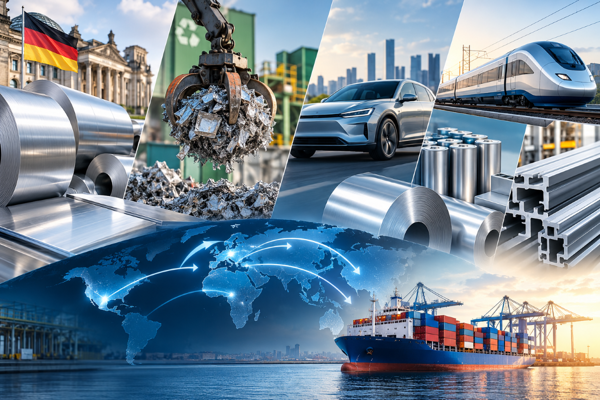
AL Circle analysis: Germany’s aluminium trade surplus, Novelis’ US expansion, Asia’s EV demand & India’s underutilised downstream capacity
Aluminium’s next growth phase is increasingly being shaped by downstream processing, supply-chain resilience and demand from specialised applications. Germany continues to generate a substantial trade surplus in flat-rolled products despite a shrinking primary aluminium base, while North America is investing in recycling and rolling. Across Asia, new manufacturing capabilities and growing demand from electric vehicles, railways and batteries are creating further opportunities. However, declining exports, underutilised capacity and uneven profitability show that investment alone does not guarantee success. For industry leaders, the challenge is to identify where demand is shifting, develop products that meet customer requirements and ensure that new investments translate into sustainable...
AL Circle Analysis: From Guinea to Gulf, how bauxite, tariffs and logistics redraw aluminium map
Aluminium markets in late 2026 are being shaped by more than the headline LME aluminium price. Bauxite security, alumina availability, geopolitical disruptions, tariff negotiations, logistics diversification and regional premiums are increasingly determining where metal moves and what buyers pay. From RUSAL reassessing Caribbean assets and Vedanta securing Odisha bauxite to Brazil extending mine life and EGA rebuilding its Guinea supply chain, producers are strengthening control over critical raw materials. At the same time, the US remains heavily dependent on imported bauxite and alumina, while Europe and Asia are experiencing sharply different premium dynamics. These developments point to a market where physical availability is becoming a regional factor even as aluminium itself remains...
Grow with
AL Circle

Canada’s aluminium & steel sector could witness demand optimism & job security if trade talks succeed amidst ongoing tariff dispute
Kirsten Hillman, Canada's ambassador to the United States, expressed confidence that the two countries could successfully reach a trade agreement within the 30-day deadline set during last week's G7 summit in Kananaskis, Alberta. This was announced right after a disappointing outcome at the G7 summit, where Canada had signalled to take stricter action against the US. Hillman stated it is "too soon to tell" whether all US tariffs on Canadian goods will be lifted and declined to clarify whether the federal government would accept the continuation of any tariffs. She emphasised that Canada is advocating for "open trade and stability" to support Canadian workers and businesses. "We can't do anything to force the US side to come to a deal, but we do think we have a good path forward if we're...

US alumina imports surge as domestic output falters — a sign of growing reliance?
While bauxite imports to the United States show a steady course, alumina tells a different story. In the first quarter of 2025, US alumina imports reached 439,000 tonnes, marking a significant uptick both year-on-year and quarter-on-quarter. The data revealed a 24.7 per cent rise from the previous quarter (352,000 tonnes) and an even sharper 53.5 per cent leap compared to Q1 2024 (286,000 tonnes), signaling a marked shift in sourcing dynamics. The upward trajectory, which began in Q2 2024 with 325,000 tonnes, gained momentum through Q3 (378,000 tonnes), momentarily slowed in Q4 (352,000 tonnes), and rebounded strongly in Q1 2025. This pattern, when juxtaposed with falling domestic production, paints a clear picture: the US is becoming increasingly dependent on imported alumina. Brazil and...

Metlen Energy & Metals warns of risks to Europe's aluminium scrap, urging safeguards
In the wake of the Trump administration's tariff hike to 50 per cent on aluminium excluding the scrap, alongside the UK coming into a discussion for relief, a rising concern has levitated in Europe. A silent "scrap battle" arises from Europe, which is deemed to have lost a vast amount of aluminium scrap and is said to be going into the US domains. The demand surge for European aluminium scrap after the doubling of the US tariff on primary aluminium is creating a threat to the in-house recycling facilities. This has been a concern since European aluminium scrap is referred to as "strategic raw material" enriched with energy and value. Hence, an excessive outflow of scrap can affect the continent's sustainability goals. Other threats include climate goals, energy security, and the...

Answered: What is ‘Tariff Offset Credit’? And, how is it going to benefit not only US automakers but global businesses?
When President Trump invoked Section 232 ‘national security’ tariffs on imported auto parts (effective May 3, 2025), it was a uniform 25 per cent duty on key systems from transmissions to lithium-ion batteries. Panic spread far and wide! And then, to temper the immediate cost shock for US automakers, the Department of Commerce rolled out an ‘Offset Credit’ mechanism. But, answers to what exactly the mechanism is, how to leverage it, and how beneficial the mechanism can be for US automakers and global businesses are found scattered across the board. Image for referential purposes only In 2024, the United States of America solidified its position as the world’s leading market for automotive products, importing a record USD 474.3 billion worth of vehicles, engines and parts while exporting...

India imposes 5-year anti-dumping duties on Chinese aluminium foil imports as domestic producers push for market resilience
The Indian government has taken a bold step by implementing five-year anti-dumping duties on aluminium foil from Russia, China and Taiwan. The duties are imposed under the finding of unfair trade practices that are poised to hurt the domestic industries, following the Indian aluminium extrusion industry’s demand to implement safeguard measures to protect the underutilised domestic units from potential overdumping by Free Trade Agreement countries. With the anti-dumping duties for the next five years, where is the Indian aluminium foil industry heading? Image source: iasgyan.in Back in March 2024, India launched a probe into aluminium foil imports from China to safeguard the interest of the domestic industries. This was initiated in response to the complaint filed by key domestic players...

No G20 repeat at G7: Canada warns of tariffs on US aluminium and steel amid faltering trade talks
Following a disappointing outcome at the G7 summit, Canada has signaled to adopt a tougher stance against the United States, as a renewed trade standoff threatens to unravel years of economic integration under the USMCA. Initially, the G7 platform had reignited a hope for the cooperative spirit that led to the 2020 USMCA trade pact, often dubbed “NAFTA 2.0”, but eventually concluded without any resolution on escalating tariff tensions. As a result, Canada is preparing to implement further retaliatory measures against the US, responding to Washington’s planned 50 per cent tariff hike on Canadian goods scheduled to take effect on July 9, 2025. At the heart of the dispute lies the inability of Canadian Prime Minister Mark Carney and US President Donald Trump to reconcile differences on...

“In aluminium extrusion, maintaining consistent thermal stability is essential to avoid product defects, de-stress, and increased rejection rates,” Soumo Roy, Director of Business Development at Tempcon
Soumo Roy is the Director of Business Development at Tempcon, where he leads global marketing initiatives and oversees end-to-end execution of industrial process cooling projects. An electrical engineer by qualification, he brings over 20 years of industry experience in delivering advanced cooling solutions for sectors such as steel, power, and mining. Soumo has played a pivotal role in expanding Tempcon’s international presence by driving exports and ensuring the delivery of custom-engineered systems designed around each client's specific process, load, and operational requirements. His strategic approach and technical insight continue to position Tempcon as a trusted name in the process cooling industry across India, the Middle East, Africa, and Asia. AL Circle: Congratulations on the...

14.7% Y-o-Y spurt in China’s aluminium imports in May as green sector demand booms
China’s wrought and unwrought aluminium imports in May 2025 displayed a reverse pattern compared to April. In May, imports rose year-on-year but declined month-on-month, while April had shown the opposite — higher imports than the previous month but lower than the same period in 2024. According to the General Administration of Customs, China’s wrought and unwrought aluminium imports in May 2025 were 350,000 tonnes, up by 14.7 per cent in May and down by 5.4 per cent from 370,000 tonnes. In contrast, the import volume in April , standing at 350,000 tonnes, was up by 2.94 per cent M-o-M from 340,000 tonnes but down by 7.89 per cent from 380,000 tonnes. In the first five months of 2025, China’s wrought and unwrought aluminium imports totalled 1.67 million tonnes, down by 12.08 per cent from...

Vedanta charts the next growth phase with record FY25 performance, demerger progress and a renewed focus on transition metals
Anil Agarwal, the Chairman of Indian mining conglomerate Vedanta Limited, has divulged the intention to position itself as a global leader in the transition metals, energy, technology and critical minerals, dubbed "Vedanta 2.0" for the next growth phase. The firm has also announced its FY25 recorded revenue and EBITDA, future growth plans and demerger progress. Image source: linkedin.com While addressing the stakeholders about the group's annual report, Mr Agarwal highlighted its position at a pivotal inflexion point, backed by a record financial performance, robust cost leadership and the near-completion of its value-unlocking demerger exercise. He further emphasised the importance of the group's organisational realignment, greater focus on vertical integration and its expanding role in...

Hydro accelerates alumina’s low-carbon shift as Alunorte hits the 700,000 tonnes Y-o-Y CO2 curb
One year since its BRL 1.3 billion (USD 234 million) investment to phase out fuel oil and switch entirely to natural gas, Hydro’s Alunorte refinery in Pará, Brazil, has managed to cut a staggering 700 thousand tonnes of carbon dioxide annually. The figure is not only a testament to the scale of the project but also a signal to the rest of the global alumina industry that real decarbonisation milestones are achievable — if backed by strategic foresight, capital intensity, and infrastructure reform. Image for representational purposes only The fuel switch at Alunorte involved converting six steam-generation units and seven calciners to operate fully on natural gas. To make this feasible in a relatively underdeveloped energy corridor, Hydro partnered with New Fortress Energy, which...

Why alumina is left out: A study unpacks the logic behind CBAM exclusion
The European Union’s hallmark policy in the view of equitable trade and environment protection—the Carbon Border Adjustment Mechanism (CBAM)—seems fair on the surface, as long as its framework remains focused on preventing carbon leakage and blocking the influx of cheap, high-emission goods into the domestic market. Under CBAM, a carbon price is levied on imported goods, aligned with the carbon costs EU producers incur under the Emission Trading System (ETS). That sounds like a just deal for domestic producers, ensuring a level playing field. But what about EU-headquartered companies that relocated their operations abroad to escape carbon taxes? Here's where the issue arises as these companies will be required to purchase certificates that reflect the carbon emissions embedded in their...

Canada eyes ‘Buy Canadian’ policy as tariff dispute with US puts aluminium and steel on the line
With the United States slapping a steep 50 per cent tariff on Canadian steel and aluminium imports, Ottawa is now fast-tracking a self-sufficient economic response potent to reshape North America’s metals supply chain. At the centre of this pivot is a proposed ‘Buy Canadian’ policy, an industrial safeguard designed to protect Canadian producers and preserve jobs by mandating the use of domestic metal in government procurement contracts. Image for representational purposes only (Source: https://policyoptions.irpp.org/) Industry Minister Mélanie Joly confirmed this week that the government is actively considering procurement requirements for both infrastructure and defence projects that would prioritise Canadian-made metals. “These decisions are being taken as we speak,” Joly said,...

LME aluminium price rallies to a 2-month peak on strong buying sentiment and muted inventory
A confluence of factors like increased retail sales in China, muted inventories, and surge in bauxite prices has propelled the LME aluminium benchmark price to USD 2,530 per tonne, marking a new high since the beginning of the second quarter of 2025. Image source: London Metal Exchange Retail sales in China have surged at an unexpectedly strong pace, indicating that economic uncertainty has had little to no dampening effect on consumer demand. Despite facing approximately 165 per cent tariffs on aluminium from the United States, China continues to maintain strong momentum in its retail sector. That’s not all. China’s improved purchase management index (PMI) for the aluminium processing industry to 49.8 per cent in May, recording an 8.7 per cent year-on-year increase, has contributed to...

India under spotlight at Canada-hosted G7 outreach session as trade, tariffs and energy security overwhelm agenda
Canada played host to this year’s G7 summit, marking its seventh turn at the helm of the influential bloc. In addition to the heads of state from G7 member nations and the European Union, which also participates in the summit, Canadian Prime Minister Mark Carney extended invitations to several non-G7 leaders. Among them were Mexican President Claudia Sheinbaum, who confirmed her attendance just days before the event following weeks of indecision, as well as Indian Prime Minister Narendra Modi and Saudi Crown Prince Mohammed bin Salman. The high-level gathering was convened in Alberta, underscoring Canada’s renewed diplomatic posture under Carney’s leadership. “As vibrant democracies bound by deep people-to-people ties, India and Canada will work together with renewed vigour, guided by...

UK consumers confused about which packaging should be recycled, here’s what you need to know
Despite the widespread awareness about sustainability, confusion around recycling persists among consumers in the United Kingdom (UK), further leading to undermined efforts in circular packaging. Aquapak's research shows that nearly 70 per cent of British consumers are unaware of the proper packaging to recycle. As per the report drafted by Recycling Magazine, out of five people, only one person reads the recycling instructions behind the packaging and the demographic for this. People between the ages of 25 and 34, one out of three people, which constitutes 31 per cent, read the instructions, and when the age group reaches 65 and above, it drops to 17 per cent of the demographic reading it. Regarding understanding the instruction provided, nearly 10 per cent of British consumers believe...

CMI’s new aluminium can sheet guidance: Recycled content math to standardise industry reporting
In the grand theatre of sustainable packaging, aluminium beverage cans have long occupied centre stage. They are hailed as icons of recyclability — endlessly reusable, energy-efficient, and economically viable. But how much of the aluminium in your next soft drink can is from recycled material? And by whose definition? Image for referential purposes only A new technical protocol released in 2024 aims to settle that debate. Titled “Guidance for Calculating Recycled Content in Aluminium Can Sheet (Version 1.0),” this industry-led initiative offers the first formalised methodology to quantify recycled content in aluminium can sheets. Developed by the Can Manufacturers Institute (CMI) and environmental NGO GreenBlue, with inputs from major players including Novelis, Ball, Constellium, and the...

Brazil among 26 nations to secure $250M climate funding for industrial decarbonisation
In a recent breakthrough for industrial decarbonisation in the Global South, Brazil has secured USD 250 million in international climate financing to steer its transition to low-carbon manufacturing for five major focus sectors. The announcement, which was made by the Climate Investment Funds (CIF) under its Clean Technology Fund, anoints Brazil as a frontrunner among emerging economies in charting a sustainable path for hard-to-abate sectors such as aluminium, cement, steel, chemicals, and fertilisers. Image for referential purposes only The funding will attract the formulation of a comprehensive investment plan led by Brazil’s Ministry of Development, Industry, Trade and Services (MDIC). The plan will map out sector-specific interventions, financing instruments, and policy measures to...

US bauxite imports slide 4% in Q1, with Turkey pulling back and Atlantic Alumina under pressure
The United States bauxite imports in the first quarter of 2025 recorded both annual and quarterly declines, highlighting the nation’s ongoing shift from primary aluminium production to a greater reliance on recycled materials. This strategic transition has reduced the demand for imported bauxite. According to data from the United States Geological Survey (USGS), Q1 2025 bauxite imports totalled 480,000 tonnes, marking a year-on-year decline of 4.2 per cent from 501,000 tonnes and lower than 500,000 tonnes brought in during Q4 2024. This decrease occurred despite a notable rise in imports from Jamaica, the United States' largest bauxite supplier. Imports from Jamaica surged to 429,000 tonnes in Q1 2025, up by 20.5 per cent from 356,000 tonnes in Q4 2024. However, this figure still marked...

