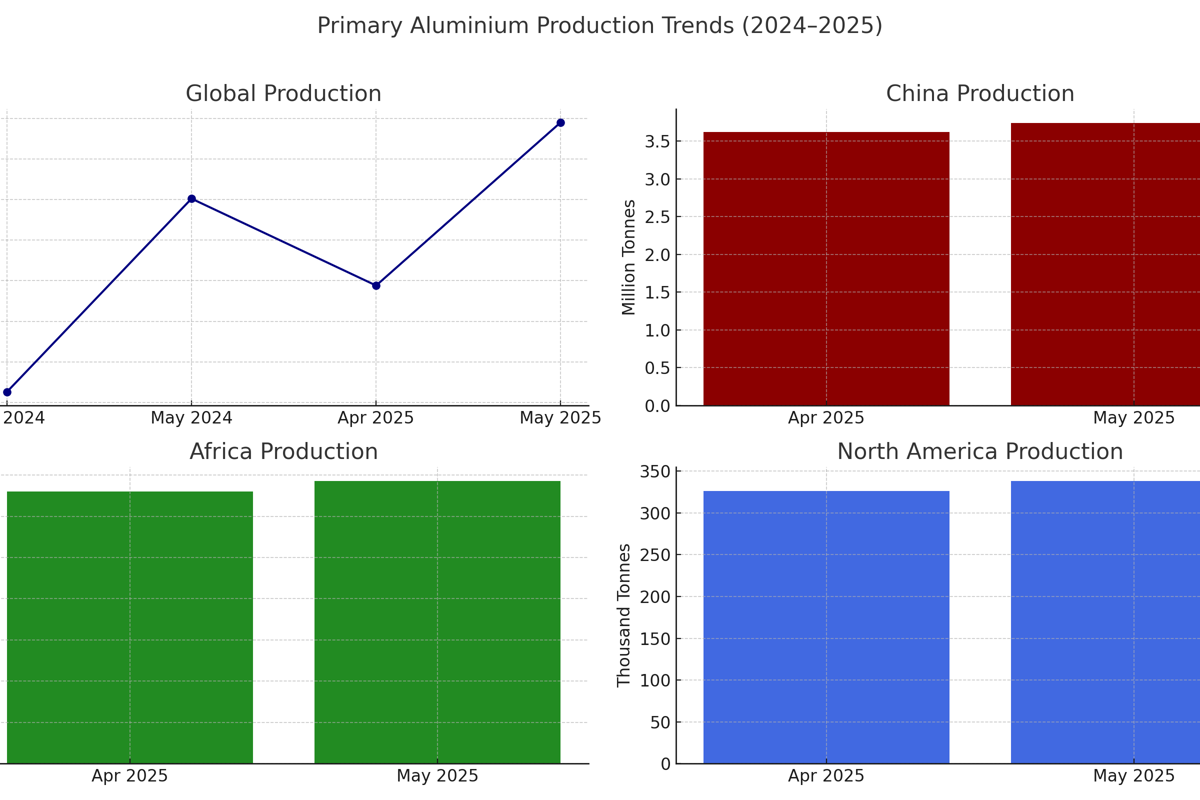
According to the International Aluminium Institute (IAI), the world’s primary aluminium production in May 2025 trended up over a month, mirroring the pattern observed in the same period last year—but with a sharper pace of growth. While in May 2024, the world’s output had grown by 2.22 per cent month-on-month, this year, it increased by 3.3 per cent.
From 6.044 million tonnes in April 2025, global output rose to 6.245 million tonnes in May, while the same period in 2024 had seen a climb from 5.913 million tonnes to 6.151 million tonnes. Thus, on a year-on-year calculation, the production volume in May 2025 was 1.53 per cent higher than in the same period of the earlier year.
Nations with a 5-month high output – China leads, but how long?
The production increased worldwide, but in some regions, it stood the highest since the beginning of 2025. Those regions include China, Africa, and North America. In China, primary aluminium production in May amounted to 3.741 million tonnes, up by 3.34 per cent M-o-M from 3.62 million tonnes. According to SMM, there were no production cuts in May and the aluminium industry operated steadily overall. The M-o-M increase to a five-month high in May brought China’s cumulative primary aluminium production to 18.191 million tonnes – marking an annual increase of 2.58 per cent from 17.733 million tonnes.
But as the primary aluminium output in China continues to grow each month, it nears the 45-million tonne cap. However, to touch the ceiling, China needs a monthly average production of 3.83 million tonnes through the rest of the year. This is an increasingly challenging prospect as operating rates have already reached over 95 per cent capacity. Data from SMM indicates that, as of May, China’s active primary aluminium capacity stood at 43.91 million tonnes out of a total 45.69 million tonnes—leaving little room for further growth without significant new capacity additions.
Africa continues its momentum
Africa, meanwhile, continued its quiet but steady resurgence. Primary aluminium production in May stood at 137,000 tonnes, returning to the level last seen in October 2024. Month-on-month, Africa’s the output grew by 3.8 per cent from 132,000 tonnes, bringing the total output in five months to 663,000 tonnes, up by 4.74 per cent from 633,000 tonnes.
Except in February, with fewer operational days, primary aluminium production in Africa stood steady above 130,000 tonnes since the beginning of 2025. The daily average output stood consistently at 4,400 tonnes without interim fluctuations, which again highlight the nation’s operational stability.
African nations like Mozambique, Cameroon, Ghana, and Guinea are benefitting from access to low-cost hydroelectric power, a critical advantage for such energy-intensive operations. Guinea-Conakry, in particular, known as the Water Tower of West Africa, features almost 1,300 watercourses, which collectively have the potential to generate up to 6,000 MW of electricity. The African government has the goal of increasing access to electricity to 65 per cent or perhaps 85 per cent by 2025 and positioning Guinea Conakry as a pioneer in renewable energy.
Adding to the momentum, Huatong Cable’s first phase of electrolytic aluminum project with an annual production capacity of 120,000 tonnes is expected to commence operations by the end of 2025. Leveraging local hydropower resources, the company expects profit per tonne of aluminum to be higher than that in Yunnan. This is another alluring factor that is driving aluminium companies to set up smelters in Africa.
North America rebounds, but lags on annual basis
North America also witnessed a five-month high in primary aluminium production during May 2025, gaining back the same volume of output as in December 2024. According to IAI, the output was 338,000 tonnes compared to 326,000 tonnes in April. That was a month-on-month rise of 3.68 per cent, with daily output consistently at 10,900 tonnes.
However, despite the month-on-month rise, North America’s year-to-date production remained slightly below 2024 levels, bringing the total output in five months of 2025 to 1.642 million tonnes, down by 1.5 per cent from 1.667 million tonnes.













_md.webp)
_md.webp)