Expansion projects, new launches and EV ambitions reshape aluminium’s downstream landscape
The global aluminium downstream sector, with further alignment with the end-use sector are undergoing some serious changes, driven by everything from major industrial expansions and strategic partnerships to fresh technology launches, policy shifts and market signals. This week’s news highlights a trend towards deeper integration in the supply chain, a surge in investment activity, and shifting dynamics in trade and electric vehicles. These factors could subtly alter the competitive landscape across various value chains.
Expansion & projects that are helping society
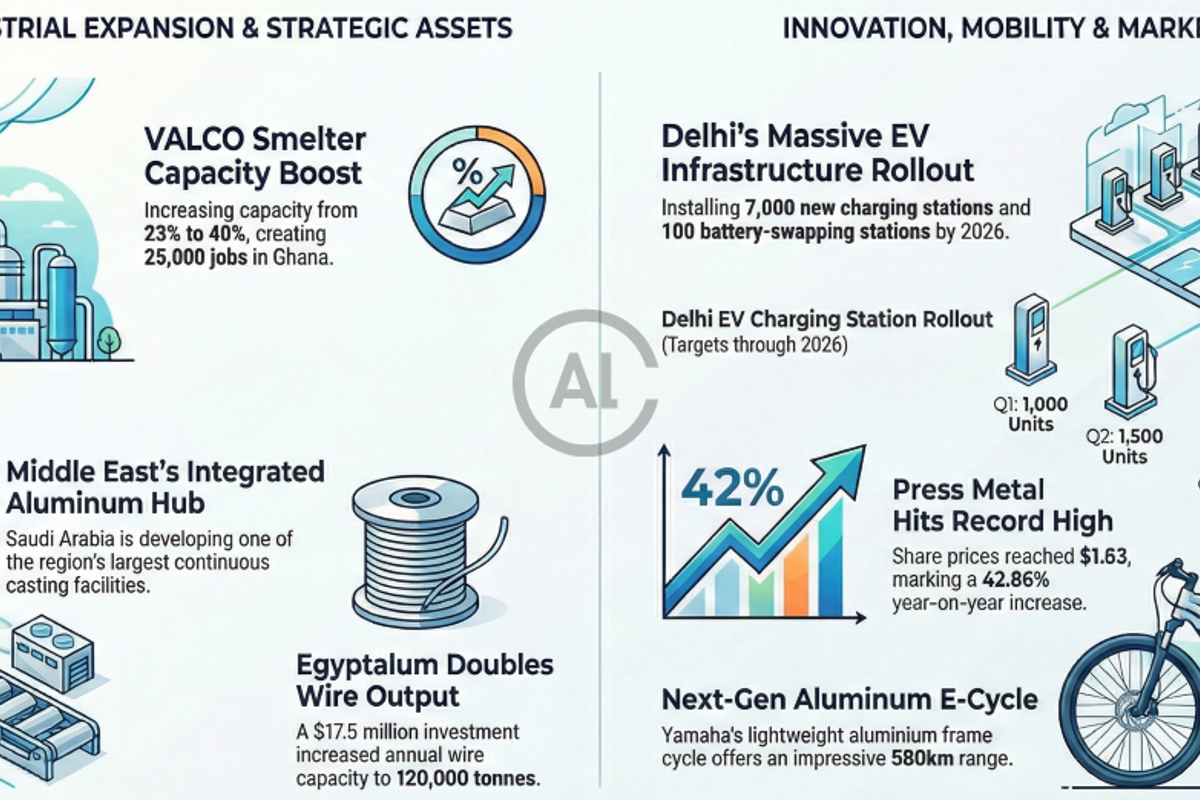
VALCO announced the plan to expand its smelter operations, aiming to boost capacity from 23 per cent to 40 per cent. This initiative aligns with Ghana’s effort to enhance value addition in the aluminium sector and lessen reliance on primary exports. The Continuous Cast Rod (CCR) project is set to be a key initiative within the larger Integrated Aluminium Industry strategy, expected to generate about USD 1 billion (roughly 1 per cent of GDP) and create over 25 thousand direct and indirect jobs in manufacturing, logistics and related fields.
Weekly downstream and end-user recap by AL Circle Pvt Ltd
Saudi Arabia is emerging as a key player in the downstream aluminium manufacturing scene. The Public Investment Fund (PIF) and Red Sea Aluminium Holdings (RSAH) shook hands for the development of a state-of-the-art integrated aluminium complex in Yanbu, located on the Kingdom’s western coast. This collaboration will combine PIF’s strategic investment prowess with RSAH’s global know-how, supported by Innovation Global Industries, Innovation New Materials, and Shandong Innovation Group. Together, they aim to create one of the largest continuous casting facilities in the Middle East, producing a wide array of high-value aluminium products for both local and international markets.
Static Hydraulic Pvt. Ltd. (SHPL) and China’s Xing Tian Xia Machinery Co., Ltd. (XTX) ca,e together to start a strategic partnership aimed at bringing co-branded XTXSH aluminium extrusion press solutions to the Indian market. By tapping into SHPL’s well-established sales network, they plan to offer cost-effective machinery specifically designed for local extrusion manufacturers. This collaboration merges XTX’s impressive 30+ years of experience in advanced extrusion press design, automation and smart manufacturing systems with SHPL’s strong expertise in hydraulic systems and industrial solutions. Read the full scoop here.
Delhi's government is to boost electric mobility by 2026, promising to set up 7 thousand new EV charging stations throughout the city in a phased approach. The targets are ambitious: 1 thousand stations in the first quarter, 1,5 hundred in the second, 23 hundred in the third and 22 hundred in the fourth. This initiative aims to significantly enhance the existing network and encourage more people to switch to electric vehicles as part of a larger strategy for cleaner mobility and better air quality. Additionally, the plan includes the installation of 100 battery-swapping stations to work alongside the charging points.
New launches and production
Walter has broadened its Tiger·tec Gold thread milling lineup with the launch of the new WSM37G grade, an innovative grade featuring a multi-layer PVD aluminium oxide coating designed to enhance temperature resistance. This new launch provides wear protection and extends tool life across various machining conditions. It's a versatile option that supports thread milling starting from a nominal diameter of 16 mm (UNC ¾) and is compatible with a wide array of materials, including steels, stainless steels, cast iron, non-ferrous alloys, heat-resistant superalloys and hardened steels up to 55 HRC, fitting perfectly within ISO material groups P, M, K, N, S and H.
Recently, Prime Minister Mostafa Madbouly paid a visit to Egyptalum to check out the brand-new high-quality aluminium wire production line. This impressive facility, which cost USD 17.5 million, was developed in collaboration with Italy’s Properzi and boosts the company’s annual capacity by 60 thousand tonnes, effectively doubling their total aluminium wire output to 120 thousand tonnes. This expansion is a significant step forward for Egyptalum, enhancing their manufacturing capabilities to better meet local demand while also improving their competitiveness in export markets throughout Europe and North Africa.
Vishay Intertechnology announced the expansion of its 193 PUR-SI series, introducing new voltage ratings of 550 V and 600 V for its miniature snap-in power aluminium electrolytic capacitors. These new additions can handle up to 30 per cent more ripple current while maintaining the same compact size, meaning there's no longer a need for those cumbersome series-connected units and balancing resistors. This change not only simplifies design processes but also helps reduce the PCB footprint and cut down on BOM costs.
Yamaha rolled out the new 350 W electric cycle, crafted with a lightweight aluminium frame that strikes the perfect balance between durability and easy handling for city commuting. It boasts a quick 10-minute charging time and an impressive range of up to 580 km on a single charge, which are features that are sure to attract daily commuters, students and young riders. With a comfortable riding position, responsive brakes, and a sleek design, this e-cycle is all about enhancing your ride. Read more.
Ford Motor Company introduced an advanced driving technology accessible to everyone, aiming for “eyes-off” Level 3 autonomous driving in a USD 30 thousand electric vehicle by 2028. This exciting announcement came from Doug Field, the Chief EV, Digital and Design Officer, during CES 2026. With this strategy, Ford is gearing up to go head-to-head with competitors like Tesla and GM in the race for next-gen EV technology. Uncover the complete features here.
Hitachi launched the FOUNDRY-MASTER Smart 2, a revamped stationary optical emission spectrometer (OES) designed to provide lab-grade precision and boost analytical performance for quality assurance and control, as well as non-ferrous metal analysis in foundries, fabrication shops and recycling facilities. It does all this while keeping a compact and sturdy design that offers great value. Building on the solid foundation of its predecessor, this new model features a scientific CMOS sensor and an ultra-stable spark source, elements that people typically find in high-end lab instruments. Get into the complete scoop here.
Share market movement of downstream players
Press Metal’s share price soared to an all-time high of USD 1.83 on Bursa Malaysia on January 21, 2026, showcasing strong investor confidence and a remarkable 42.86 per cent year-on-year increase, even as the broader market experienced a modest uptick. This surge in stock value comes on the heels of the company’s strategic decision to hedge 40 per cent of its 2026 alumina supply, helping to shield against raw material price fluctuations. Additionally, there are optimistic consensus forecasts for Q4 2025 earnings, which could potentially lead to the company’s best quarterly profit ever.
Constellium’s share price moved up to a new 52-week high of USD 23.01 on January 21, 2026. This surge happened even as HARBOR Capital Advisors made a slight adjustment by trimming its stake by 15 shares, part of a broader reshuffling among institutional investors. Regulatory filings indicate that while HARBOR reduced its position, other market players stepped in, with Allspring Global Investments boosting its holdings and several others, like Blue Trust and Eastern Bank, either starting or increasing their investments in the aluminium products manufacturer.
Imports, exports and premiums this week
After successfully boosting India’s iPhone export ecosystem to a whopping USD 50 billion, New Delhi is now setting its sights on achieving similar growth for the auto components sector. Government and industry leaders are aiming for a five-year compound annual growth rate (CAGR) of about 14 per cent. This ambitious goal hinges on mirroring the electronics industry’s successful strategies, which include aligning with global standards, enhancing manufacturing capabilities and integrating more closely into international supply chains. Read more.
India’s beverage industry is facing a challenge in the supply of aluminium cans just as the high-demand summer season approaches. This is largely due to regulatory delays in obtaining the mandatory Bureau of Indian Standards (BIS) certification, which was introduced under a Quality Control Order in April 2025. These delays are slowing down approvals for both local producers and international manufacturers. As a result, major soft drink and beer companies are ramping up their import orders from Sri Lanka, the Middle East and other global suppliers to avoid any production hiccups.
Sri Lanka’s aluminium fabrication industry, which has long been supported by local manufacturers of doors, windows and façade systems, plays a crucial role in providing over 30 thousand jobs across various sectors like extrusion, glass processing and downstream supply chains. However, it’s currently grappling with increasing competitive pressure due to loopholes in the Board of Investment (BOI) policy that allow fully fabricated aluminium products to come in duty-free, even when they’re made domestically. Learn more.
China has ramped up its ongoing trade spat with India by officially requesting the World Trade Organisation (WTO) to set up a dispute settlement panel regarding New Delhi’s incentive programs for electric vehicles, batteries, and automobiles. This comes after attempts to resolve the issues during bilateral talks in November 2025 and January 2026 fell short. Beijing claims that India’s production-linked incentives and related policies unfairly favour local producers over imported goods, which could violate WTO rules on subsidies and trade practices.
_0_0.png)
Casting the Future: Metal China/Diecasting China/Nonferrous China 2026 X 40th Anniversary of China Foundry Association Officially Launched
Next articleSwisstek Aluminium opens a new design studio to rev architectural solutions
Grow with
AL Circle