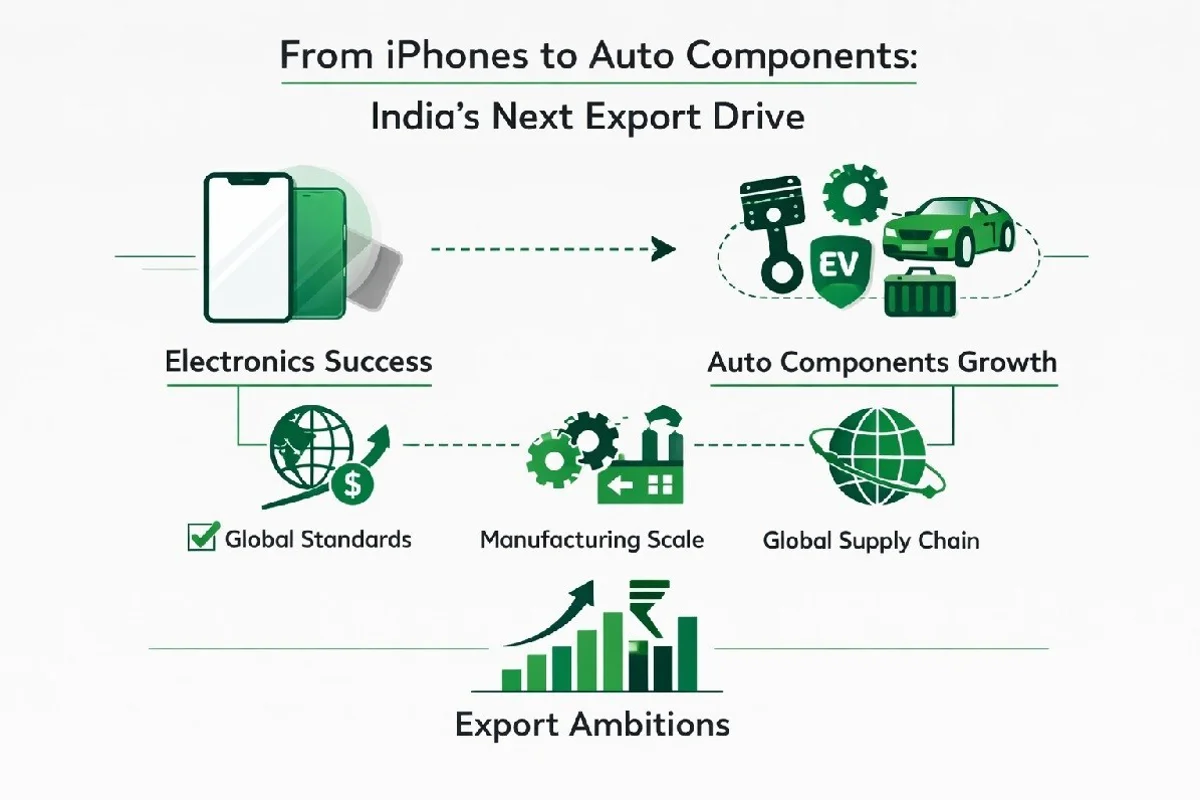
After turning iPhones into a USD 50 billion export success and building a global presence in electronics, India is now trying to answer a harder question: can auto components deliver the same scale of growth in global markets?
The government believes the answer could be yes - but only if the sector can replicate what electronics got right: standards alignment, manufacturing depth and integration into global supply chains.
The confidence to attempt this shift comes from the electronics success history, which is now reinforcing confidence that a similar export breakthrough is possible in auto components. Electronics production rose nearly six-fold from INR 1.9 billion (USD 30.7 million) in 2014 - 15 to INR 1.13 trillion (USD 12.5 billion) in 2024 - 25, while mobile phone exports jumped 127 times to INR 2 trillion (USD 22 billion), making India the world’s second-largest mobile phone manufacturer. Electronics exports expanded eightfold to INR 327 billion (USD 3.62 billion), from INR 38 billion (USD 421 million), and created around 25 lakh jobs.
In FY2024 - 25, the United States, the United Arab Emirates, the Netherlands, the United Kingdom and Italy emerged as the top destinations for Indian electronic goods.
A key link between the electronics boom and the auto-component push is aluminium, which sits at the intersection of both industries. The metal plays a central role across electronics, automotive components and iPhone production, reinforcing the idea that capabilities built in one sector can spill over into another.
To know more about the global primary aluminium industry 2026 outlook, pre-book the report “Global Aluminium Industry Outlook 2026” at a special price.
Aluminium at the crossroads of electronics and autos
In automobiles, aluminium alloys from the 6000 and 7000 series are widely used in body panels, wheels, engines and suspension systems to reduce weight and improve fuel efficiency. Components such as hoods, doors, pistons and bumper reinforcements commonly rely on alloys including 5052, 6061 and 7075.
In electronics, aluminium is used in device casings, heat sinks, circuit boards and connectors for its conductivity, formability and corrosion resistance. In iPhone production, Apple relies on aluminium chassis and frames, including anodised 7000-series alloys, to deliver lightweight yet durable designs.
This material overlap has strengthened policymakers’ belief that India’s electronics success is not a one-off, but a template that could extend into auto manufacturing.
Can auto components follow the iPhone export model?
To move in that direction, policymakers are pushing for closer alignment with global standards so Indian manufacturers can integrate into international value chains dominated by Mexico and networks linked to Japanese and United States firms.
The auto-component industry has expanded steadily at home. According to the Automotive Component Manufacturers Association of India (ACMA), industry turnover reached INR 6.73 lakh crore (USD 80.2 billion) in FY2024 -25, growing 9.6 per cent year on year and at a CAGR of 14 per cent from FY20 to FY25. Supplies to OEMs rose 10 per cent to INR 570 billion (USD 6.3 billion), while exports increased 8 per cent to USD 22.9 billion. Imports rose 7.3 per cent to USD 22.4 billion, leaving a trade surplus of USD 453 million.
If we look outside home, North America accounted for about 32 -33 per cent of exports, Europe for around 29 – 32 per cent, and Asia for roughly 24 -26 per cent, with Asia recording the fastest growth in FY2025. Africa and Latin America together accounted for about 10 per cent, while Middle East markets such as the UAE and Qatar gained traction. Total exports stood at USD 21.2 billion in FY2024 and USD 22.9 billion in FY2025.
This percentages and rise in export shows, though slowly but is moving toward a bigger auto export graph and also the new expansion projects will help in this.
The auto-component sector plans INR 250 - 350 billion (USD 2.77 – 3.87 billion) in capital expenditure in FY2026, following INR 150 - 200 billion (USD 1.66 – 2.2 billion) spent in FY2025, with a focus on localisation of EV components such as traction motors, control units and battery systems.
Recent investment moves across the auto-component space suggest companies are trying to build depth at home rather than rely on imports. Firms such as Bharat Forge, Lumax Auto Technologies, Pioneer Corporation and Hyundai Motor India have all announced projects aimed at expanding local capacity and tightening supply chains.
Lumax Auto Technologies, through its arm Greenfuel Energy Solutions, has begun making ferrule-less tubes and fittings for CNG vehicles at its Manesar facility, which became operational in late 2025. Until now, the torque-tightened technology was fully imported from Germany through WEH Gas Tech. The Manesar unit can support about 100,000 vehicles a year. The company started with a INR 25 million (USD 0.27 million) investment and plans to scale this to INR 75 million (0.83 million) over the next four to five years, helping bring down costs and supply OEMs such as Maruti Suzuki directly from India.
Pioneer Corporation is also preparing to expand its footprint. From 2026, it plans to operate a new manufacturing plant and R&D centre in India to produce in-car systems such as infotainment units, speakers and displays. The move is linked to rising demand for software-driven vehicles and electric models, and is expected to reduce dependence on imports as India’s auto electronics market heads towards an estimated USD 69.5 billion by 2031.
Hyundai Motor India has announced a separate expansion plan. The company has committed an additional INR 6.18 billion to raise capacity at its Talegaon plant to 19 lakh units a year by 2028. The expansion will include component manufacturing for engines, transmissions and EV-related parts such as batteries and motors.
What the current auto export picture shows
While global automotive demand is estimated at about USD 2.2 trillion, India’s contribution remains modest at roughly USD 30 billion, or around 1.4 per cent, according to NITI Aayog.
Passenger vehicles account for about 71 per cent of global automotive demand, yet India has captured only around 1 per cent of this segment. Motorcycles, by contrast, represent roughly 3 per cent of global demand, where India’s export share is about 9 per cent. This imbalance has highlighted the need to shift India’s export focus towards higher-demand segments.
India’s automotive exports already reach markets such as Japan, Mexico and several regions across Africa and Latin America. However, Indian firms continue to have a limited presence in Europe, where certification, technical standards and compliance requirements are significantly higher.
Government officials argue that closing the export gap will require a shift in focus. “Logistics or location is not the biggest cost in this sector. The real competitiveness challenge lies in production efficiency. If we improve productivity and align standards, integration into global supply chains will follow,” a source said.
Consultations with manufacturers are underway to identify gaps in technology, testing and documentation. “We met key industry players to identify gaps in technology, testing and documentation. The intent is to remove friction points that restrict companies from exporting at scale,” the source added.
Under the Viksit Bharat framework, policymakers believe that if productivity improves, standards align and investments continue, auto components - supported by materials such as aluminium - could replicate the export leap achieved by electronics.
Must read: Key industry individuals share their thoughts on the trending topics













_md.webp)
_md.webp)
_md.webp)







