China's 22.87 Mt extrusion market faces a structural shift as 317 GW solar growth counters weak construction demand
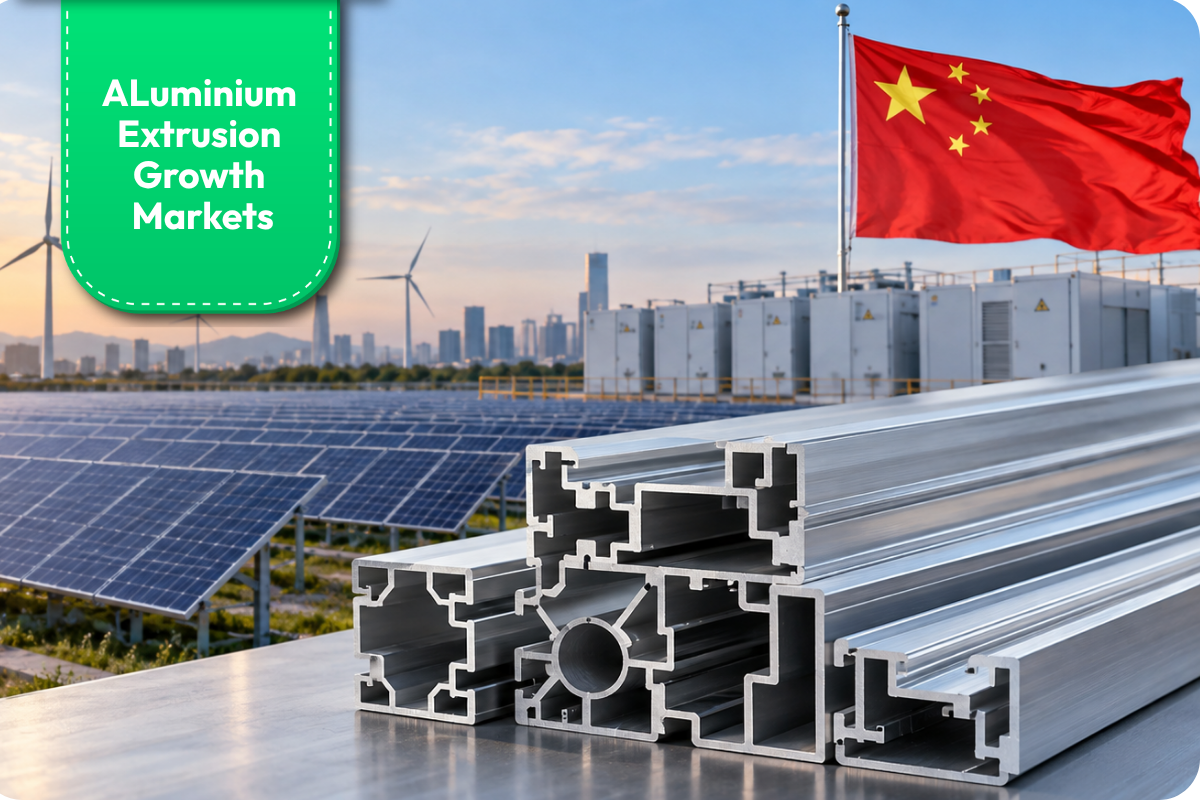
The global aluminium extrusion landscape is undergoing a structural transition driven by industrial decarbonisation, global electrification, and the rapid deployment of clean energy infrastructure. Historically anchored by civil engineering and residential real estate, demand for extruded aluminium profiles in China, the world’s dominant manufacturing hub, is decoupling from traditional property sectors.
Persistent structural weakness in China’s domestic construction market has slowed the consumption of conventional architectural profiles such as window frames, door sections, and curtain walls. Conversely, advanced industrial applications, specifically solar photovoltaic (PV) racking, battery energy storage systems (BESS), power grid modernisation, and electric vehicles (EVs), have emerged as the primary growth drivers for the industry.
China maintains a central position in the global aluminium value chain. In 2025, global aluminium extrusion capacity reached approximately 49.9 million tonnes per annum, against a total global demand of 35.25 million tonnes.
Chinese extruders account for approximately 32.93 million tonnes of this installed capacity, representing 66 per cent of the global total. Domestic extrusion consumption in China reached roughly 22.87 million tonnes in 2025, accounting for nearly two-thirds of total global demand. Total processed aluminium extrusion output in China stood at 24 million tonnes in 2025, forming a crucial component of the nation’s 46 million tonnes of total processed aluminium semis output.
The transition from property-led volume expansion to value-added industrial production is reshaping China's consumption mix. Between 2015 and 2025, the share of aluminium consumed by China's traditional construction sector contracted from 35 per cent to 26 per cent, with architectural extrusion representing roughly 20 per cent of total national aluminium usage.
Over the same period, the combined demand share of green technology applications (including solar PV, EV battery structural members, power grid conductors, and high-speed rail) expanded from 11 per cent to 29 per cent.
The transition is further constrained by China’s mandatory 45 million tonne policy ceiling on primary aluminium smelting, which has forced domestic fabricators to optimise material efficiency, expand secondary scrap recycling, and reallocate extrusion capacity toward high-margin, clean-technology applications.
To know the global production, demand and consumption forecasts of aluminium extrusions, explore our report "The World of Aluminium Extrusions to 2035"
Macro capacity, production, and utilisation dynamics
Despite commanding two-thirds of global extrusion capacity, China’s extrusion sector exhibits structural divergence in capacity utilisation. In early 2026, China’s composite extrusion operating rate fluctuated between 47.6 per cent and 50.6 per cent, down from broader processing averages of 60.8 per cent recorded in late 2025.
The aggregate suppression is driven primarily by overcapacity in small-to-medium architectural press lines (under 2,500 tonnes press force), where weakness in domestic real estate development has created idle capacity.
In contrast, specialised industrial extrusion lines, specifically those equipped with high-tonnage automated presses, precision quenching, and inline CNC machining for solar frames, power electronics, and transportation, maintain operational rates between 70 and 85 per cent. Industrial profiles, energy storage structures, and power transmission components provided the primary structural support for the extrusion industry throughout 2025 and 2026, offsetting real estate contractions.
Role of photovoltaic solar frame and racking systems
Photovoltaic (PV) solar module frames and ground-mounted racking profiles represent the largest single non-construction volume market for aluminium extrusions in China. Solar PV systems rely on extruded aluminium profiles due to their high strength-to-weight ratio, structural rigidity under wind loading, long-term corrosion resistance, and geometric consistency required for automated module assembly.
In 2025, global new PV solar installations reached approximately 650 GW. An average solar module requires approximately 4.9 to 5 tonnes of extruded aluminium framing per megawatt (MW), translating to a global primary frame demand of 3.2 million tonnes in 2025. Across the entire global PV value chain (including ground-mount tracking structures, inverter enclosures, and mounting brackets), total aluminium consumption was estimated to reach nearly 8 million tonnes.
Because China manufactures over 80 per cent of the world's solar PV modules, domestic Chinese extruders process the vast majority of this volume. In early 2026, export order dynamics experienced temporary volatility due to the cancellation of China's 13 per cent export tax rebate on aluminium semis in late 2024, driving overseas buyers to front-load solar frame procurement before trade flows normalised.
While solar PV framing delivers large tonnages, intense domestic market competition and low entry barriers for basic framing profile production have compressed processing margins. Consequently, leading Chinese extruders are vertically integrating anodising, automated punching, and corner-key assembly to capture higher manufacturing margins.
To explore leads and business opportunities in the downstream/semi-fabricated segment of the aluminium value-chain, visit AL Biz now!
Battery energy storage systems and power electronics
The scaling of grid-scale Battery Energy Storage Systems (BESS) and distributed energy storage across China has established a high-margin growth vector for precision extrusions. The global market for lithium battery structural parts was valued at USD 3.25 billion in 2025 and is projected to expand at a CAGR of 10.7 per cent through 2034. Extruded profiles serve as core load-bearing and thermal management components within these systems.
BESS applications demand complex multi-hollow extruded profiles. Liquid-cooling cold plates, manufactured using high-purity aluminium alloys with internal extruded fluid channels, dissipate heat from dense lithium-iron-phosphate (LFP) battery cells.
Additionally, structural side beams, module enclosures, and floor panels require high-strength 6xxx-series alloys (such as 6061 and 6082) extruded with tight dimensional tolerances to resist thermal expansion and mechanical shock. This structural integration mirrors developments in China’s electric vehicle sector, where 17.20 million NEVs sold in 2025 consumed 3.35 million tonnes of aluminium (averaging 195 kg per vehicle), predominantly in extruded battery boxes and spaceframes.
Wind infrastructure, grid transmission, and power sub-stations
China’s deployment of ultra-high-voltage (UHV) power grids and offshore/onshore wind installations represents another vital structural demand driver. Wind turbine nacelles, generator housings, internal platform ladders, and rotor hub components utilise heavy-section structural extrusions.
In grid transmission, extruded aluminium busbar systems (utilising high-conductivity 1050 and 6101 alloys) are increasingly replacing traditional copper conductors in substations, transformer stations, and industrial power distribution.
While extruded aluminium possesses approximately 61 per cent of copper’s electrical conductivity, its lower mass density (one-third that of copper) and cost advantage make aluminium busbars effective for high-amperage applications. Furthermore, global grid expansion drove a 37 per cent year-on-year surge in China’s aluminium wire and cable exports in early 2026, totalling 53,280 tonnes over two months.
Technical transformations, plant economics, and manufacturing dynamics
The shift from civil construction to renewable energy applications has necessitated widespread technological upgrading across China's extrusion plants. Traditional architectural extrusion relies primarily on standard 6063 alloy processed on hydraulic presses ranging from 800 to 2,500 tonnes of press force. Conversely, renewable energy components require advanced alloy formulations and large structural presses.
Alloy engineering and press infrastructure
Renewable energy applications demand optimised mechanical properties:
- Solar framing profiles utilise modified 6063-T5/T6 and 6005A-T6 alloys, balancing high extrusion speeds with yield strength and corrosion resistance against outdoor atmospheric degradation.
- Structural BESS and EV components depend on high-strength 6061-T6 and 6082-T6 alloys, which incorporate higher levels of magnesium and silicon. These alloys offer superior fracture toughness and energy absorption during structural impact, though they exhibit a lower extrudability index, requiring lower press speeds and precise quench system control.
- Thermal and electrical profiles rely on high-purity 1xxx-series (1050, 1070) or specialised 6101 alloys to maximise electrical and thermal conductivity.
To process large multi-hollow sections, such as wide solar mounting decks and integrated EV/BESS battery trays, Chinese extruders have scaled installations of high-tonnage presses.
By 2024-2025, China operated over 7,000 extrusion presses out of 20,000 globally. Crucially, installations of ultra-large presses (exceeding 5,000 to 10,000+ tonnes press force) grew by over 12 to 22 per cent annually, allowing extruders to produce wide, thin-walled, integrated profiles in a single press pass and eliminating complex welding operations.
Strategic outlook and long-term projections
Looking ahead to the decade ending in 2035, China's aluminium extrusion industry will complete its transition from a property-driven market to an advanced industrial and clean-technology supply chain. Total extrusion usage in China is projected to expand from 22.60 million tonnes in 2025 to 27.46 million tonnes by 2035 (a 1.97 per cent CAGR), accounting for 54.7 per cent of total global incremental volume growth over the period.
At the global level, building and construction’s share of total extrusion demand will fall below 50 per cent by 2035, with electrical/electronics (4.26 per cent CAGR) and transportation/EVs (3.58 per cent CAGR) outstripping baseline industrial growth. In China, solar PV frame production, grid transmission profiles, and battery energy storage structural members will account for over one-third of total industrial extrusion output by 2030.
Note: This is exclusive coverage by AL Circle and may not be reproduced, republished or shared without prior permission.
Manaksia Aluminium AGM: ₹2.5 billion RPT cap approved with Metal Star
Next articleChina aluminium extrusion output slumps as property weakness deepens, export boost fades
Grow with
AL Circle