Aluminium wire trade report: 10 leading exporters in the global market
Global aluminium wire exports continued to show resilience in 2025 (as of data collected till October), reinforced by increasing demand from the power transmission, renewable energy, automotive and construction sectors. Aluminium wire remains widely used in electrical infrastructure due to its high conductivity, lightweight properties and cost advantage. This trend has reinforced the role of several key exporters that supply aluminium wire and conductor products to international markets.
Explore- Most accurate data to drive business decisions with Global ALuminium Industry Outlook 2026 across the value chain
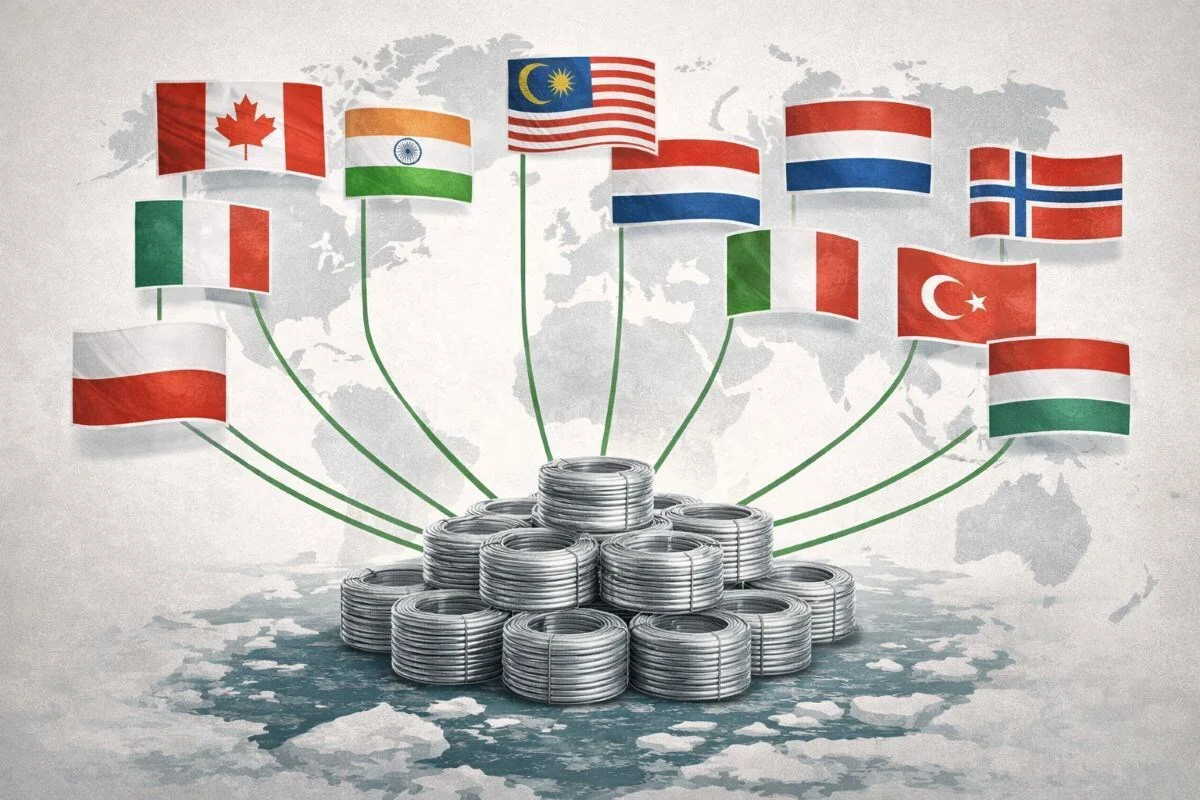
According to the data of UN Comtrade, as of October 2025, countries, namely Canada, India, Malaysia, the Netherlands, Norway, Italy, Indonesia, Poland, Turkey and Hungary, emerged as the leading exporters of aluminium wire.
Their export performance has been shaped by capacity expansions, investments in downstream manufacturing, supply chain diversification and the global shift towards low-carbon aluminium production. Energy costs, trade policies and sustainability regulations have also played an important role in shaping aluminium wire supply and export flows.
Canada
Backed by leading companies like Rio Tinto and Alcoa, Canada is one of the leading global producers of aluminium, reinforced by a low-carbon aluminium supply. This provides a stable base for downstream products such as aluminium wire rods and conductors.
Despite the Trump administration’s heavy 50 per cent tariff imposition on aluminium, Canada remained the leading aluminium wire exporter in the global market.
As of October 2025, Canada exported 160,196 tonnes of aluminium wire to the world. Valued at USD 546.4 million, the country emerges as the leading on the list of the major aluminium wire exporters for 2025.
India
India’s aluminium sector has continued expanding, led by major producers such as National Aluminium Company (NALCO), Hindalco Industries and Vedanta Aluminium. Capacity expansions and downstream investments have strengthened the country’s position in the global aluminium products market.
The rapid development of renewable energy and transmission infrastructure within India has also stimulated domestic demand for aluminium wiring products.
Government initiatives aimed at boosting manufacturing competitiveness and export diversification have further encouraged the growth of aluminium product exports.
Till October 2025, India exported around 140,080.68 tonnes of aluminium wire, which amounted to USD 451.8 million.
Malaysia
Malaysia has gradually established itself as a regional hub for smelting and manufacturing of primary aluminium (such as Press Metal Aluminium Holdings) in Southeast Asia. Investments in secondary aluminium production and recycling facilities have supported the development of downstream industries, including the manufacture of aluminium wire.
Taking the data of February and May on an average monthly output of 10271 tonnes, the aluminium wire shipment volume from Malaysia reached 105,066 tonnes as of October 2025. This quantity amounted to USD 303 million.
Netherlands
Although not a major primary aluminium producer, the Netherlands has become a key distribution and re-export centre within Europe’s aluminium supply chain. Strong intra-European trade and growing demand for electrical conductors used in renewable energy infrastructure have supported export activity.
Netherlands, till October 2025, exported 78064 tonnes of aluminium wire, the cumulative quantity valued at USD 302.81 million.
Norway
Norway’s aluminium industry benefits from abundant renewable hydropower, which enables the production of some of the lowest-carbon aluminium in the world. Norsk Hydro has invested heavily in recycling technologies and decarbonised aluminium solutions. The country’s aluminium sector continues to supply semi-fabricated products, including wire rods and conductors, to global customers.
Norway’s aluminium wire shipment volume as of October 2025 amounted to 54,015 tonnes. The total value accumulated to USD 54 million.
Italy
Italy is recognised as one of Europe’s key downstream aluminium manufacturing centres, with strong capabilities in extrusion, rolling and conductor production.
The country’s aluminium sector is closely integrated with automotive, electrical equipment and construction industries across Europe. Increasing investments in energy infrastructure and renewable power transmission projects within the European Union have supported demand for aluminium wiring products produced by Italian manufacturers.
Till October 2025, the country shipped 34,796 tonnes of aluminium wire to the world, valued at USD 147.07 million.
Indonesia
Indonesia has been strengthening its aluminium value chain through bauxite mining expansion and new alumina refining capacity. Government policies aimed at restricting raw material exports and encouraging domestic processing have accelerated the development of the country’s aluminium industry.
These initiatives have encouraged investment in downstream metal processing, including the production of aluminium-based products used in electrical and industrial applications.
Indonesia’s aluminium wire export quantity as of October 2025 reached 30,809 tonnes, valued at USD 93 million.
Must read: Key industry individuals share their thoughts on the trending topics
Poland
Poland has developed into an important aluminium processing hub in Central Europe, supported by its diversified manufacturing sector and proximity to major EU markets.
The country’s aluminium prices and demand is closely linked to industries such as automotive manufacturing, electrical equipment and construction. Growth in these sectors has supported the expansion of aluminium processing facilities, enabling Poland to increase exports of semi-fabricated products, including aluminium wire.
Till October 2025, Poland supplied 32,189 tonnes of aluminium wire to the global market, which amounted to USD 119.09 million.
Turkey
Turkey has built a strong reputation in the aluminium downstream manufacturing and export. Its geographical position between Europe, the Middle East and Asia allows Turkish manufacturers to supply multiple regional markets efficiently.
Turkey shipped 30,148 tonnes of aluminium wire as of October 2025, the export price amounting to USD 101.6 million.
Hungary
Hungary’s aluminium industry is relatively smaller but strategically positioned within the European manufacturing ecosystem. The country has developed capabilities in aluminium recycling, transformation and automotive component production.
Demand from the automotive and electrical sectors continues to drive aluminium consumption, while EU sustainability policies and investments in modern processing technologies are helping expand Hungary’s downstream manufacturing capacity, including aluminium wire products.
As of October 2025, Hungary’s aluminium wire export quantity was 18,731 tonnes, valued at USD 72 million.
These economies represent a diverse mix of primary aluminium producers, downstream processing centres and logistics-driven trading hubs. Canada and Norway benefit from strong upstream aluminium production, while countries such as Italy and Poland are known for their advanced manufacturing and processing capabilities. Meanwhile, the Netherlands continues to function as a major European trading gateway for aluminium products.
Don't miss out- Buyers are looking for your products on our B2B platform

Image source: The image has been generated by AI for referential purposes only.
Japan auto-parts makers eye aluminium from Russia’s RUSAL amidst Middle East crisis
Next articleTredegar posts robust Q4 growth as FY2025 net income reaches $33.5m
Grow with
AL Circle